Home
Class 12
CHEMISTRY
A sample of 2 kg of helium (assumed idea...

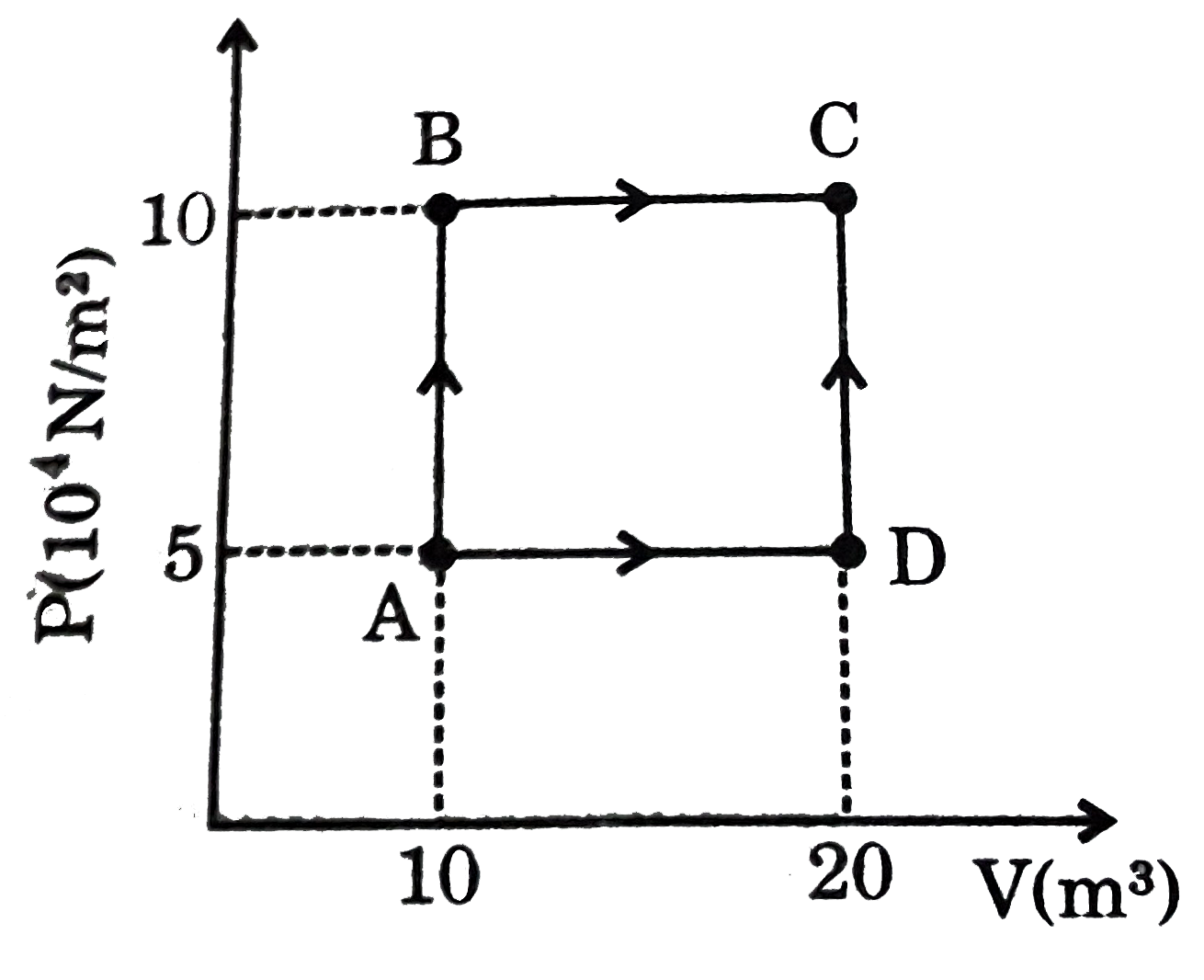
A sample of 2 kg of helium (assumed ideal) is taken through the process ABC and another sample of 2 kg of the same gas is taken through the process ADC. Then, the temperature of the states A and B are : (Given `R = 8.3 J//"mol"-K)`:

Text Solution

Verified by Experts

The correct Answer is:

C

`(0.5xx10^(5))/(1.01xx10^(5))xx10xx10^(3)=(2xx1000)/(2)xx0.082T_(A)`
`(1)/(1.01)=0.082T_(A)`
`T_(A)=120.5K`
at constant volume
`(P_(A))/(T_(A))=(P_(6))/(T_(B))`
`T_(B)=(P_(B).T_(A))/(P_(A))=(10)/(5)xx120.5=241K`
Promotional Banner

Topper's Solved these Questions

  • THERMODYNAMICS

    RESONANCE|Exercise A-1|1 Videos
  • THERMODYNAMICS

    RESONANCE|Exercise A-2|1 Videos
  • THERMODYNAMICS

    RESONANCE|Exercise exercise-3 part-III Advanced level Solutions (STAGE-II)|45 Videos
  • TEST SERIES

    RESONANCE|Exercise CHEMISTRY|50 Videos

Similar Questions

Explore conceptually related problems

A sample of 2kg of helium (assumed ideal) is taken through the process ABC and another sample of 2kg of the same gas is taken through the process ADC . Then the temperature of the states A and B are (given R = 8.3J mol^(-1)K^(-1))

A sample of 2 kg of monoatomic helium (assumed ideal) is taken through the process ABC and another sample of 2 kg of the same gas is taken through the process ACD as shown in (figure). Given molecular mass of He = 4 and R = 8.3J mol e^(-1)K^(-1) (i) What is the temperature of He in each of the states A, B, C and D? (ii) How much is the heat involves in process , ABC and ADC?

A sample of 2kg monoatomic helium gas (assumed ideal) is taken through the process ABC and another samples of 2 kg of the same gas is taken through the process ADC. Given that the molecular mass of helium = 4 amu, find the temperature of helium in the state D. [Take the universal gas constant R= 25/3 J mol^(-1) K^(-1) ]

A sample of 2 kg of monatomic helium (assumed ideal) is taken through the process ABC another sample of 2 kg of the same gas is taken through the process ADC as shown in Fig. Given molecular mass of helium = 4. a. What is the temperature of helium in each of the states A, B, C and D ? b. Is there any way of telling afterwards which sample of helium went through the process ABC and which went through the process ADC ? Write yes or no. How much is the heat involved in each of the process ABC and ADC ?

A sample of 2 kg monoatomic helium (assumed ideal ) is taken from A to C through the process ABC and another sample of 2 kg of the same gas is taken through the process ADC (seefig). Given molecular mass of helium = 4 . (i) What is the temperature of helium in each of the states A ,B , C and D ? (ii) Is there any way of telling afterwards which sample of helium went through the process ABC and which went through the process ADC ? Write Yes and No. How much is the heat involved in the process ABC and ADC ?

A gas is taken through a cyclic process ABCA as shown in, if 2.4 cal of heat is given in the process, what is the value of J ?

An ideal gas is taken through a process PT^(3)= constant. The coefficient of thermal expansion of the gas in the given process is

In figure, a sample of 3 moles of an ideal gas is undergoing through a cyclic process ABCA. A total of 1500J of heat is withdraw from the sample in the process. The work done by the gas during the part BC is -P K J. FIND P. (R = (25)/(3) J//"mole"K)

An ideal gas is taken through a process PT^3 = constant . The coefficient of thermal expansion of the gas in the given process in n/T. Find n.

RESONANCE-THERMODYNAMICS-MISCELLANEOUS SOLVED EXAMPLES
  1. Find (in terms of 'a') the amount of energy required to raise the temp...

    Text Solution

    |

  2. A thermally isolated vessel contains 100g of water at 0^(@)C. When air...

    Text Solution

    |

  3. Work done in expansion of an ideal gas from 4 litre to 6 litre against...

    Text Solution

    |

  4. 1 mole of ice at 0^(@)C and 4.6 mm Hg pressure is converted to water v...

    Text Solution

    |

  5. For Ag, bar(C)(p)(JK^(-1)mol^(-1)) is given by 24+0.006 T. Calculate D...

    Text Solution

    |

  6. Calculate the amount of heat evolved during the complete combustion o...

    Text Solution

    |

  7. For the equation C("diamond")+2H(2)(g)rarrCH(4)(g) DeltaH(1) , C(g)+5H...

    Text Solution

    |

  8. The standard molar enthalpies of formation of cyclohexane (l) and benz...

    Text Solution

    |

  9. Following graph shows a single stange expansion process, then workdone...

    Text Solution

    |

  10. A sample of 2 kg of helium (assumed ideal) is taken through the proces...

    Text Solution

    |

  11. In an isothermal expansion of a gaseous sample the correct relation is...

    Text Solution

    |

  12. One mole of an ideal mono-atomic gas is caused to go through the cycle...

    Text Solution

    |

  13. A certain mass of gas expanded from ( 1L, 10 atm) to (4 L, 5 atm) agai...

    Text Solution

    |

  14. One mole of an ideal monoatomic gas expands isothermally against const...

    Text Solution

    |

  15. For a perfectly crystaline solid C(p.m)=aT^(3) , where a is constant. ...

    Text Solution

    |

  16. Given the following data {:("Substance",DeltaH^(@)(KJ//mol),S^(@)(J/...

    Text Solution

    |

  17. If Delta H(f)^(@) for Ag^(+) (infinitely diluted), NO(3)^(-) (infinite...

    Text Solution

    |

  18. What is the work done against the atmosphere when 25 grams of water va...

    Text Solution

    |
