Home
Class 12
CHEMISTRY
One mole of an ideal mono-atomic gas is ...

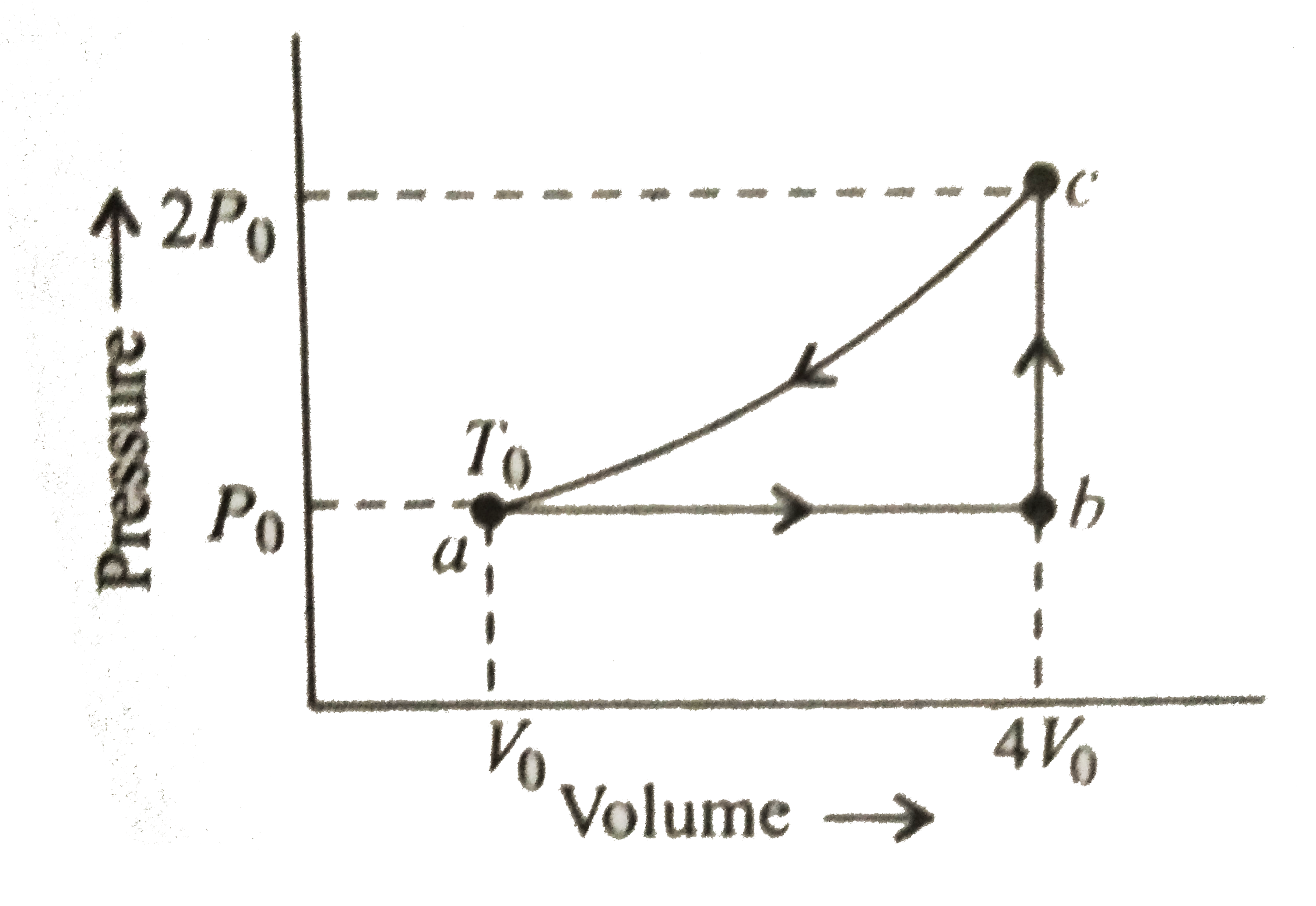
One mole of an ideal mono-atomic gas is caused to go through the cycle shown in the figure below. Then the change in the internal enegry in expanding the gas from `a` to `c` along the path `abc` is:

A

`3P_(0)V_(0)`

B

`6 RT_(0)`

C

`4.5 RT_(0)`

D

`10.5 RT_(0)`

Text Solution

Verified by Experts

The correct Answer is:

D

`Pv= nRT` at point `C`
`2P_(0)xx4V_(0)=1xxRT_(c)`
`T_(c )=[(8P_(0)V_(0))/(R )]`
at point a
`P_(0)V_(0)=1xxRT_(0)`
`T_(0)=(P_(0)V_(0))/(R ) , T_(c )=8T_(0)`
change in internal energy `=[ nC_(v)dT]`
For path `a` to `b=1xx(3)/(2)Rxx[3T_(0))=(9)/(2)RT_(0)`
For path `b` to `c=1xx(3)/(2)Rxx[4T_(0)]=6T_(0)R`
Total change `=(9)/(2)RT_(0)+6RT_(0)=(21RT_(0))/(2)=10.5 RT_(0)`
So total change in internal energy
`Delta U =10.5 RT_(0)`
Promotional Banner

Topper's Solved these Questions

  • THERMODYNAMICS

    RESONANCE|Exercise A-1|1 Videos
  • THERMODYNAMICS

    RESONANCE|Exercise A-2|1 Videos
  • THERMODYNAMICS

    RESONANCE|Exercise exercise-3 part-III Advanced level Solutions (STAGE-II)|45 Videos
  • TEST SERIES

    RESONANCE|Exercise CHEMISTRY|50 Videos

Similar Questions

Explore conceptually related problems

Ideal gas is taken through the process shown in the figure :

One mole of an ideal monoatomic gas undergoes a cyclic process as shown in figure. Then the change in the energy in expanding the gas from a to c along the path abc is:

One mole of an ideal mono-atomic gas is taken round cyclic process ABCD as shown in figure below. Calculate

An ideal monoatomic gas is carried around the cycle ABCDA as shown in the figure. The efficiency of the gas cycle is

One mole of an ideal monoatomic gas is heated at a constant pressure of one atmosphere from 0^(@) to 100^(@)C. Then the change in the internal energy is

One mole of an ideal diatomic gas undergoes a transition from A to B along a path AB as shown in the figure, The change in internal energy of the gas during the transition is :

RESONANCE-THERMODYNAMICS-MISCELLANEOUS SOLVED EXAMPLES
  1. Find (in terms of 'a') the amount of energy required to raise the temp...

    Text Solution

    |

  2. A thermally isolated vessel contains 100g of water at 0^(@)C. When air...

    Text Solution

    |

  3. Work done in expansion of an ideal gas from 4 litre to 6 litre against...

    Text Solution

    |

  4. 1 mole of ice at 0^(@)C and 4.6 mm Hg pressure is converted to water v...

    Text Solution

    |

  5. For Ag, bar(C)(p)(JK^(-1)mol^(-1)) is given by 24+0.006 T. Calculate D...

    Text Solution

    |

  6. Calculate the amount of heat evolved during the complete combustion o...

    Text Solution

    |

  7. For the equation C("diamond")+2H(2)(g)rarrCH(4)(g) DeltaH(1) , C(g)+5H...

    Text Solution

    |

  8. The standard molar enthalpies of formation of cyclohexane (l) and benz...

    Text Solution

    |

  9. Following graph shows a single stange expansion process, then workdone...

    Text Solution

    |

  10. A sample of 2 kg of helium (assumed ideal) is taken through the proces...

    Text Solution

    |

  11. In an isothermal expansion of a gaseous sample the correct relation is...

    Text Solution

    |

  12. One mole of an ideal mono-atomic gas is caused to go through the cycle...

    Text Solution

    |

  13. A certain mass of gas expanded from ( 1L, 10 atm) to (4 L, 5 atm) agai...

    Text Solution

    |

  14. One mole of an ideal monoatomic gas expands isothermally against const...

    Text Solution

    |

  15. For a perfectly crystaline solid C(p.m)=aT^(3) , where a is constant. ...

    Text Solution

    |

  16. Given the following data {:("Substance",DeltaH^(@)(KJ//mol),S^(@)(J/...

    Text Solution

    |

  17. If Delta H(f)^(@) for Ag^(+) (infinitely diluted), NO(3)^(-) (infinite...

    Text Solution

    |

  18. What is the work done against the atmosphere when 25 grams of water va...

    Text Solution

    |
