Home
Class 12
PHYSICS
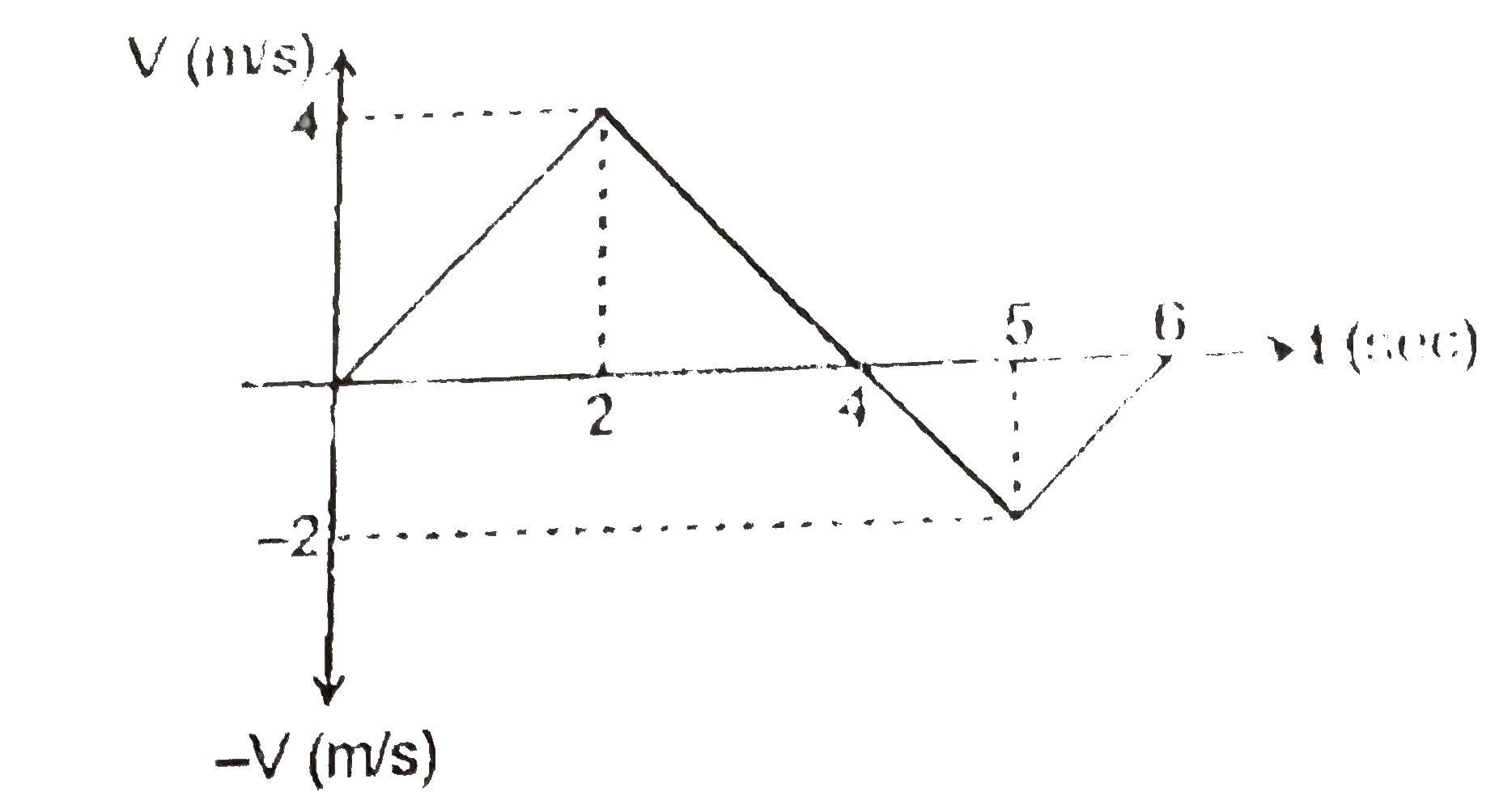
During one dimensional motion on x-axis ...

During one dimensional motion on x-axis Velocity time graph for particle is given.

Average acceleration between (t = 0 sec) to (t = 6 sec)

A

`(5)/(3)m//s^(2)`

B

`(1)/(2)m//s^(2)`

C

`1m//s^(2)`

D

zero

Text Solution

Verified by Experts

The correct Answer is:

D

`(:vec(a):)=(0-0)/(6)=0`
Promotional Banner

Topper's Solved these Questions

  • REVIEW TEST

    VIBRANT|Exercise PART - II : PHYSICS|262 Videos
  • TEST PAPERS

    VIBRANT|Exercise PART - II : PHYSICS|56 Videos

Similar Questions

Explore conceptually related problems

During one dimensional motion on x-axis Velocity time graph for particle is given. Find total displacement during (t = 0 sec) to (t = 6 sec)

During one dimensional motion on x-axis Velocity time graph for particle is given. Find total distance during (t = 0 sec) to (t = 6 sec)

Acceleration time graph of a particle moving along a straight line is given. Then average acceleration between t=0 & t=4 is :-

The velocity-time graph of a body is given below. Find the average velocity from t = 0 to t = 40 s .

Acceleration-time graph of a particle moving in a straight line is as shown in figure. At time t = 0, velocity of the particle is zero. Find (a) average acceleration in a time interval from t = 6 s to t = 12 s, (b) velocity of the particle at t = 14 s.

A particle is moving on X- axis. Its velocity time graph is given in the figure. Find distance travelled by the particle in 5 sec .

The position (x) of a particle moving along x - axis veries with time (t) as shown in figure. The average acceleration of particle in time interval t = 0 to t = 8 s is

The velocity time graph of a body moving in a straight line is shown. Find its (a) instantaneous velocity at t = 1.5 sec (b) average acceleration from t = 1.5 sec. to t = 2.5 sec (c) draw its acceleration time graph from t = 0 to t = 2.5 sec

Find the modulus of average acceleration (in m/s2) of the block from time t = 2 sec to t = 4 sec.

Acceleration - time graph for a particle is given in figure. If it starts motion at t = 0, distance travelled in 3 s will be ,br>

VIBRANT-REVIEW TEST-PART - II : PHYSICS
  1. During one dimensional motion on x-axis Velocity time graph for partic...

    Text Solution

    |

  2. During one dimensional motion on x-axis Velocity time graph for partic...

    Text Solution

    |

  3. During one dimensional motion on x-axis Velocity time graph for partic...

    Text Solution

    |

  4. Particle running with constant speed v in circle of radius R then answ...

    Text Solution

    |

  5. Particle running with constant speed v in circle of radius R then answ...

    Text Solution

    |

  6. A particle is performing one dimensional motion on x-axis and it's x-c...

    Text Solution

    |

  7. A particle is performing one dimensional motion on x-axis and it's x-c...

    Text Solution

    |

  8. A particle is performing one dimensional motion on x-axis and it's x-c...

    Text Solution

    |

  9. A force vec(F)=3hat(i)+chat(j)+2hat(k) acting on a particle causes a d...

    Text Solution

    |

  10. Two forces are applied to a 5.0 kg crate, one is 6.0N to the north and...

    Text Solution

    |

  11. The relationship between the displacement travelled by a body and the ...

    Text Solution

    |

  12. A particle moves along a straight line in such a way that its accelera...

    Text Solution

    |

  13. The car delivered the cargo from point A to point B, moving at average...

    Text Solution

    |

  14. While solving a physics problem you perform a series of algebraic mani...

    Text Solution

    |

  15. Given vec(a)+vec(b)+vec(c )+vec(d)=vec(O), which of the following stat...

    Text Solution

    |

  16. Two vectors vec(P) & vec(Q) are arranged in such a way that they form ...

    Text Solution

    |

  17. An object is moving due north with an acceleration in that direction. ...

    Text Solution

    |

  18. On the basis of dimensions, decide which of the following relation for...

    Text Solution

    |

  19. The charge flowing in a conductor varies with time as Q ="at"- (1)/(2)...

    Text Solution

    |

  20. The velocity-time graph of a body moving in a straight line is shown i...

    Text Solution

    |
