Home
Class 12
PHYSICS
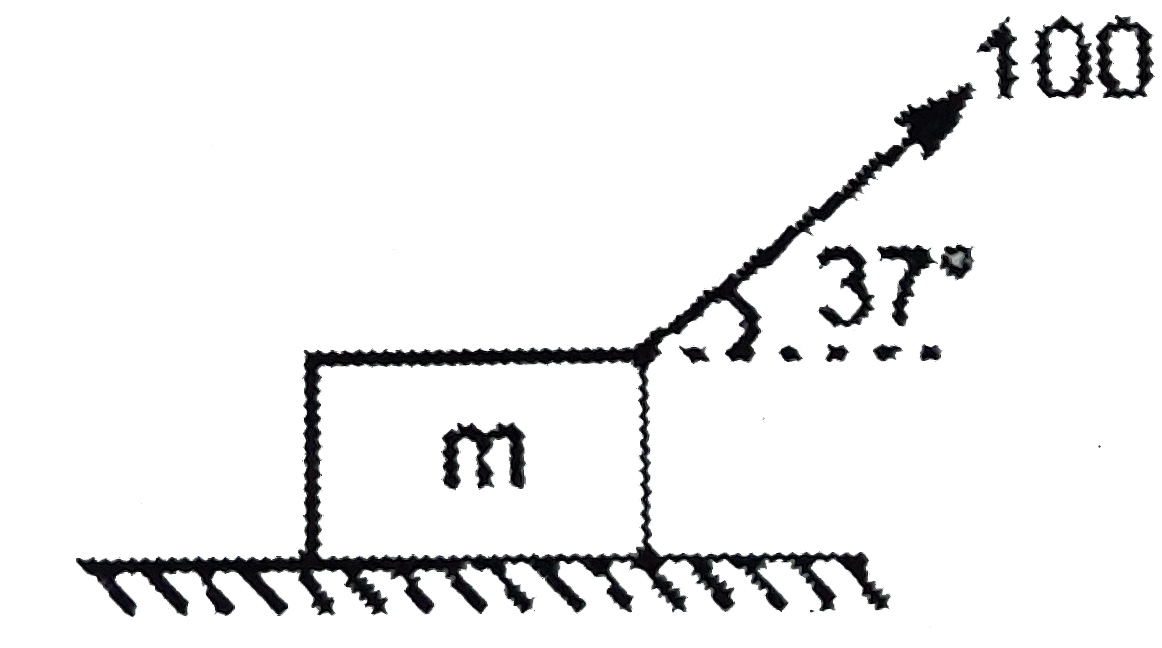
If m=20 kg, mu(s)=0.5, find friction on ...

If `m=20 kg, mu_(s)=0.5`, find friction on block.

A

60 N

B

70 N

C

100 N

D

80 N

Text Solution

Verified by Experts

The correct Answer is:

A

`V=sqrt(gRtantheta)implies (20)^(2)=10xx100xxtan thetaimpliestan theta=(4)/(10)=(2)/(5)implies theta=tan^(-1)(2//5)`
Promotional Banner

Topper's Solved these Questions

  • REVIEW TEST

    VIBRANT|Exercise PART - II : PHYSICS|262 Videos
  • TEST PAPERS

    VIBRANT|Exercise PART - II : PHYSICS|56 Videos

Similar Questions

Explore conceptually related problems

A prismatic block of mass m is kept on a groove . The bottom line of the groove makes an angle theta with horizontal . The angle between is phi If the groove is symmetrical with the normal to the inclined plane containing the bottom line of the groove a. Find the coefficient of friction mu_(0) between the block and groove so that the block begins to slide. b. If mu gt mu_(0) find the friction force on the block. c. If mu lt mu_(0) find the acceleration of the block.

In the arrangement shown in figure pulley P can move whereas other two pulleys are fixed. All of them are light. String is light and inextensible. The coefficient of friction between 2 kg and 3 kg block is mu = 0.75 and that between 3 kg block and the table is mu = 0.5 . The system is released from rest (i) Find maximum value of mass M, so that the system does not move. Find friction force between 2 kg and 3 kg blocks in this case. (ii) If M = 4 kg, find the tension in the string attached to 2 kg block. (iii) If M = 4 kg and mu_(1) = 0.9 , find friction force between the two blocks, and acceleration of M. (iv) Find acceleration of M if m_(1) = 0.75, m_(2) = -0.9 and M = 4 kg.

A block of mass m is kept on the floor of a freely falling lift .During the free fall of the lift, the block is pulled horizontally with a force of F = 5 N, mu_(s) = 0.1 The friction force on the block will be

The coefficient of friction between block A of mass m_(1)=5kg and block B of mass m_(2)=10 kg is mu_(2)=0.5 . There is no friction froce between block B and fixed horizontal surface. A force of 300N acts on block B in horizontal direction and a horizontal force of magnitude F acts on block A as shown , both towards right. Initially there is no relative motion between the blocks. The minimum value of F such that relative motion starts between A and B is :

A force of 200N is applied as shown in the figure on block of 3 kg. The coefficient of friction between the block and the wall is 0.3. Find the friction acting on the block. (in N) {Take g = 10 m//s^(2)

In the arrangement shown in figure coefficient of friction between 5kg block and incline plane is mu=0.5 . Friction force acting on the 5kg block is

In the figure shown, if friction coefficient of block 1 kg and 2kg with inclined plane is mu_(1) = 0.5 and mu_(2) = 0.4 respectively, then

A block of mass M is sliding down the plane. Coefficient of static friction is mu_(s) and kinetic friction is mu_(k) . Then friction force acting on the block is :

Block B of mass m_(B) = 0.5 kg rests on block A, with mass m_(A) = 1.5kg which in turn is on a horizontal tabletop (as shown in figure) .The coefficient of kinetic friction between block A and the tabletop is mu_(k) = 0.4 and the coefficient of static friction between block A and blockB is mu_(s) = 0.6 A light string attached block A passes over a frictionless, massless pulley and block C is suspeneded from the other end of the string. What is the largest mass m_(c) (in kg) that block C can have so that block A and B still slide together when the system is relaced from rest?

A block of mass m=2kg is placed in equilibrium on a moving plank accelerating with a=4m//s^(2) . If coefficient of friction between plank and block mu=0.2 . The friction force acting on theblock is:

VIBRANT-REVIEW TEST-PART - II : PHYSICS
  1. If m=20 kg, mu(s)=0.5, find friction on block.

    Text Solution

    |

  2. In (x-y) plane motion of particle it's (x-y) coordinate depends on tim...

    Text Solution

    |

  3. Three forces of magnitude 10N are acting on a block of mass 2 kg at 12...

    Text Solution

    |

  4. Find int(0)^(1)picos((pi)/(2)t)dt=?

    Text Solution

    |

  5. During displacement of a body two forces are acting on it simultaneous...

    Text Solution

    |

  6. Resultant of two forces when angle between them is 60^(@) is 6 Newton ...

    Text Solution

    |

  7. Force vec(F)=(4sqrt(2hat(i))+3sqrt(2)hat(j)) acting on a body so that ...

    Text Solution

    |

  8. Two forces 10 N and 15 N are acting on a body then which cannot be the...

    Text Solution

    |

  9. If acceleration of particle changing with time is a = (4t-2) m//s^(2) ...

    Text Solution

    |

  10. Young modulus of steel is 3 xx 10^(11) N//m^(2). When expressed in C.G...

    Text Solution

    |

  11. If momentum P, area A and time T are selected as fundamental quantitie...

    Text Solution

    |

  12. Two forces are acting on body vec(F)(1)=-(50-t^(2))hat(j) Newton and v...

    Text Solution

    |

  13. In the given velocity v//s position graph find acceleration at x = 2m

    Text Solution

    |

  14. Select correct statements

    Text Solution

    |

  15. If x = (4t^(2)+2) any y = 2t, then find ((dx)/(dy)) at t = 2 sec. (x i...

    Text Solution

    |

  16. Which of the following cannot be the group of fundamental quantities. ...

    Text Solution

    |

  17. Statement-1 : Using dimensional analysis we can drive only those formu...

    Text Solution

    |

  18. If side length of cube changing at 0.1mm//sec. Then what will be rate ...

    Text Solution

    |

  19. During one dimensional motion on x-axis Velocity time graph for partic...

    Text Solution

    |

  20. During one dimensional motion on x-axis Velocity time graph for partic...

    Text Solution

    |

  21. During one dimensional motion on x-axis Velocity time graph for partic...

    Text Solution

    |
