Home
Class 12
PHYSICS
A force F=-K(yhati+xhatj) (where K is a ...

A force `F=-K(yhati+xhatj)` (where K is a positive constant) acts on a particle moving in the x-y plane. Starting from the origin, the particle is taken along the positive x-axis to the point `(a, 0)`, and then parallel to the y-axis to the point `(a, a)`. The total work done by the force F on the particle is

A

`-2ka^(2)`

B

`2ka^(2)`

C

`-ka^(2)`

D

`ka^(2)`

Text Solution

Verified by Experts

The correct Answer is:
B

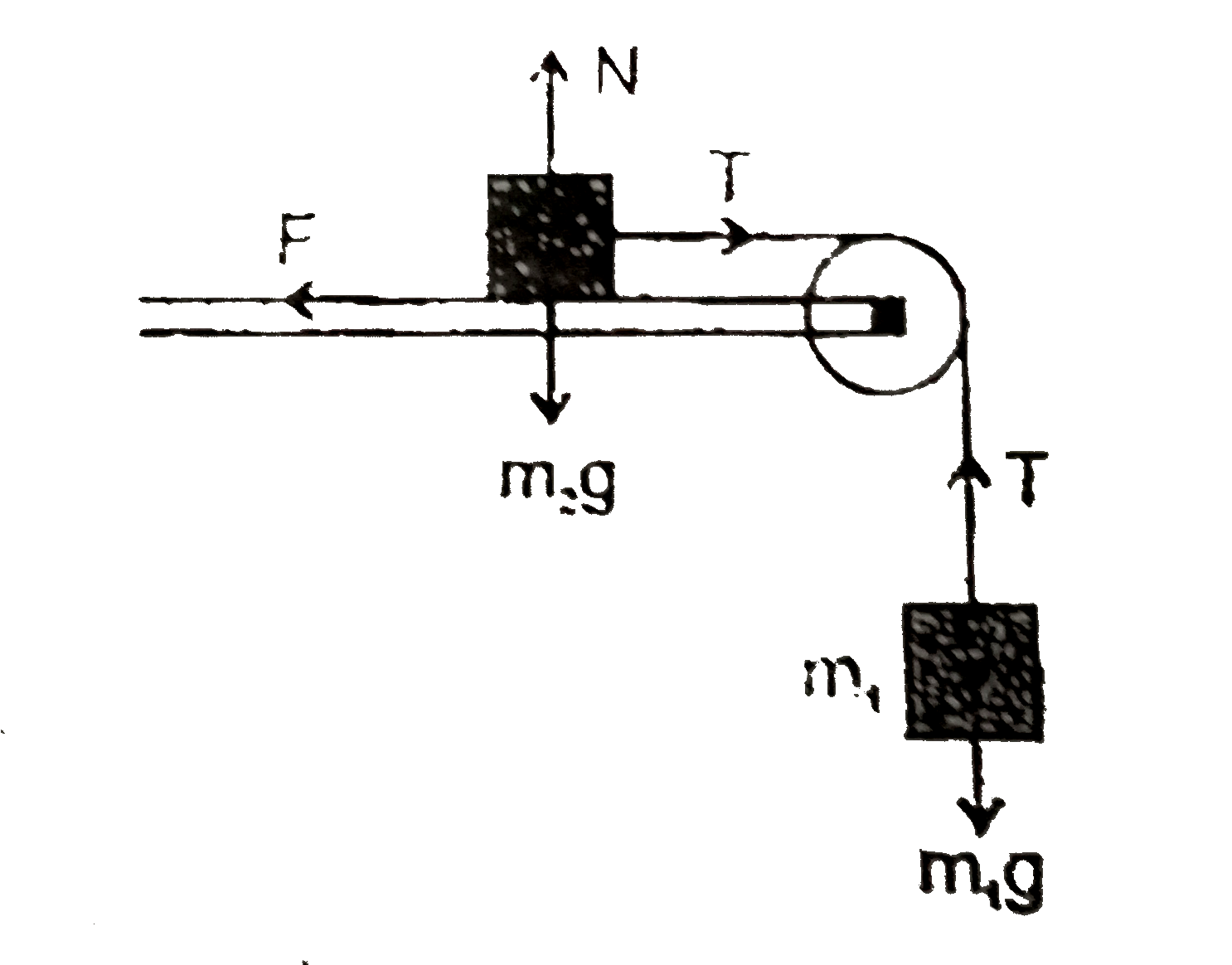
The mass of the hanging part = `m_(1) = m(l)/(n)`
[m = mass per unit length of chain]
The mass of section on tablen = `m_(2) = m (l-(l)/(n))`
For the chain to just move, `m_(1)g = T = F = mu m_(2)g`.
`implies m((l)/(n))g=muml(1-(l)/(n))gimplies mu = (1)/(n-1)`
Promotional Banner

Topper's Solved these Questions

  • REVIEW TEST

    VIBRANT|Exercise PART - II : PHYSICS|262 Videos
  • TEST PAPERS

    VIBRANT|Exercise PART - II : PHYSICS|56 Videos

Similar Questions

Explore conceptually related problems

A force vec(F) = - K (y hat(i) + x hat(j)) (where K is a positive constant) acts on a particle moving in the x - y plane. Starting from the origin, the particle is taken along the positive x-axis to the point (a, 0) and then parallel to the y-axis to the point (a, a) . The total work.done by the force F on the particle is:

A force vec((F)) = - K(yhat(i) + x hat(j)) (where K is a positive constant) acts on a particle moving in the X-Y plane. Starting from the origin, the particle is taken along the positive X-axis to the point (a, 0) and then parallel to the Y-axis to the point (a,a). The total done by the force vec(F) . of the particle is

A force vecF(yhatl+xhatJ), where K is a positive constant, acts on a particle moving in the XY-Plane. Starting from the origin, the particle is taken along the positive X-axis to a point (a,0) and then parallel to the y-axis to the point (a,a). Calculate the total work done by the force on the particle.

A force F = -K(y hatI + x hatj) (where K is a posive constant ) acts on a particle moving in the xy plane . Starting form the original , the partical is taken along in the positive x axis to the point (x,0) and then partical to they axis the point (x,0) . The total work done by the force F on the particls is

A force vecF=(4hati+5hatj)N acts on a particle moving in XY plane. Starting from origin, the particle first goes along x-axis to the point (5.0) m and then parallel to the Y-axis to the point (5,4 m. The total work done by the force on the particle is

A force vecF=k[yhati+xhatj] where k is a positive constant acts on a particle moving in x-y plane starting from the point (3, 5), the particle is taken along a straight line to (5, 7). The work done by the force is :

A force vec F = (3 vec i + 4vec j)N , acts on a particle moving in x-y plane. Starting from origin, the particle first goes along x-axis to thepoint (4,0)m and then parallel to the y -axis to the point(4, 3)m. The total work done by the force on the particle is (##NAR_NEET_PHY_XI_P2_C06_E09_014_Q01.png" width="80%">

A single force acts on a particle situated on the negative x-axis. The torque about the origin is in the positive z-direction. The force is

A force F acting on a particle varies with the position x as shown in figure. Find the work done by this force in displacing the particle from

VIBRANT-REVIEW TEST-PART - II : PHYSICS
  1. A force F=-K(yhati+xhatj) (where K is a positive constant) acts on a p...

    Text Solution

    |

  2. In (x-y) plane motion of particle it's (x-y) coordinate depends on tim...

    Text Solution

    |

  3. Three forces of magnitude 10N are acting on a block of mass 2 kg at 12...

    Text Solution

    |

  4. Find int(0)^(1)picos((pi)/(2)t)dt=?

    Text Solution

    |

  5. During displacement of a body two forces are acting on it simultaneous...

    Text Solution

    |

  6. Resultant of two forces when angle between them is 60^(@) is 6 Newton ...

    Text Solution

    |

  7. Force vec(F)=(4sqrt(2hat(i))+3sqrt(2)hat(j)) acting on a body so that ...

    Text Solution

    |

  8. Two forces 10 N and 15 N are acting on a body then which cannot be the...

    Text Solution

    |

  9. If acceleration of particle changing with time is a = (4t-2) m//s^(2) ...

    Text Solution

    |

  10. Young modulus of steel is 3 xx 10^(11) N//m^(2). When expressed in C.G...

    Text Solution

    |

  11. If momentum P, area A and time T are selected as fundamental quantitie...

    Text Solution

    |

  12. Two forces are acting on body vec(F)(1)=-(50-t^(2))hat(j) Newton and v...

    Text Solution

    |

  13. In the given velocity v//s position graph find acceleration at x = 2m

    Text Solution

    |

  14. Select correct statements

    Text Solution

    |

  15. If x = (4t^(2)+2) any y = 2t, then find ((dx)/(dy)) at t = 2 sec. (x i...

    Text Solution

    |

  16. Which of the following cannot be the group of fundamental quantities. ...

    Text Solution

    |

  17. Statement-1 : Using dimensional analysis we can drive only those formu...

    Text Solution

    |

  18. If side length of cube changing at 0.1mm//sec. Then what will be rate ...

    Text Solution

    |

  19. During one dimensional motion on x-axis Velocity time graph for partic...

    Text Solution

    |

  20. During one dimensional motion on x-axis Velocity time graph for partic...

    Text Solution

    |

  21. During one dimensional motion on x-axis Velocity time graph for partic...

    Text Solution

    |

