

Home
Class 12
PHYSICS
A block of 4kg mass starts at rest and s...

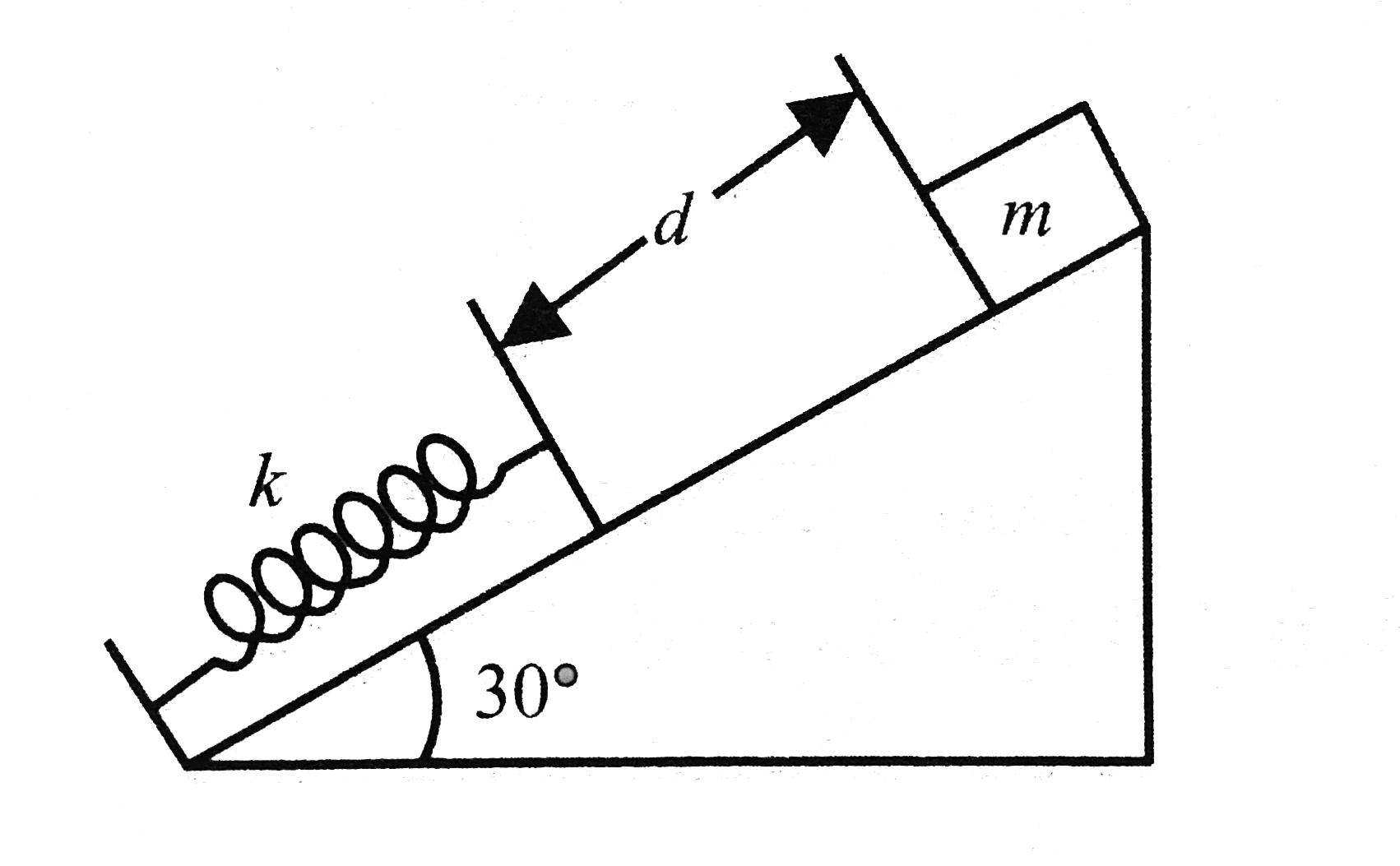
A block of `4kg` mass starts at rest and slides a distance `d` down a friction less incline ( angle `30^@`) where it runs into a spring of negligible mass. The block slides an additional `25cm` before it is brought to rest momentarily by compressing the spring. The force constant of the spring is `400Nm^-1`. The value of `d` is (take `g=10ms^-2`)

A

25 cm

B

37.5 cm

C

62.5 cm

D

None of the above

Text Solution

Verified by Experts

The correct Answer is:
C

`h=(1)/(2)g t^(2)=(1)/(2)xx10xx4=20m`. The height of the ball from ground at `t = 2 s " is "45-20=25m`
Promotional Banner

Topper's Solved these Questions

  • REVIEW TEST

    VIBRANT|Exercise PART - II : PHYSICS|262 Videos
  • TEST PAPERS

    VIBRANT|Exercise PART - II : PHYSICS|56 Videos

Similar Questions

Explore conceptually related problems

A block of 200 g mass is dropped from a height of 2 m on to a spring and compress the spring to a distance of 50 cm. The force constant of the spring is

A block of mass 4 kg slides on a horizontal frictionless surface with a speed of 2m//s . It is brought to rest in compressing a spring in its path. If the force constant of the spring is 400 N//m , by how much the spring will be compressed

A body of mass 0.1 g moving with a velocity of 10 m/s hits a spring (fixed at the other end) of force constant 1000 N/m and comes to rest after compressing the spring. The compression of the spring is

An ideal massless spring S can compressed 1.0 m in equilibrium by a force of 1000 N . This same spring is placed at the bottom of a friction less inclined plane which makes an angle theta =30^@ with the horizontal. A 10 kg mass m is released from the rest at top of the inclined plane and is brought to rest momentarily after compressing the spring by 2.0 m. the distance through which the mass moved before coming to rest is.

A spring gets compressed when a body of mass 5 g is dropped on it from a height of 2 m . Calculate the maximum distance s through whichthe spring is compressed. The force constant of spring is 100 Nm^(-1) .

If the force constant of spring is 50Nm^(-1) , find mass of the block, if it an rests in the given situation (g=10ms^(-2) ).

A block of mass m starts at rest at height on a frictionless inclined plane. The block slides down the plane, travels across a rough horizontal surface with coefficient of kinetic friction mu and compresses a spring with force constant k a distance x before momentarilly coming to rest. Then the spring extends and the block travels back across the rough surface, sliding up the plane. The block travels a total distance d on rough horizontal surface. The correct experssion for the maximum height h' that the block reaches on its return is :

An ideal massless spring S can compressed 1.0 m in equilibrium by a force of 1000 N . This same spring is placed at the bottom of a friction less inclined plane which makes an angle theta =30^@ with the horizontal. A (10 kg) mass (m) is released from rest at the top of the incline and and is brought to rest momentarily after compressing the spring by 2 m. if g =10 ms^(-1) , what is the speed of just before it touches the spring? .

An ideal massles spring S can be compressed 1 m by a force of 100 N in equilibrium. The same spring is placed at the bottom of a frictionless plane inclined at 30^(@) to the horizontal. A 10 kg block M is released from rest at the top of the incline and is brought to rest momentarily after compressing the spring by 2 m. If g = 10 m//s^(2) , the speed of mass just before it touches the spring is sqrt(10x) m//s . Find value of x?

VIBRANT-REVIEW TEST-PART - II : PHYSICS
  1. A block of 4kg mass starts at rest and slides a distance d down a fric...

    Text Solution

    |

  2. In (x-y) plane motion of particle it's (x-y) coordinate depends on tim...

    Text Solution

    |

  3. Three forces of magnitude 10N are acting on a block of mass 2 kg at 12...

    Text Solution

    |

  4. Find int(0)^(1)picos((pi)/(2)t)dt=?

    Text Solution

    |

  5. During displacement of a body two forces are acting on it simultaneous...

    Text Solution

    |

  6. Resultant of two forces when angle between them is 60^(@) is 6 Newton ...

    Text Solution

    |

  7. Force vec(F)=(4sqrt(2hat(i))+3sqrt(2)hat(j)) acting on a body so that ...

    Text Solution

    |

  8. Two forces 10 N and 15 N are acting on a body then which cannot be the...

    Text Solution

    |

  9. If acceleration of particle changing with time is a = (4t-2) m//s^(2) ...

    Text Solution

    |

  10. Young modulus of steel is 3 xx 10^(11) N//m^(2). When expressed in C.G...

    Text Solution

    |

  11. If momentum P, area A and time T are selected as fundamental quantitie...

    Text Solution

    |

  12. Two forces are acting on body vec(F)(1)=-(50-t^(2))hat(j) Newton and v...

    Text Solution

    |

  13. In the given velocity v//s position graph find acceleration at x = 2m

    Text Solution

    |

  14. Select correct statements

    Text Solution

    |

  15. If x = (4t^(2)+2) any y = 2t, then find ((dx)/(dy)) at t = 2 sec. (x i...

    Text Solution

    |

  16. Which of the following cannot be the group of fundamental quantities. ...

    Text Solution

    |

  17. Statement-1 : Using dimensional analysis we can drive only those formu...

    Text Solution

    |

  18. If side length of cube changing at 0.1mm//sec. Then what will be rate ...

    Text Solution

    |

  19. During one dimensional motion on x-axis Velocity time graph for partic...

    Text Solution

    |

  20. During one dimensional motion on x-axis Velocity time graph for partic...

    Text Solution

    |

  21. During one dimensional motion on x-axis Velocity time graph for partic...

    Text Solution

    |