

Home
Class 12
PHYSICS
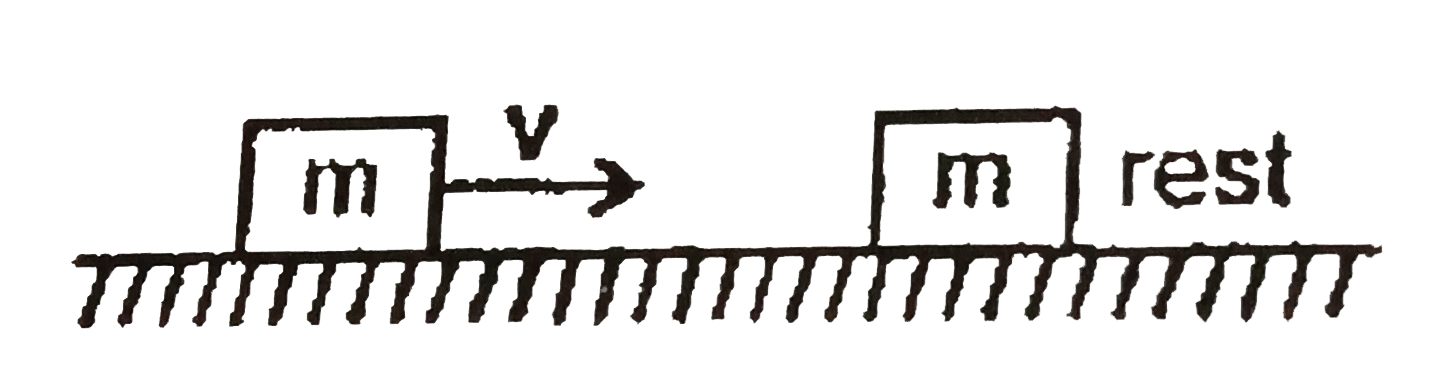
Two block of same mass m undergo headon ...

Two block of same mass m undergo headon collision as shown. E is the coefficient of restitution. Choose the correct statement(s) :

A

If e = 1, just after collision KE of right block is `(1)/(2)mv^(2)`.

B

If e = 0, loss in KE is `(1)/(2)((mv^(2))/(2))`.

C

If e = `(1)/(2)`, loss in KE = `(3)/(16)mv^(2)`.

D

No impulsive force acts on left block during collision.

Text Solution

Verified by Experts

The correct Answer is:
A, B, D

With respect to box, psudo force = mg act upwards. So `F_("net")=0`
Promotional Banner

Topper's Solved these Questions

  • REVIEW TEST

    VIBRANT|Exercise PART - II : PHYSICS|262 Videos
  • TEST PAPERS

    VIBRANT|Exercise PART - II : PHYSICS|56 Videos

Similar Questions

Explore conceptually related problems

The coefficient of restitution ( e) for a perfectly elastic collision is

The coefficient of restitution e for a perfectly elastic collision is

Choose the incorrect statement about the coefficient of restitution

Two balls of equal mass have a head-on collision with speed 6 m//s . If the coefficient of restitution is (1)/(3) , find the speed of each ball after impact in m//s

Consider two satellites A and B of equal mass m , moving in the same circular orbit about the earth, but in the opposite sense as shown in Fig. The orbital radius is r . The satellites undergo a collision which is perfectly inelastic. For this situation, mark out the correct statement(s). [Take mass of earth as M ]

A ball of mass m moving with velocity u strikes another identical ball at rest. Find the velocities of the balls after the collision if the coefficient of restitution is e and the collision is head -on. Also , calculate the loss in K.E.

In the figure shown, all the surfaces are rough. Both the blocks have the same mass. The friction coefficient between all the surface is the same. Choose the correct statements.

A block of mass m moving with speed v_(0) strikes another particle of mass 2 m at rest. If collision is head - on and the coefficient of restitution e = 1//2 , then the loss in kinetic energy will be

VIBRANT-REVIEW TEST-PART - II : PHYSICS
  1. An iron ball of mass m, suspended by a light in-extensible string of l...

    Text Solution

    |

  2. A particle is moving along the path given by y=(C )/(6)t^(6) (where C ...

    Text Solution

    |

  3. Two block of same mass m undergo headon collision as shown. E is the c...

    Text Solution

    |

  4. A force given by the relation F = 8t, (F in Newton and t in sec.) acts...

    Text Solution

    |

  5. Two blocks of mass 10 kg and 30 kg are kept as shown in the figure. Th...

    Text Solution

    |

  6. The system shown in the figure is in equilibrium. Masses m(1) & m(2) a...

    Text Solution

    |

  7. A box is failing freely. Inside the box, a particle is projected with ...

    Text Solution

    |

  8. A plank of mass M is moving on a smooth horizontal surface with speed ...

    Text Solution

    |

  9. The spring block system lies on a smooth horizontal surface. The free ...

    Text Solution

    |

  10. A particle moves from rest at A on the surface of a smooth circular cy...

    Text Solution

    |

  11. Initially spring is in natural length and block of mass m is released ...

    Text Solution

    |

  12. A block of mass m tied with a string moves in a vertical plane. A cons...

    Text Solution

    |

  13. On a rough horizontal x-y plane a body starts moving from origin with ...

    Text Solution

    |

  14. A long cylindrical tank of cross-section area 0.5m^(2) is filled with ...

    Text Solution

    |

  15. In the figure shown when the massless spring is in relaxed state, its ...

    Text Solution

    |

  16. A small particle is given an initial velocity v(0)=10 m//s along the t...

    Text Solution

    |

  17. In the arrangement shown in the figure pulleys are small, light and fr...

    Text Solution

    |

  18. A small hoop of mass m is given an initial velocity of magnitude v(0) ...

    Text Solution

    |

  19. The acceleration of a particle moving in straight line is defined by t...

    Text Solution

    |

  20. A particle leaves the origin at t = 0 with an intial velocity vec(V)=3...

    Text Solution

    |