Home
Class 12
PHYSICS
A rod of length l and cross-section are...

A rod of length l and cross-section area A has a variable thermal conductivity given by K = `alpha` T, where `alpha` is a positive constant and T is temperature in kelvin. Two ends of the rod are maintained at temperature `T_(1)` and `T_(2)` `(T_(1)gtT_(2))`. Heat current flowing through the rod will be

A

`(Aalpha(T_(1)^(2)-T_(2)^(2)))/(l)`

B

`(Aalpha(T_(1)^(2)+T_(2)^(2)))/(l)`

C

`(Aalpha(T_(1)^(2)+T_(2)^(2)))/(3l)`

D

`(Aalpha(T_(1)^(2)-T_(2)^(2)))/(2l)`

Text Solution

Verified by Experts

The correct Answer is:
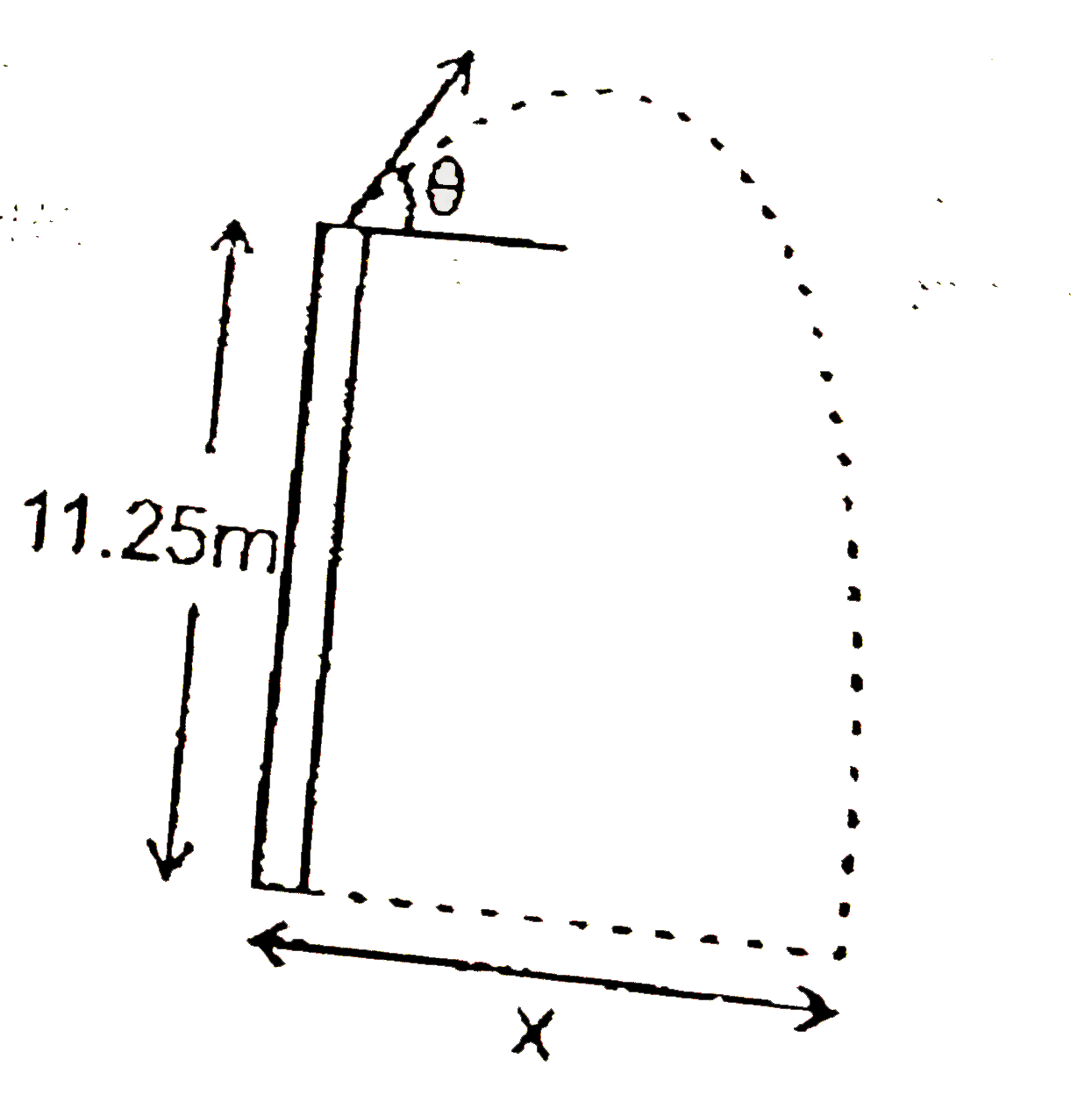
A

`-11.25 = x(tan theta)-(10x^(2))/(2xx400)(1+tan^(2)theta)`
`implies(x^(2))/(80)tan^(2)theta-x(tan theta)+((x^(2))/(80)-11.25)=0`
For real value of `'theta'`
`D ge 0`
`x^(2)-4((x^(2))/(80))((x^(2))/(80)-11.25)ge0`
`implies x^(2)le4xx625`
`implies x le 50 " "x_("max")=50m`
Promotional Banner

Topper's Solved these Questions

  • REVIEW TEST

    VIBRANT|Exercise PART - II : PHYSICS|262 Videos
  • TEST PAPERS

    VIBRANT|Exercise PART - II : PHYSICS|56 Videos

Similar Questions

Explore conceptually related problems

A rod of length l and cross sectional area A has a variable conductivity given by K=alphaT , where alpha is a positive constant T is temperatures in Kelvin. Two ends of the rod are maintained at temperatures T_1 and T_2(T_1gtT_2) . Heat current flowing through the rod will be

A rod of length L with sides fully insulated is made of a material whose thermal conductivity K varies with temperature as K=(alpha)/(T) where alpha is constant. The ends of rod are at temperature T_(1) and T_(2)(T_(2)gtT_(1)) Find the rate of heat flow per unit area of rod .

Two bars of same length and same cross-sectional area but of different thermal conductivites K_(1) and K_(2) are joined end to end as shown in the figure. One end of the compound bar it is at temperature T_(1) and the opposite end at temperature T_(2) (where T_(1) gt T_(2) ). The temperature of the junction is

A metal rod of area of cross section A has length L and coefficient of thermal conductivity K the thermal resistance of the rod is .

Two bodies of masses m_(1) and m_(2) and specific heat capacities S_(1) and S_(2) are connected by a rod of length l, cross-ssection area A, thermal conductivity K and negligible heat capacity. The whole system is thermally insulated. At time t=0 , the temperature of the fisrt body is T_(1) and the temperature of the second body is T_(2)(T_(2)gtT_(1)) . Find the temperature difference between the two bodies at time t.

A tapering rod of length L has cross sectional radii of a and b(lt a) at its two ends. Its thermal conductivity is k. The end with radius a is maintained at a higher temperature T_(1) and the other end is maintained at a lower temperature T_(2) . The curved surface is insulated. (i) At which of the two points – 1 and 2 – shown in the figure will the temperature gradient be higher? (ii) Calculate the thermal resistance of the rod.

" A metal rod of area of cross section A has length L and coefficient of thermal conductivity K The thermal resistance of the rod is "

Two rods of same length and cross section are joined along the length. Thermal conductivities of first and second rod are K_(1) and K_(2) . The temperature of the free ends of the first and seconds rods are maintained at theta_(1) and theta_(2) respectively. The temperature of the common junction is

A rof of length l with thermally insulated lateral surface consists of material whose heat conductivity coefficient varies with temperature as x = alpha//T , where alpha is a constant. The ends of the rod are kept at temperatures T_1 and T_2 . Find the function T (x) , where x is the distance from the end whose temperature is T_1 , and the heat flow density.

Two ends of a rod of uniform cross sectional area are kept at temperature 3T_(0) and T_(0) as shown. Thermal conductivity of rod varies as k=alphaT , (where alpha is a constant and T is absolute temperature). In steady state, the temperature of the middle section of the rod is

VIBRANT-REVIEW TEST-PART - II : PHYSICS
  1. A clock with a metallic pendulum gains 5 s each day at a temperature o...

    Text Solution

    |

  2. A rod of length 6 m has specific gravity rho (= 25//36). One end of th...

    Text Solution

    |

  3. A rod of length l and cross-section area A has a variable thermal con...

    Text Solution

    |

  4. Velocity of a particle moving in a straight line is v=sqrt(9+4s). Here...

    Text Solution

    |

  5. Consider a one dimensional head on collision of two balls. Statemen...

    Text Solution

    |

  6. A ball is thrown horizontally from a height h above a staircase as sho...

    Text Solution

    |

  7. The Poisson's ratio of a material is 0.4. If a force is applied to a w...

    Text Solution

    |

  8. A steel rod of length L, density d and cross-sectional area A, is hing...

    Text Solution

    |

  9. A thin uniform copper rod of length l and cross-section area A and mas...

    Text Solution

    |

  10. Two bars of masses m(1) and m(2) connected by a non-deformed light spr...

    Text Solution

    |

  11. A rod of length 2 m is at a temperature of 20^@ C. find the free expan...

    Text Solution

    |

  12. A trolley containing a liquid slides down a smooth inclined plane of a...

    Text Solution

    |

  13. A small body with relative density d(1) falls in air from a height 'h'...

    Text Solution

    |

  14. A solid sphere rolls down two different inclined planes of the same he...

    Text Solution

    |

  15. The displacement of a particle after time t is given by x = (k // b^(2...

    Text Solution

    |

  16. A bimetallic strip is made of aluminium and steel (alpha(Al)gtalpha(st...

    Text Solution

    |

  17. A liquid is kept in a cylindrical vessel which is rotated along its ax...

    Text Solution

    |

  18. A particle moves in the X-Y plane with velocity vec(v)=alphahat(i)+bet...

    Text Solution

    |

  19. A body at temperature theta(0) having Newton's cooling constant K is p...

    Text Solution

    |

  20. The coefficient of linear expansion varies linearly from alpha(1) and ...

    Text Solution

    |

