A
B
C
D
Text Solution
Verified by Experts
The correct Answer is:



Topper's Solved these Questions
Similar Questions
Explore conceptually related problems
RESONANCE-AROMATIC COMPOUNDS -Exercise -3 Part-I
- Identify A, B, C, D and write the balanced chemical equations of forma...
Text Solution
|
- under Hofmann conditions will give:
Text Solution
|
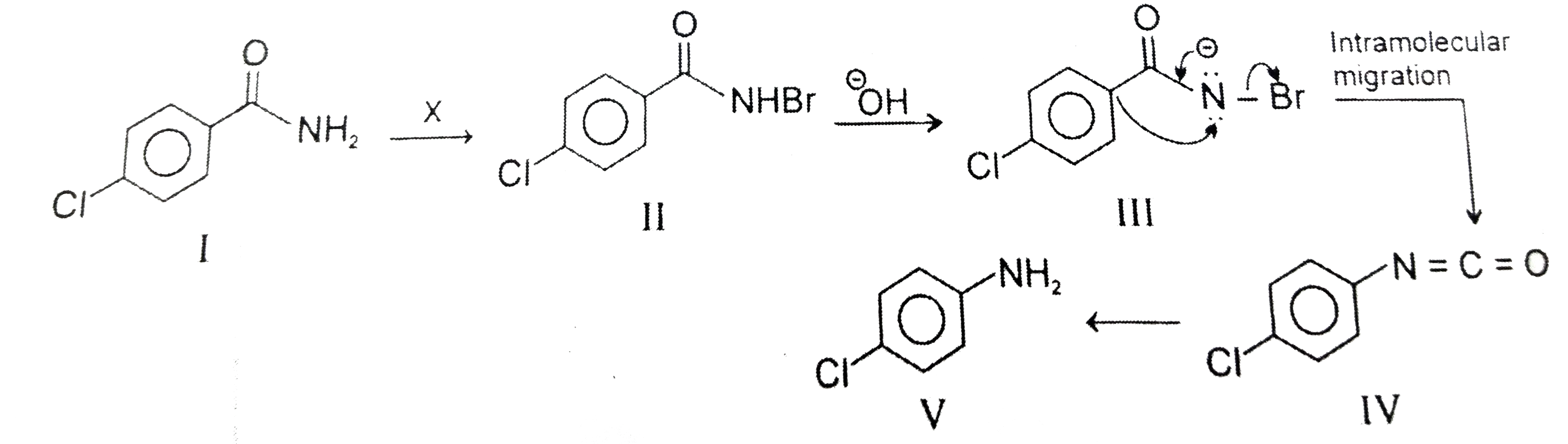
- Which reagent (X) is used to convert I to II
Text Solution
|
- Consider the pathway of a well known organic reaction Which step ...
Text Solution
|
- CH(3)NH(2)+CHCl(3)+KOH to nitrogen containing compound +KCl+H(2)O. Nit...
Text Solution
|
- What are P & Q.
Text Solution
|
- Riemer-Tiemann reaction intorduces an aldehyde group, on to the aromat...
Text Solution
|
- Reimer-Tiemann reaction introduces an aldehyde group on to the aromati...
Text Solution
|
- Riemer-Tiemann reaction intorduces an aldehyde group, on to the aromat...
Text Solution
|
- In the reaction the intermediate(s) is/are:
Text Solution
|
- Match the reactions in Column I with appropriate options in Column II.
Text Solution
|
- The major product of the following reaction is :
Text Solution
|
- Among the compounds given, the one that would form a brilliant colored...
Text Solution
|
- In the following reaction, the products formed is(are)
Text Solution
|
- The major product(s) of the following is (are):
Text Solution
|
- P and Q are isomers of dicarboxylic acid C(4)H(4)O(4). Both decolorize...
Text Solution
|
- P and Q are isomers of dicarboxylic acid C(4)H(4)O(4). Both decolorize...
Text Solution
|
- The reactivity of compound Z with different halogens under appropriat...
Text Solution
|
- The the identification of beta-napthol using dye test, it is necessary...
Text Solution
|
- Match the four starting materials (P,Q,R,S) gien in List-I with the co...
Text Solution
|