Home
Class 11
CHEMISTRY
Reimer-Tiemann reaction introduces an al...

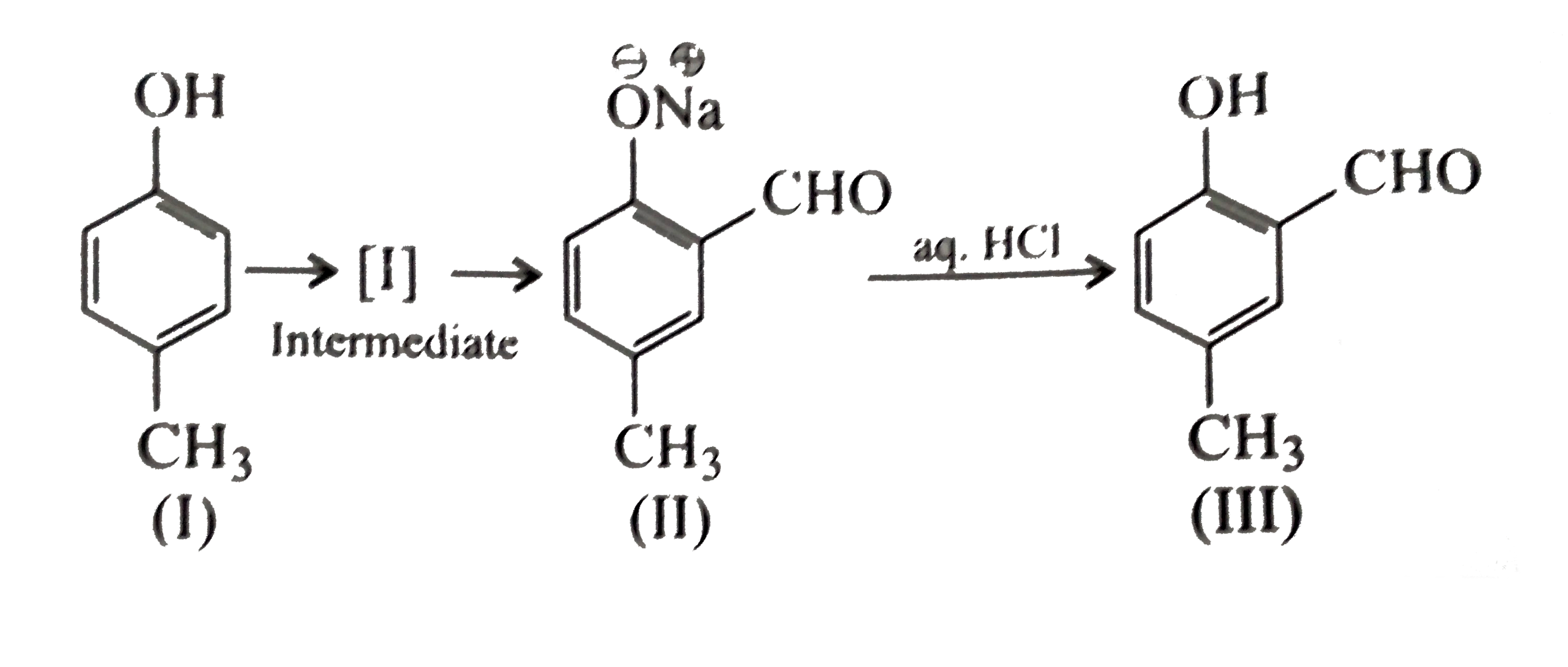
Reimer-Tiemann reaction introduces an aldehyde group on to the aromatic ring of phenol, ortho to the hydroxyl group. This reacrtion involves electrophilic aromatic subsititution. It is a general method for the synthesis of subsituted salicyladehydes as depiced below:

The electrophile in this reaction is:

A

`:CHCl`

B

`.^(+)CHCl_(2)`

C

`:CCl_(2)`

D

`.^(.)CCl_(3)`

Text Solution

Verified by Experts

The correct Answer is:

C
Promotional Banner

Topper's Solved these Questions

  • AROMATIC COMPOUNDS

    RESONANCE|Exercise PART-II JEE MAIN|19 Videos
  • AROMATIC COMPOUNDS

    RESONANCE|Exercise JEE(MAIN) ONLINE PROBLEM|16 Videos
  • AROMATIC COMPOUNDS

    RESONANCE|Exercise PART IV- COMPREHENSION|14 Videos
  • ATOMIC STRUCTURE

    RESONANCE|Exercise PHYSICAL CHEMISTRY(ATOMIC EQUILIBRIUM)|48 Videos

Similar Questions

Explore conceptually related problems

Reimer -Tiemann reaction introduces an aldehyde group on to the aromatic ring of phenol, ortho to the hydroxyl group. This reaction involves electrophilic aromatic substitution. This is a general method for the synthesis of substituted salicyladehydes as depicted below. The electrophile in this reaction is

Reimer-Tiemann reaction introduces an aldehyde group on to the aromatic ring of phenol, ortho to the hydroxyl group. This reacrtion involves electrophilic aromatic subsititution. It is a general method for the synthesis of subsituted salicyladehydes as depiced below: The structure of the intremediate (I) is:

Reimer-Tiemann reaction introduces an aldehyde group on to the aromatic ring of phenol, ortho to the hydroxyl group. This reacrtion involves electrophilic aromatic subsititution. It is a general method for the synthesis of subsituted salicyladehydes as depiced below: Which one of the following reagents is used in the above reaction ?

Reimer -Tiemann reaction introduces an aldehyde group on to the aromatic ring of phenol, ortho to the hydroxyl group. This reaction involves electrophilic aromatic substitution. This is a general method for the synthesis of substituted salicyladehydes as depicted below. The structure of the intermediate I is

RESONANCE-AROMATIC COMPOUNDS -Exercise -3 Part-I
  1. What are P & Q.

    Text Solution

    |

  2. Riemer-Tiemann reaction intorduces an aldehyde group, on to the aromat...

    Text Solution

    |

  3. Reimer-Tiemann reaction introduces an aldehyde group on to the aromati...

    Text Solution

    |

  4. Riemer-Tiemann reaction intorduces an aldehyde group, on to the aromat...

    Text Solution

    |

  5. In the reaction the intermediate(s) is/are:

    Text Solution

    |

  6. Match the reactions in Column I with appropriate options in Column II.

    Text Solution

    |

  7. The major product of the following reaction is :

    Text Solution

    |

  8. Among the compounds given, the one that would form a brilliant colored...

    Text Solution

    |

  9. In the following reaction, the products formed is(are)

    Text Solution

    |

  10. The major product(s) of the following is (are):

    Text Solution

    |

  11. P and Q are isomers of dicarboxylic acid C(4)H(4)O(4). Both decolorize...

    Text Solution

    |

  12. P and Q are isomers of dicarboxylic acid C(4)H(4)O(4). Both decolorize...

    Text Solution

    |

  13. The reactivity of compound Z with different halogens under appropriat...

    Text Solution

    |

  14. The the identification of beta-napthol using dye test, it is necessary...

    Text Solution

    |

  15. Match the four starting materials (P,Q,R,S) gien in List-I with the co...

    Text Solution

    |

  16. Among The following the number of reaction(s) that prouduce(s) benzad...

    Text Solution

    |

  17. The major product U in the following reactions is

    Text Solution

    |

  18. In the following reactions, the major product W is:

    Text Solution

    |

  19. The product(s) of the following reactions sequence is(are)

    Text Solution

    |

  20. The correct statement(s) about the following reaction sequence is (are...

    Text Solution

    |
