Home
Class 12
PHYSICS
The particle P shown in the figure has...

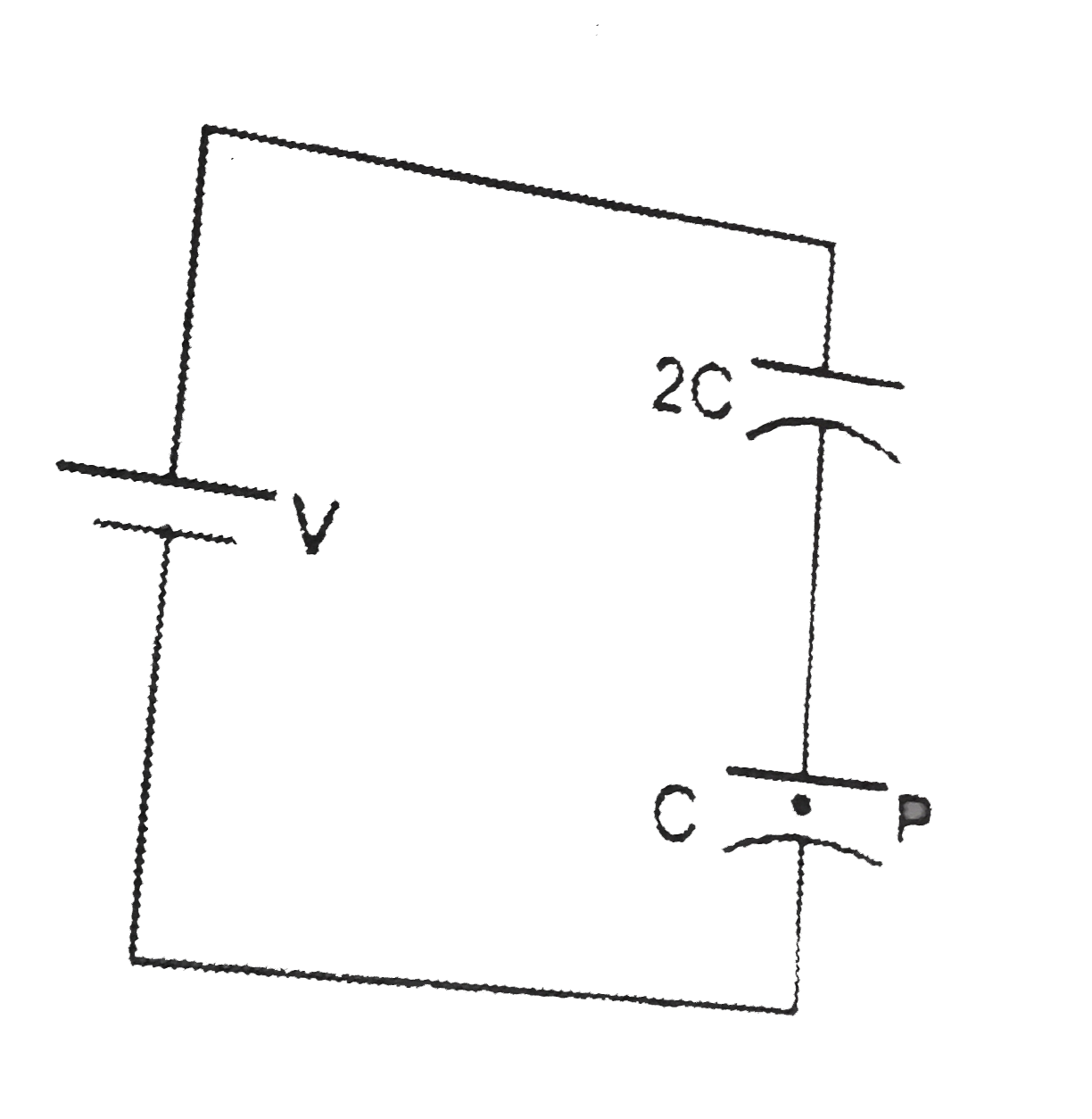
The particle P shown in the figure has a mass m and a charge -q. Each horizontal plate has a surface area A potential difference `V=n((mg epsilon_(0)A)/(2qc))` should be applied to the combination to hold the particle p in equilibrium then find the value of n.

Text Solution

Verified by Experts

The correct Answer is:

3
Promotional Banner

Topper's Solved these Questions

  • CAPACITANCE

    RESONANCE|Exercise Exercise - 3|26 Videos
  • CAPACITANCE

    RESONANCE|Exercise High Level Problems|16 Videos
  • CAPACITANCE

    RESONANCE|Exercise Exercise - 1|79 Videos
  • ATOMIC PHYSICS

    RESONANCE|Exercise Advanved level problems|17 Videos
  • COMMUNICATION SYSTEMS

    RESONANCE|Exercise Exercise 3|13 Videos

Similar Questions

Explore conceptually related problems

The particle P shown in the figure has a mass of 10 mg and a charge of -0.01 muC . Each plate has a surface area 10^(-2) m^2 on one side. What potential difference V should be applied to the combination to hold the particle P in equilibrium?

A sphere carrying a charge of Q having weight w falls under gravity between a pair of vertical plates at a distance of d from each other. When a potential difference V is applied between the plates the acceleration of sphere changes as shown in the figure, to along line BC. The value of Q is

Lower plate of a parallel plate capacitor is fixed on a horizontal insulating surface. The upper plate is suspended above it using on elastic cord of force constant K. The upper plate has negligible mass and area of each plate is A. When there is no charge on the plates the equilibrium separation between them is d. When a potential difference = V is applied between the plates the equilibrium separation changes to x. (a) Calculate V as a function of x. (b) Find the value of x for which V is maximum. Calculate the maximum value of V (= V_(max)) (c) What will happen if V gt V_(max) ? (d) Plot a rough graph showing variation of equilibrium separation (x) with V

Each of the two block shown in the figure has mass m. The pulley is smooth and the coefficient of friction for all surfaces in contact is mu . A constant horizontal force P applied in two cases shown in such a way that block A start just sliding then the value of minimum force P in case-I and case-II is :

A particle having charge +q and mass m is approaching (head on) a free particle having mass M and charge 10 q. Initially the mass m is at large distance and has a velocity V_(0) , whereas the other particle is at rest. (a) Find the final velocity of the two particles when M = 20 m. (b) Find the final state of the two particles if M = m .

(a) Find the potential difference between the plates of a parallel plate capacitor of capacitance 5muF if a charge +800muC is placed on one plate and- 200muC on another plate. (b) The charege given to plate are as shown. The capacitance between the adjacent plates is C . find the charge on outer surface of plate 3 , and potential difference between plate 1 and 2 . (c) If A is area of each plate and d is separation between adjacent plates, find the charge supplied by battery. (d) Five idential capacitor plates each of area A are arranged such that adjacent plates are at a distance d apart. the plates are connected to a source of emf V as shown. what is the magnitude and nature of charge on plates 1 and 3 respectively?

A uniform electric field of magnitude E exists in between two parallel metal plates , as shown in the figure given below. One particle of mass m and charge q is projected along the central line between the plates. Particle just missed to strike upper plate , while coming out of plates. Find : (a)Time taken by the particle to come out of plates. (b)Speed of the particle as it comes out of plates. (c) Angle of deviation suffered by particle. The length of the plates is L and the distance between the plates is d. Ignore gravity .

A charged particle of m and charge Q has acquired a certain velocity by passing through a potential di Iierence U_o . With this velocity it flies into the field of a parallel-plate capacitor, with the distance between the plates being L, the potential di fference bei ng U. The velocity of the particle is directed parallel to the plates. Where should the magnetic field that makes the particle move along a straight line in the capacitor be directed and what should its value be (the induction B) ?

RESONANCE-CAPACITANCE-Exercise - 2
  1. A network of six identical capacitors, each of capacitance C is for...

    Text Solution

    |

  2. Both the capacitors shown in figure are made of square plates of edg...

    Text Solution

    |

  3. The particle P shown in the figure has a mass m and a charge -q. Eac...

    Text Solution

    |

  4. A capacitor of capacitance 2.0 mu F is charged to a potential differ...

    Text Solution

    |

  5. Four capacitors of capacitance 10 mu F and a battery of 2V are arrang...

    Text Solution

    |

  6. A part of circuit in a steady state along with the current flowing in ...

    Text Solution

    |

  7. Five capacitors are connected as shown in the figure. Initially S is ...

    Text Solution

    |

  8. In steady state, find the charge on the capacitor in (mu C) shown in...

    Text Solution

    |

  9. Calculate the steady state current (in A ) in the 2 mu resistor shown ...

    Text Solution

    |

  10. Find the potential difference between points A and B (in V) of the s...

    Text Solution

    |

  11. (i) What is the final potential (in V) of point b with respect to gr...

    Text Solution

    |

  12. Find the equivalent capacitance in (mu F) of the infinite ladder show...

    Text Solution

    |

  13. The equivalent capacitance of the combination shown in the figure be...

    Text Solution

    |

  14. The electric field between the plates of a parallel-plate capacitor of...

    Text Solution

    |

  15. A capacitor of capacitance C charged by battery at V volt and then di...

    Text Solution

    |

  16. Hard rubber has a dielectric constant of 2.8 and a dielectric strengh...

    Text Solution

    |

  17. Two square metal plates of side 1 m are kept 0.01 m apart like a paral...

    Text Solution

    |

  18. Three conducting plates of area 500 cm^(2) area kept fixed as shown....

    Text Solution

    |

  19. Consider the arrangement of parallel plates of the previous problem. ...

    Text Solution

    |

  20. For a charged parallel plate capacitor shown in the figure, the force ...

    Text Solution

    |
