Home
Class 12
PHYSICS
A parallel plate capacitor has a dielec...

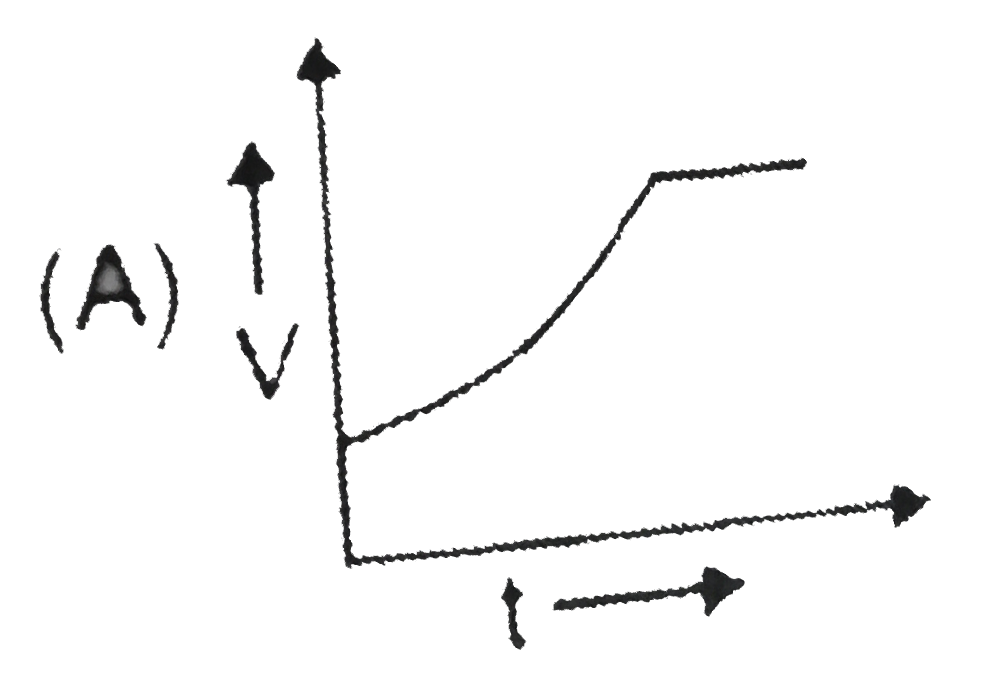
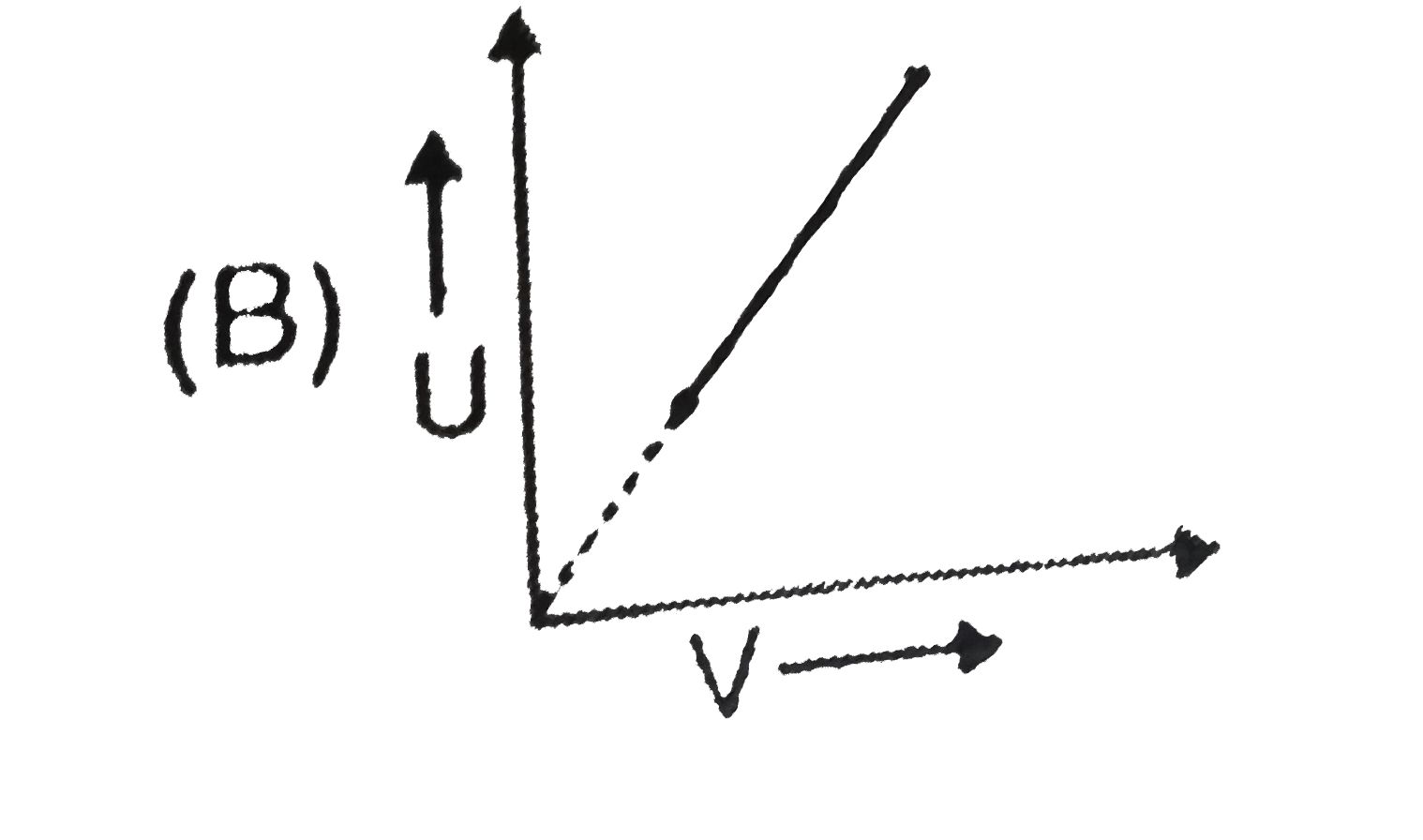
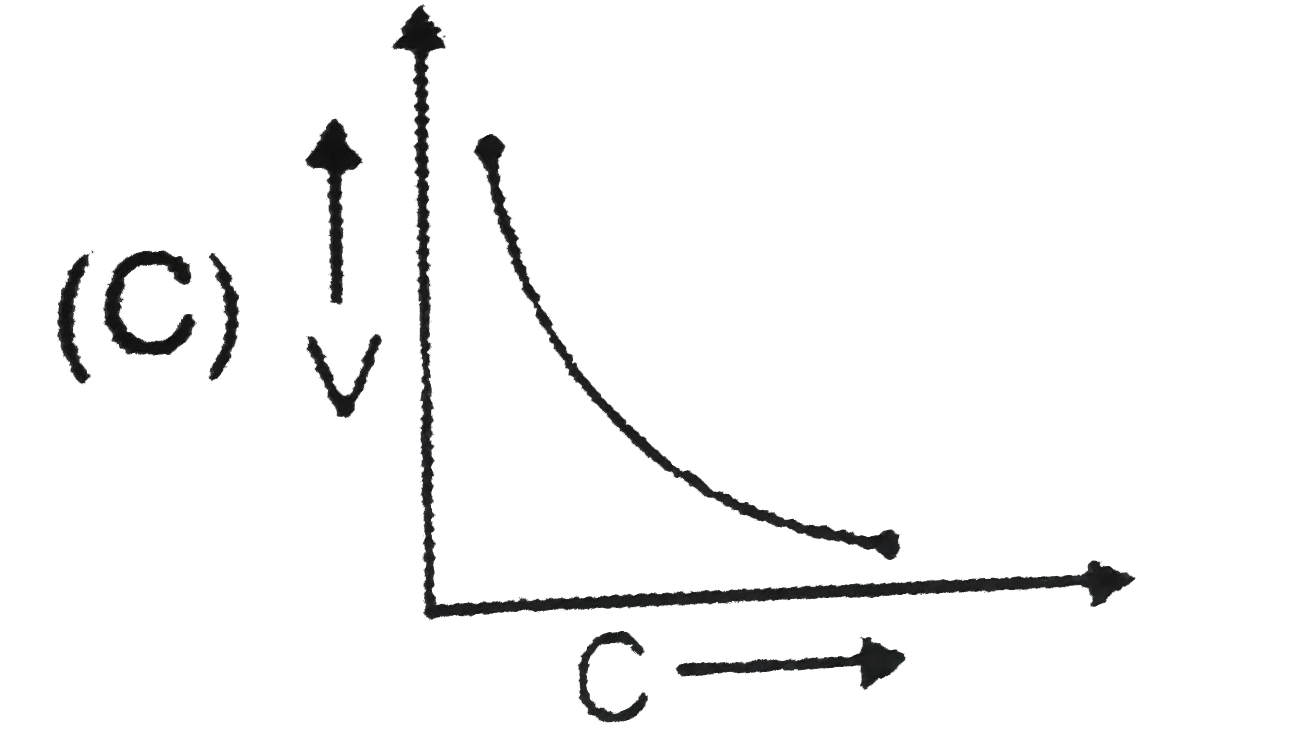
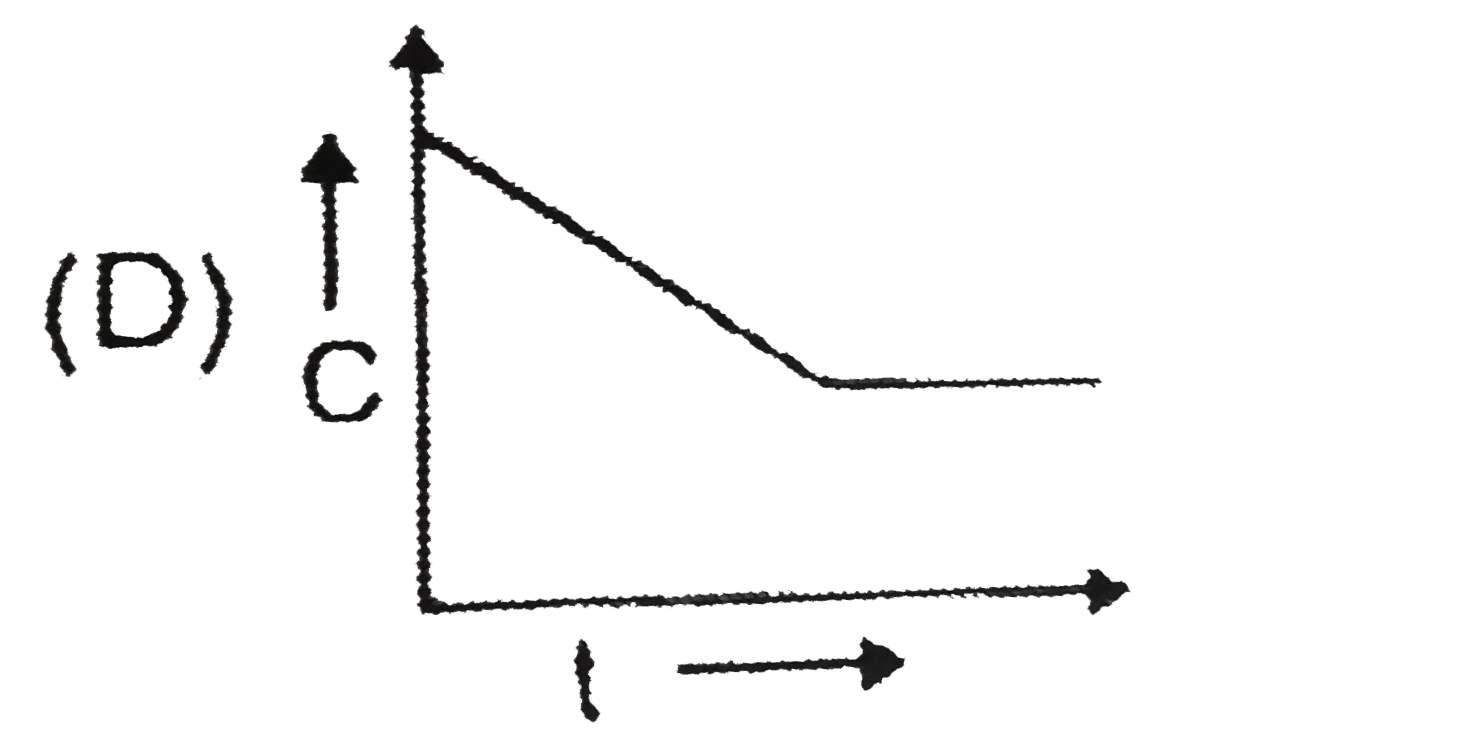
A parallel plate capacitor has a dielectric slab in it. The slab just fills the space inside the capacitor. The capacitor is charged by a battery and the battery is disconnected . Now the slab is started to pull out uniformly at t = 0. If at time t, capacitance of the capacitor is C, potential difference across plate is V, and energy stored in it is U, then which of the following graphs are correct ?

A

B

C

D

Text Solution

AI Generated Solution

The correct Answer is:

To solve the problem regarding the behavior of a parallel plate capacitor with a dielectric slab being pulled out, we will analyze the relationships between capacitance (C), potential difference (V), and energy stored (U) in the capacitor over time. ### Step-by-Step Solution: 1. **Understanding the Initial Conditions**: - Initially, the capacitor has a dielectric slab with a dielectric constant \( K \). The capacitance of the capacitor can be expressed as: \[ C = K \cdot \frac{\epsilon_0 A}{d} \] - Here, \( \epsilon_0 \) is the permittivity of free space, \( A \) is the area of the plates, and \( d \) is the separation between the plates. 2. **When the Dielectric is Pulled Out**: - As the dielectric slab is pulled out uniformly, the dielectric constant \( K \) effectively decreases, leading to a decrease in capacitance \( C \). When the slab is completely removed, the capacitance becomes: \[ C_0 = \frac{\epsilon_0 A}{d} \] - Thus, the relationship between the capacitance with and without the dielectric is: \[ C = K \cdot C_0 \] - As \( K \) decreases, \( C \) also decreases over time. 3. **Relationship Between Charge, Capacitance, and Voltage**: - Since the capacitor is charged and then disconnected from the battery, the charge \( Q \) on the capacitor remains constant. The relationship between charge, capacitance, and voltage is given by: \[ Q = C \cdot V \] - Rearranging gives us: \[ V = \frac{Q}{C} \] - As capacitance \( C \) decreases, the potential difference \( V \) across the capacitor must increase since \( Q \) is constant. 4. **Energy Stored in the Capacitor**: - The energy \( U \) stored in the capacitor is given by: \[ U = \frac{1}{2} C V^2 \] - Since \( V \) increases as \( C \) decreases, we can analyze how \( U \) changes. As \( C \) decreases, the energy stored will also change, but the exact relationship will depend on the specific values of \( C \) and \( V \). 5. **Graphical Representation**: - **Capacitance vs. Time (C vs. t)**: This graph will show a decreasing trend as the dielectric is pulled out. - **Potential vs. Time (V vs. t)**: This graph will show an increasing trend as the capacitance decreases. - **Energy vs. Potential (U vs. V)**: This graph will show a quadratic relationship since \( U \) is proportional to \( V^2 \). - **Potential vs. Capacitance (V vs. C)**: This graph will show an inverse relationship since \( V \) is inversely proportional to \( C \). ### Conclusion: Based on the analysis, all four graphs representing the relationships between capacitance, potential, and energy are correct.
Promotional Banner

Topper's Solved these Questions

  • CAPACITANCE

    RESONANCE|Exercise Exercise - 3|26 Videos
  • CAPACITANCE

    RESONANCE|Exercise High Level Problems|16 Videos
  • CAPACITANCE

    RESONANCE|Exercise Exercise - 1|79 Videos
  • ATOMIC PHYSICS

    RESONANCE|Exercise Advanved level problems|17 Videos
  • COMMUNICATION SYSTEMS

    RESONANCE|Exercise Exercise 3|13 Videos

Similar Questions

Explore conceptually related problems

A parallel plate capacitor is charged by a battery. The battery is removed and a thick glass slab is inserted between the plates. Now,

In a parallel plate capacitor, the region between the plates is filled by a dielectric slab. The capacitor is charged from a cell and then disconnected from it. The slab is now taken out :

Between the plates of a parallel plate capacitor a dielectric plate in introduced just to fill the complete space between the plates. The capacitor is charged and later disconnected from the battery. The dielectric plate is then slowly drawn out of the capacitor plates. the plot of the potential difference across the plates and the length of the dielectric plate drawn out is

Space between the plates of a parallel plate capacitor is filled with a dielectric slab. The capacitor is charged and then the supply is disconnected to it. If the slab is now taken out then

A capacitor of capacitance 10 mu F is charged to a potential 50 V with a battery. The battery is now disconnected and an additional charge 200 mu C is given to the positive plate of the capacitor. The potential difference across the capacitor will be.

A dielectric slab is placed between the plates of a parallel plate capacitor. Its capacitance

In a parallel-plate capacitor, the region between the plates is filled by a dielectric slab. The capacitor is connected to a cell and the slab is taken out. Then

A capacitor C is charged to a potential difference V and battery is disconnected. Now if the capacitor plates are brough close slowely by some distance:

A capacitor is charged by using a battery which is then disconnected. A dielectric slab is then slipped between the plates, which results in

RESONANCE-CAPACITANCE-Exercise - 2
  1. In the adjoining diagram all the capacitors are initially uncharged, ...

    Text Solution

    |

  2. In the circuit shown in figure the switch S is closed at t = 0. A lo...

    Text Solution

    |

  3. When a charged capacitor is connected with an uncharged capacitor , t...

    Text Solution

    |

  4. In the circuit shown each capacitor has a capcitance C. The emf of the...

    Text Solution

    |

  5. Two similar condensers are connected in parallel and are charged to...

    Text Solution

    |

  6. We have a combination as shown in following figure. Choose the corre...

    Text Solution

    |

  7. The charge across the capacitor in two different RC circuit 1 and 2 ar...

    Text Solution

    |

  8. The instantaneous charge on capacitor in two discharging RC circuils...

    Text Solution

    |

  9. Capacitor C1 of capacitance 1 micro-farad and capacitor C2 of capacita...

    Text Solution

    |

  10. The terminals of a battery of emf V are connected to the two plates of...

    Text Solution

    |

  11. A parallel plate capacitor of plate area A and plate separation d is c...

    Text Solution

    |

  12. The plates of a parallel plate capacitor with no dielectirc are connec...

    Text Solution

    |

  13. A parallel plate capacitor has a dielectric slab in it. The slab jus...

    Text Solution

    |

  14. A parallel plate air capacitor is connected to a battery. The quantiti...

    Text Solution

    |

  15. Capacitor C(3) in the circuit is a veriable capacitor (its capacitance...

    Text Solution

    |

  16. Capacitor C(3) in the circuit is a veriable capacitor (its capacitance...

    Text Solution

    |

  17. Capacitor C(3) in the circuit is a veriable capacitor (its capacitance...

    Text Solution

    |

  18. In the shown circuit involving a resistor of resistance R Omega, capa...

    Text Solution

    |

  19. In the shown circuit involving a resistor of resistance R Omega, capa...

    Text Solution

    |

  20. In the shown circuit involving a resistor of resistance R Omega, capa...

    Text Solution

    |
