Home
Class 12
PHYSICS
find out mass of the charge Q, so that i...

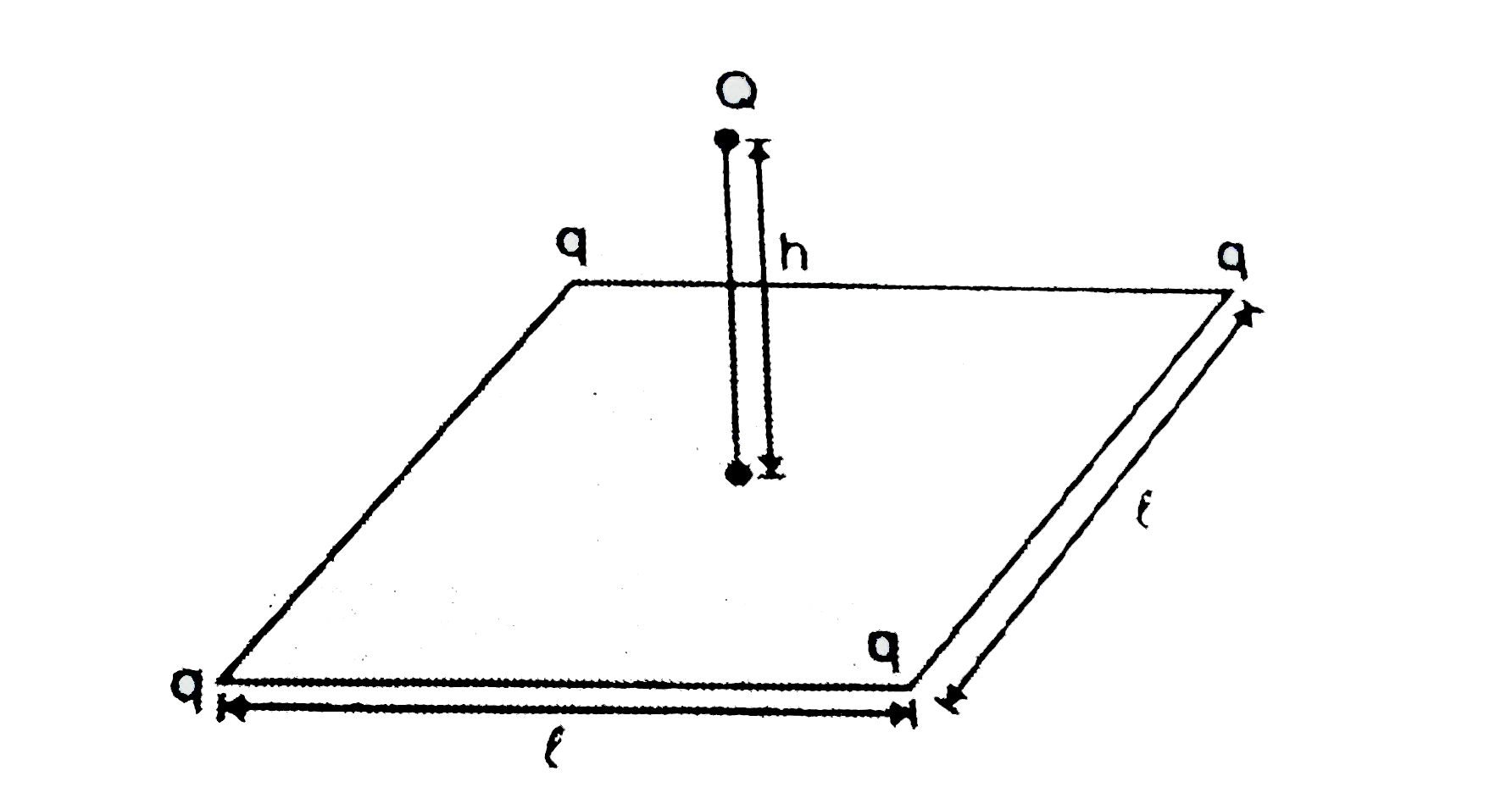
find out mass of the charge Q, so that it remains in equilibrium for the given configuration.

Text Solution

Verified by Experts
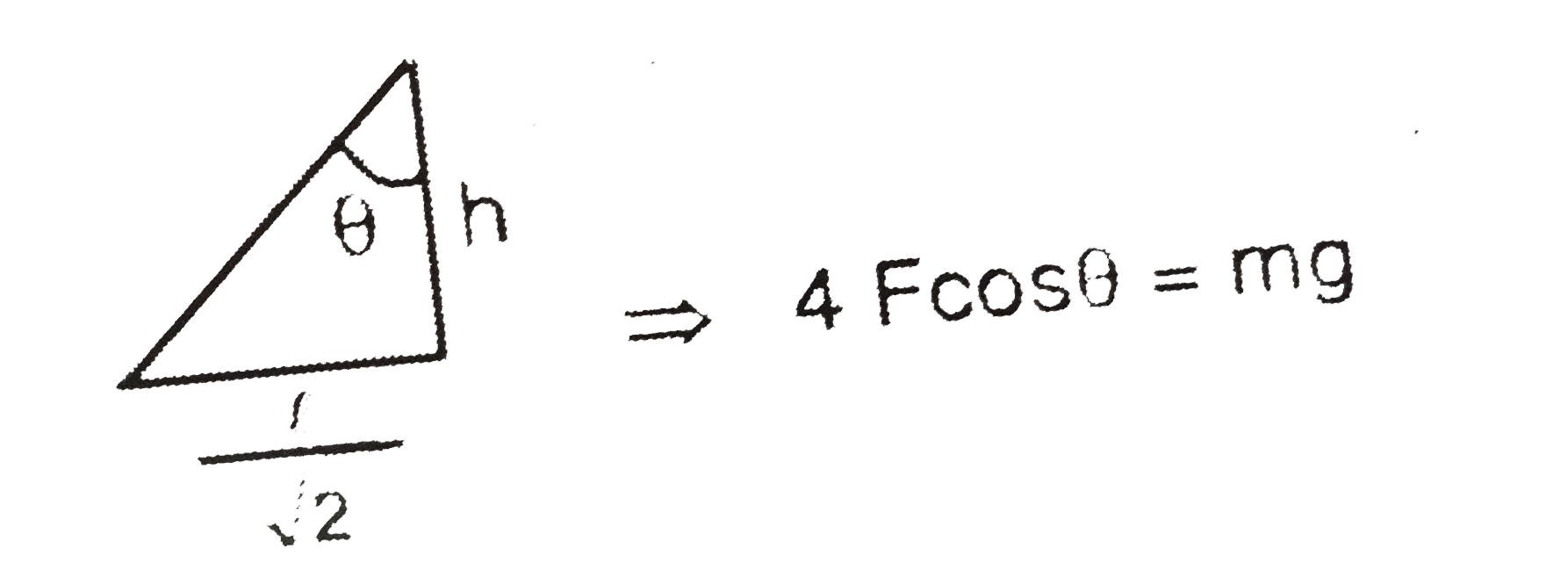

`implies 4 F cos theta = mg`
`implies 4xx(KQq)/((l^(2)/2+h^(2))^(3//2))h=mg" ":. m=(4KQqh)/(g (l^(2)/2+h^(2))^(3//2))`
Promotional Banner

Topper's Solved these Questions

  • ELECTROSTATICS

    RESONANCE|Exercise Problems|22 Videos
  • ELECTROSTATICS

    RESONANCE|Exercise Exercise-1 Section (A)|9 Videos
  • ELECTROMAGNETIC INDUCTION

    RESONANCE|Exercise A.l.P|19 Videos
  • EXPERIMENTAL PHYSICS

    RESONANCE|Exercise PART -II|10 Videos

Similar Questions

Explore conceptually related problems

Find the current in the conductor PQ so that it remains in equilibrium under its own weight and the magnetic force. If direction of current is reversed then what would be initial acceleration of the rod? Mass of the rod is m. (Friction is assumed to be absent)

If a charge q is placed at the centre of the line joining two equal charges Q such that the system is in equilibrium then the value of q is

(a) Derive and expression for the electric field at any point on the equatorial line of an electric dipole. (b) Two identical point charges, q each kept 2m apart in air. A third point charge Q of unknown magnitude and sign is placed on the line joining the charges such that the system remains in equilibrium. Find the position and nature of Q.

Two point charges of +q each are placed at two diagonally opposite corners of a square. Another two point charges of -q charge each are placed at the two remaining corners. Take the edge length of square equal to l. Calculate (i) work needed to move these charges slowly from an infinite separation to this given configuration. (ii) Assume that four charges at corners of the square are held fixed. Another charge Q is to be moved from infinity to the centre of this square slowly. What additional work is required to do so?

Four charges equal to -Q are placed at the four corners of a square and a charge q is at its centre. If the system is in equilibrium the value of q is

Four charges equal to -Q are placed at the four corners fo a square and a charge q is at its centre, If the system is in equilibrium the value of q si

(a) Two point charges Q and 16 Q are fixed at separation d . Where should a third point charge be placed between them so that it experiences no force I.e. in equilibrium ? (b) In the previous problem , if we replace Q by - Q , where should the third charge be placed on the joining the charges so that it is equilibrium ? (c ) Three point charges Q , q and Q are placed at x = 0 , x = d//2 and x = d . Find q in terms of Q so that all charges are in equilibrium. (d) Two point charges 9 Q and 25 Q are placed at separation d . Where should a third charge q be placed between them so that all charges are in equilibrium ? Also find the value of q and its nature.

Two point charges +4q and +q are placed at a distance L apart. A third charge Q is so placed that all the three charges are in equilibrium. Then location. And magnitude of the third charge will be

RESONANCE-ELECTROSTATICS-HLP
  1. find out mass of the charge Q, so that it remains in equilibrium for t...

    Text Solution

    |

  2. An electrometer consister of a fixed vertical metal bar OB at the top ...

    Text Solution

    |

  3. A uniform rod AB of mass m and length l is hinged at its mid point C. ...

    Text Solution

    |

  4. (i) Three equak charge q(0) each are placed at three corners of an equ...

    Text Solution

    |

  5. A solid of radius 'R' is uniformly charged with charge density rho in ...

    Text Solution

    |

  6. A uniform surface charge of density sigma is given to a quarter of a d...

    Text Solution

    |

  7. Figure shows a rod of length L which is uniformly charged with linear ...

    Text Solution

    |

  8. A charged ball of mass 5.88xx10^(-4) kg is suspended from two silk str...

    Text Solution

    |

  9. A charge of 16xx10^(-9) C is fixed at the origin of coordinates. A sec...

    Text Solution

    |

  10. Two large conducting plates are placed parallel to each other with a ...

    Text Solution

    |

  11. A ball of mass 10^(-2) kg and having charge + 3 xx 10^(-6)C is tied at...

    Text Solution

    |

  12. A system consits fo a thin charged wire ring of radius R and a very ...

    Text Solution

    |

  13. A thin nonconducting ring of radius R has a linear charge density ...

    Text Solution

    |

  14. Two point charges q and -q are separated by the distance 2l. Find the...

    Text Solution

    |

  15. A system consists of a ball of radius R carrying a uniformly distribut...

    Text Solution

    |

  16. Find the electric field potentail and strength at the centre of a hem...

    Text Solution

    |

  17. A non-conducting disc of radius a and uniform positive surface charge ...

    Text Solution

    |

  18. The potential difference between two large parallel plates is varied a...

    Text Solution

    |

  19. Four point charges +8muC,-1muC,-1muC and , +8muC are fixed at the poin...

    Text Solution

    |

  20. A small ball of mass 2 xx 10^-3 kg, having a charge 1 mu C, is suspend...

    Text Solution

    |

  21. Three point charges q, 2q and 8q are to be placed on a . 9cm long st...

    Text Solution

    |