Home
Class 12
PHYSICS
If an isolated infinite plate contains a...

If an isolated infinite plate contains a charge `Q_1` on one of its surfaces and a charge `Q_2` on its other surface, then prove that electric field intensity at a point in front of the plate will be `Q//2Aepsilon_0`, where `Q = Q_1+Q_2`

Text Solution

Verified by Experts
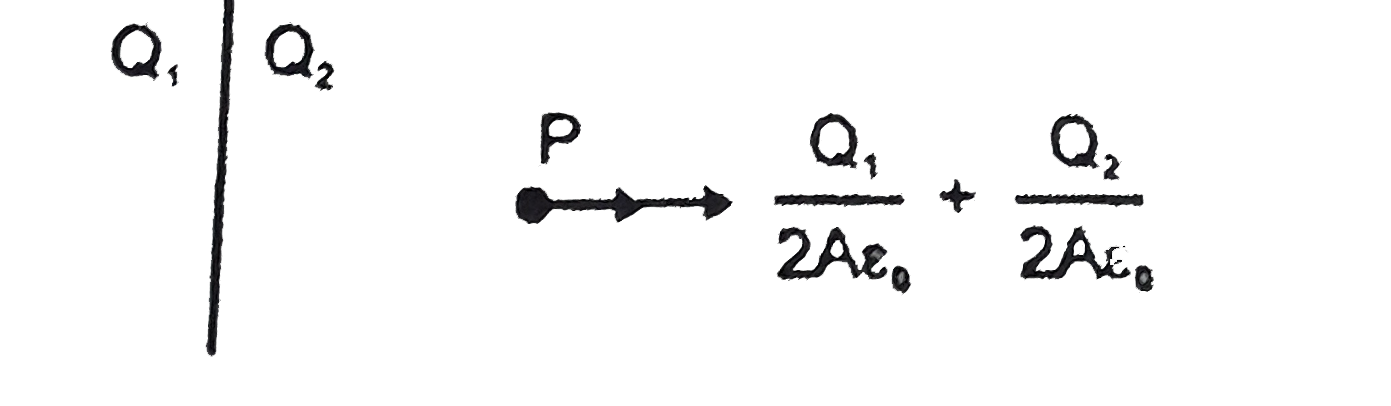
Electric field at point P : `vec(E) =vec(E)_(Q_(1))+vec(E)_(Q_(2))=Q_(1)/(2A epsi_(0)) hat(n)+Q_(2)/(2A epsi_(0)) hat(n)=(Q_(1)+Q_(2))/(2Aepsi_(0)) hat(n)==Q/(2Aepsi_(0)) hat(n)`

[This shows that the resultant field due to a sheet depends only on the tota, charge of the sheet and not on the distribution of charge on individual surfaces.]
Promotional Banner

Topper's Solved these Questions

  • ELECTROSTATICS

    RESONANCE|Exercise Problems|22 Videos
  • ELECTROSTATICS

    RESONANCE|Exercise Exercise-1 Section (A)|9 Videos
  • ELECTROMAGNETIC INDUCTION

    RESONANCE|Exercise A.l.P|19 Videos
  • EXPERIMENTAL PHYSICS

    RESONANCE|Exercise PART -II|10 Videos

Similar Questions

Explore conceptually related problems

If an isollated infinite sheet contains charge Q_(1) on its one surface and charge Q_(2) on its other surface, then prove that electric field intensity at a point in front of sheet will be Q/(2A epsi_(0)) , where Q=Q_(1)+Q_(2)

If q is the charge per unit area on the surface of a conductor, then the electric field intensity at a point on the surface is

Charge 2Q and -Q are placed as shown in figure. The point at which electric field intensity is zero will be somewhere

Suppose a charge +Q_1 is given to the positive plates and a charge -Q_2 to the nagative plate of a capatitor. What is the "charge on the capatitor"?

A charge Q is enclosed by a Gaussian surface. If surface area is doubled and charge Q is tripled then the outward electric flux will

In a parallel plate capacitor with plate area A and charge Q, the force on one plate because of the charge on the other is equal to

In an isolated parallel plate capacitor of capacitance C the four surfaces have charges Q_(1), Q_(2), Q_(3) and Q_(4) as shown in the figure. The potential difference between the plates is :

The ratio of charge on left surface of plate A to the charge on the right surface of plate B is +Q +3Q -20 (A) (B) (C)

RESONANCE-ELECTROSTATICS-HLP
  1. If an isolated infinite plate contains a charge Q1 on one of its surfa...

    Text Solution

    |

  2. An electrometer consister of a fixed vertical metal bar OB at the top ...

    Text Solution

    |

  3. A uniform rod AB of mass m and length l is hinged at its mid point C. ...

    Text Solution

    |

  4. (i) Three equak charge q(0) each are placed at three corners of an equ...

    Text Solution

    |

  5. A solid of radius 'R' is uniformly charged with charge density rho in ...

    Text Solution

    |

  6. A uniform surface charge of density sigma is given to a quarter of a d...

    Text Solution

    |

  7. Figure shows a rod of length L which is uniformly charged with linear ...

    Text Solution

    |

  8. A charged ball of mass 5.88xx10^(-4) kg is suspended from two silk str...

    Text Solution

    |

  9. A charge of 16xx10^(-9) C is fixed at the origin of coordinates. A sec...

    Text Solution

    |

  10. Two large conducting plates are placed parallel to each other with a ...

    Text Solution

    |

  11. A ball of mass 10^(-2) kg and having charge + 3 xx 10^(-6)C is tied at...

    Text Solution

    |

  12. A system consits fo a thin charged wire ring of radius R and a very ...

    Text Solution

    |

  13. A thin nonconducting ring of radius R has a linear charge density ...

    Text Solution

    |

  14. Two point charges q and -q are separated by the distance 2l. Find the...

    Text Solution

    |

  15. A system consists of a ball of radius R carrying a uniformly distribut...

    Text Solution

    |

  16. Find the electric field potentail and strength at the centre of a hem...

    Text Solution

    |

  17. A non-conducting disc of radius a and uniform positive surface charge ...

    Text Solution

    |

  18. The potential difference between two large parallel plates is varied a...

    Text Solution

    |

  19. Four point charges +8muC,-1muC,-1muC and , +8muC are fixed at the poin...

    Text Solution

    |

  20. A small ball of mass 2 xx 10^-3 kg, having a charge 1 mu C, is suspend...

    Text Solution

    |

  21. Three point charges q, 2q and 8q are to be placed on a . 9cm long st...

    Text Solution

    |

