Home
Class 12
PHYSICS
Two hollow concentric non-conducting sph...

Two hollow concentric non-conducting spheres of radius the a and `b (a gt b)` contain charges `Q_(a)` and `Q_(b)` respectively. Prove that potential difference between the two spheres is independent of charge on outer sphere. If outer sphere is given an extra charge, is there any change in potential difference ?

Text Solution

Verified by Experts
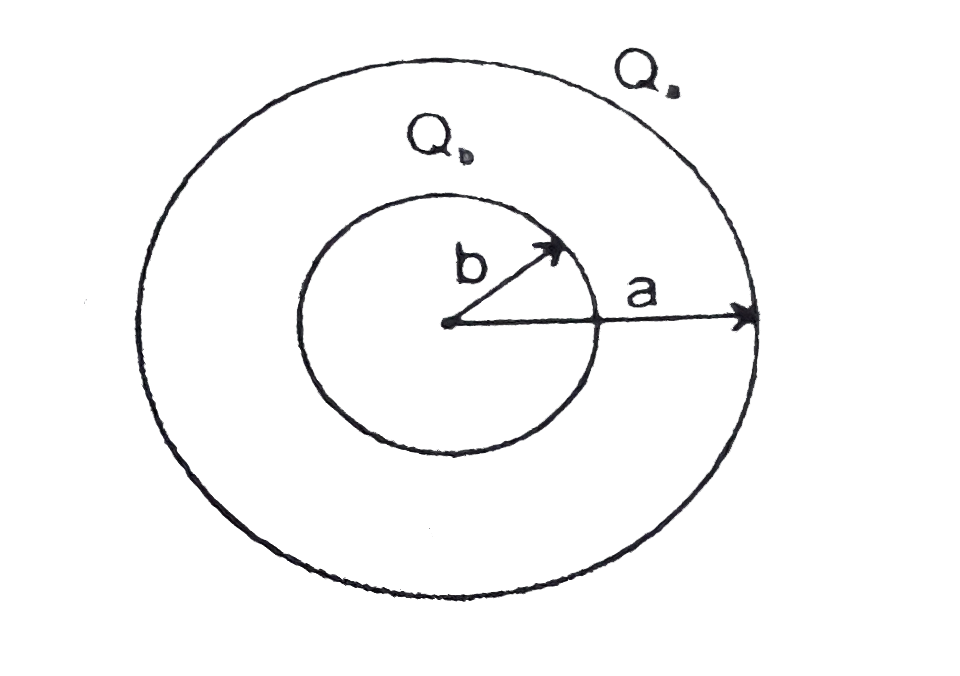
`V_("inner sphere")=(KQ_(b))/b+(KQ_(a))/a`
`V_("outer sphere")=(KQ_(b))/a+(KQ_(a))/a`
`V_("inner sphere")-V_("outer sphere")=(KQ_(b))/b-(KQ_(b))/a`
`:. DeltaV=KQ_(b)[1/b-1/a]`
Which is independent of charge on outer sphere. If outer sphere in given any extra charge, then there will be no change in potential difference.
Promotional Banner

Topper's Solved these Questions

  • ELECTROSTATICS

    RESONANCE|Exercise Problems|22 Videos
  • ELECTROSTATICS

    RESONANCE|Exercise Exercise-1 Section (A)|9 Videos
  • ELECTROMAGNETIC INDUCTION

    RESONANCE|Exercise A.l.P|19 Videos
  • EXPERIMENTAL PHYSICS

    RESONANCE|Exercise PART -II|10 Videos

Similar Questions

Explore conceptually related problems

Two concentric conducting spheres of radii R and 2R are crrying charges Q and -2Q , respectively. If the charge on inner sphere is doubled, the potetial differece between the two spheres will

Two concentric conducting spheres of radii R and 3R carrying charges Q and 2Q respectively.If the charge on inner sphere is doubled.The potential difference between inner and outer spheres will..?

Consider two concentric metal spheres. The outer sphere is given a charge Qgt0 , then ,

There are three conecentric hollow spheres of radii a, b and c and they are charged with charges q_(1),q_(2) and q_(3) respectively. Calculate the potential of the spheres.

A solid conducting sphere, having a charge Q, is surrounded by an uncharged conducting hollow spherical shell. Let the potential difference between the surface of the solid sphere and that of the outer surface of the hollow shell be V. If the shell is now given a charge of -4 Q, the new potential difference between the same two surfaces

A and B are two thin concentric hollow conductors having radii a and 2a and charge 2Q and Q, respectively. If potential of outer sphere is 5V, then potential of inner sphere is

A solid conducting sphere having a charge Q is surrounded by an uncharged concentric conducting hollow spherical shell. Let the potential difference between the surface of the solid sphere and that of the outer surface of the hollow shell be V. If the shell is now given a charge of -3Q , the new potential difference between the same two surfaces is :

A and B are two hollow, concentric, conducting spheres, with A inside B . A and B are given Q_(1) and Q_(2) respectively. If they are now joined by a thin wire, whtat charge will flow from A to B ?

A conducting sphere is enclosed by a hollow conducting shell. Initially the inner sphere has a charge Q while the outer one is uncharged. The potential difference between the two spherical surface is found to be V. later on the outer shell is given a charge -4Q. The new potential difference between the two surfaces is : (A) V (B) -V (C) -2V (D) 2V

RESONANCE-ELECTROSTATICS-HLP
  1. Two hollow concentric non-conducting spheres of radius the a and b (a ...

    Text Solution

    |

  2. An electrometer consister of a fixed vertical metal bar OB at the top ...

    Text Solution

    |

  3. A uniform rod AB of mass m and length l is hinged at its mid point C. ...

    Text Solution

    |

  4. (i) Three equak charge q(0) each are placed at three corners of an equ...

    Text Solution

    |

  5. A solid of radius 'R' is uniformly charged with charge density rho in ...

    Text Solution

    |

  6. A uniform surface charge of density sigma is given to a quarter of a d...

    Text Solution

    |

  7. Figure shows a rod of length L which is uniformly charged with linear ...

    Text Solution

    |

  8. A charged ball of mass 5.88xx10^(-4) kg is suspended from two silk str...

    Text Solution

    |

  9. A charge of 16xx10^(-9) C is fixed at the origin of coordinates. A sec...

    Text Solution

    |

  10. Two large conducting plates are placed parallel to each other with a ...

    Text Solution

    |

  11. A ball of mass 10^(-2) kg and having charge + 3 xx 10^(-6)C is tied at...

    Text Solution

    |

  12. A system consits fo a thin charged wire ring of radius R and a very ...

    Text Solution

    |

  13. A thin nonconducting ring of radius R has a linear charge density ...

    Text Solution

    |

  14. Two point charges q and -q are separated by the distance 2l. Find the...

    Text Solution

    |

  15. A system consists of a ball of radius R carrying a uniformly distribut...

    Text Solution

    |

  16. Find the electric field potentail and strength at the centre of a hem...

    Text Solution

    |

  17. A non-conducting disc of radius a and uniform positive surface charge ...

    Text Solution

    |

  18. The potential difference between two large parallel plates is varied a...

    Text Solution

    |

  19. Four point charges +8muC,-1muC,-1muC and , +8muC are fixed at the poin...

    Text Solution

    |

  20. A small ball of mass 2 xx 10^-3 kg, having a charge 1 mu C, is suspend...

    Text Solution

    |

  21. Three point charges q, 2q and 8q are to be placed on a . 9cm long st...

    Text Solution

    |

