Home
Class 12
PHYSICS
A particle of mass m and charge q is loc...

A particle of mass m and charge q is located midway between two fixed charged particles each having a charge q and a distance 2l apart. Prove that the motion of the particle will be SHM if it is displaced slightly along the line connecting them and released. Also find its time period.

Text Solution

Verified by Experts
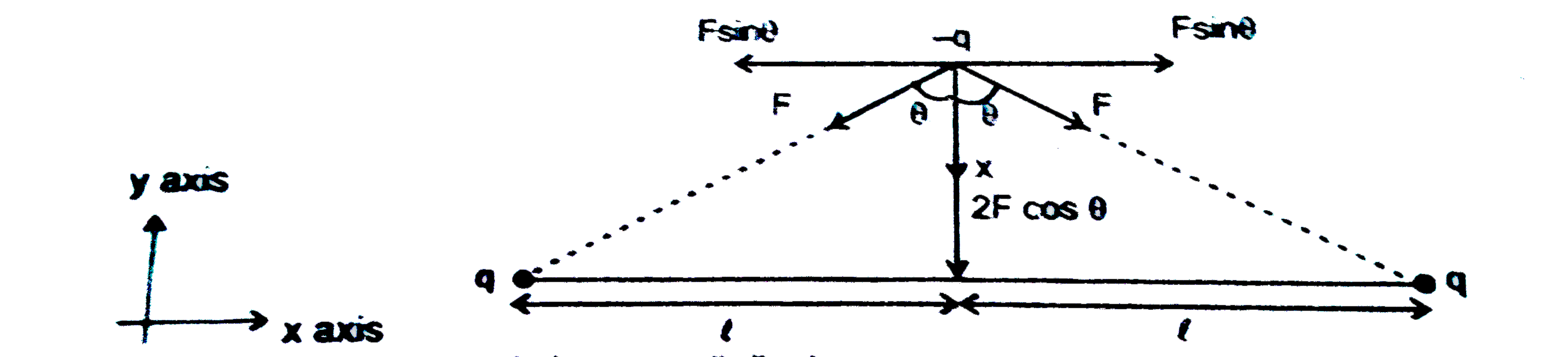
Let x-y direction is taken as :

Particle is shifted along y-axis by a small displacement x.
After resolving component of forces between q and -q charges :
By figure. `F_("net")` in x-axis =0 [`F_("net")=` net force on -q charge]
Net force on -q charge in y direction `=-2F cos theta=-2. (kq q)/((x^(2)+l^(2))). x/((x^(2)+l^(2))^(1//2))`
`|vec(F)|=(2Kq^(2)x)/((x^(2)+l^(2))^(3//2))" "implies" "ma=(2Kq^(2)x)/l^(3)" "("for "x lt lt l)` (a=acceleration of -q charge)
`implies a=(2Kq^(2))/(ml^(2)). x ("downwards")`
This is equation of S.H.M. `(a=-omega^(2) x)`
So, time period of this charge (-q) :
`T=2pi sqrt((ml^(3))/(2Kq^(2)))`
Promotional Banner

Topper's Solved these Questions

  • ELECTROSTATICS

    RESONANCE|Exercise Exercise-1 Section (A)|9 Videos
  • ELECTROSTATICS

    RESONANCE|Exercise Exercise-1 Section (B)|12 Videos
  • ELECTROSTATICS

    RESONANCE|Exercise HLP|39 Videos
  • ELECTROMAGNETIC INDUCTION

    RESONANCE|Exercise A.l.P|19 Videos
  • EXPERIMENTAL PHYSICS

    RESONANCE|Exercise PART -II|10 Videos

Similar Questions

Explore conceptually related problems

A particle of mass m and charge +q is located midway between two fixed charged particles each having a charge +q and at a distance 2L apart. Assuming that the middle charge moves along the line joining the fixed charges, calculate the frequency of oscillation when it is displaced slightly.

Two infinitely long line charges having charge density lamda each are parallel to each other and separated by distance d. A charge particle of mass m and charge q is placed at mid point between them. This charge displaced slightly along a line AB which is perpendicular to the line charges and in the plane of the charges. prove that the motion of the particle will be SHM for small displacement and lamda q gt 0 Neglect gravity. Find the time period.

A particle of mass m and charge q is placed at rest in a uniform electric field E and then released, the kinetic energy attained by the particle after moving a distance y will be

Two points charges , each Q , are fixed at separation 2d . A charged particle having charge q and mass m is placed between them. (a) Now this charged particle is slightly displaced along the line joining the charges , slow that it will execute simple harmonic motion and find the time period of oscillation. (b) If charge q is negative and it is displaced slightly perpendicular to the line joining the charges , repeat the part (a) .

Two positively charged particles each having charge Q and are d distance apart. A third charge is introduced in midway on the line joining the two charges. Find the nature and magnitude of third charge so that the system is in equilibrium.

A particle of mass m and charge -q moves along a diameter of a uniformluy charged sphere of radinus R and carrying a total charge +Q . Find the frequency of S.H.M. of the particle if the amplitude does not exceed .

As shown in the adjoining figure two charge particles each having charge q and mass m and d distance apart from each other. If two particle in equilibrium under the gravitational and electric force, then determine the ratio q//m .

A particle of mass m carrying a charge -q_(1) starts moving around a fixed charge +q_(2) along a circulare path of radius r. Find the time period of revolution T of charge -q_(1) .

RESONANCE-ELECTROSTATICS-Problems
  1. Two equal positive point charges 'Q' are fixed at points B (a, 0) and ...

    Text Solution

    |

  2. A particle of mass m and charge q is located midway between two fixed ...

    Text Solution

    |

  3. A charges Q is placed at each of the two opposite corners of a square....

    Text Solution

    |

  4. An infinitely large non-conducting sheet of thickness t and uniform vo...

    Text Solution

    |

  5. Figure shows a uniformly charged thin non-conducting sphere of total c...

    Text Solution

    |

  6. Figure shows two concentric spheres of radii R(1) and R(2) (R(2) gt R(...

    Text Solution

    |

  7. A solid non conducting sphere of radius R and uniform volume density r...

    Text Solution

    |

  8. Three identical spheres, each having a charge q and radius R. are kept...

    Text Solution

    |

  9. A uniform electric field of 20 N/C exists in the vertically downward d...

    Text Solution

    |

  10. An electric field of 10 N/C exists along the x-axis in space. Calculat...

    Text Solution

    |

  11. Some equi-potential surfaces are shown in figure. What can you say abo...

    Text Solution

    |

  12. A point charge of charge -q and mass m is released with negligible spe...

    Text Solution

    |

  13. Four small point charges (each of equal magnitude q) are placed at fou...

    Text Solution

    |

  14. If V=x^(2)y+y^(2)z then find vec(E) at (x, y, z)

    Text Solution

    |

  15. Magnitude of electric field only on the x-coordinate as vec(E)=20/x^(2...

    Text Solution

    |

  16. If E=2r^(2) then find V(r)

    Text Solution

    |

  17. A charge Q is uniformly distributed over a rod of length l. Consider a...

    Text Solution

    |

  18. A charge Q is placed at the centre of a cube. Find the flux of the ele...

    Text Solution

    |

  19. An isolated conducting sphere of charge Q and radius R is grounded by ...

    Text Solution

    |

  20. An isolated conducting sheet of area A and carrying a charge Q is plac...

    Text Solution

    |

