Home
Class 12
PHYSICS
An electric field of 10 N/C exists along...

An electric field of 10 N/C exists along the x-axis in space. Calculate the potential difference `V_(B)-V_(A)` where the points A and B are given by -
(a) A = (0, 0), B = (8m, 3m), (b) A = (8m, 3m) , B = (12m, 6m)
(c) A = (0, 0) , B = (12m, 6m)

Text Solution

Verified by Experts
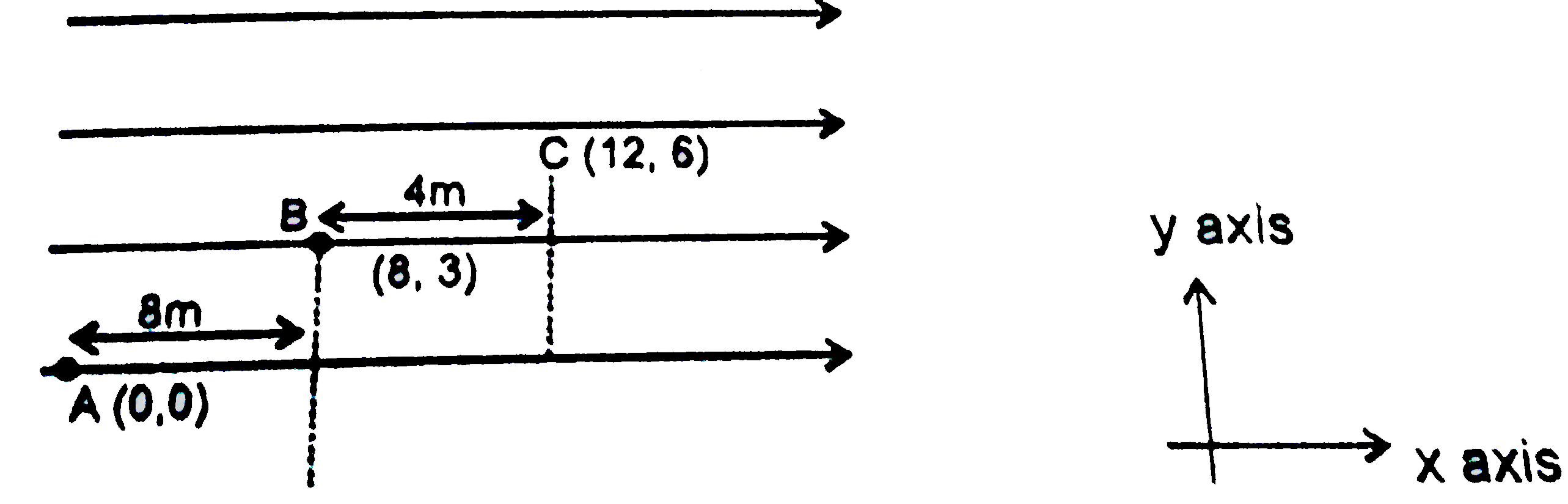
Electric field in x- axis means `vec(E)=10 hat(i)`

`{:((a),|DeltaV_(AB)|=vec(E).vec(d)=10 hat(i). 8hat(i)=80 V,implies,V_(B)-V_(A)=-80 V),((b),|DeltaV_(BC)|=vec(E).vec(d)=10 hat(i). 4hat(i)=40" volt",implies,V_(C)-V_(B)=-40 V),((c),|DeltaV_(AC)|=vec(E).vec(d)=10 hat(i). 12 aht(i)=120" volt",implies,V_(C)-V_(A)=-120 V):}`
Promotional Banner

Topper's Solved these Questions

  • ELECTROSTATICS

    RESONANCE|Exercise Exercise-1 Section (A)|9 Videos
  • ELECTROSTATICS

    RESONANCE|Exercise Exercise-1 Section (B)|12 Videos
  • ELECTROSTATICS

    RESONANCE|Exercise HLP|39 Videos
  • ELECTROMAGNETIC INDUCTION

    RESONANCE|Exercise A.l.P|19 Videos
  • EXPERIMENTAL PHYSICS

    RESONANCE|Exercise PART -II|10 Videos

Similar Questions

Explore conceptually related problems

An electric field of 20 N/C exists along the negative x-axis in space. Calculate the potential difference V_(B)-V_(A) , where the points A and B are given by : (a) A= (0, 0), B=(0, 4m) (b) A=(2m, 1m), B=(4m, 3m)

An electric field of 20 N//C exists along the x-axis in space. Calculate the potential difference V_B - V_A where the points A and B are given by a. A=(0,0), B=(4m, 2m) b. A=(4m,2m),B=(6m,5m)

A uniform electric field of 30NC^(-1) exists along the X-axis calculate the potential difference V_(B)-V_(A) between the points A (4m,2m) and B(10m,5m).

A uniform electric field is along x-axis. The potential difference V_(A)-V_(B)=10 V is between two points A (2m, 3m) and (4m, 8m). Find the electric field intensity.

The electric field in a certain region is given by E=5 hat(i)-3hat(j) kv//m . The potential difference V_(B)-V_(A) between points a and B having coordinates (4, 0, 3) m and (10, 3, 0) m respectively, is equal to

Potential difference between two points (V_(A) - V_(B)) in an electric field E = (2 hat(i) - 4 hat(j)) N//C , where A = (0, 0) and B = (3m, 4m) is

A uniform electric field is present in the positive x - direction. If the intensity of the field is 5 NC^-1 then find the potential difference (V_B - V_A) between two points A (0 m, 2 m) and B (5 m, 3 m).

The electric field in a certain region is given by E=(5hati-3hatj)kV//m . Find the difference in potential V_B-V_A . If A is at the origin and point B is at a. (0,0,5)m, b. (4,0,3) m.

RESONANCE-ELECTROSTATICS-Problems
  1. A charges Q is placed at each of the two opposite corners of a square....

    Text Solution

    |

  2. An infinitely large non-conducting sheet of thickness t and uniform vo...

    Text Solution

    |

  3. Figure shows a uniformly charged thin non-conducting sphere of total c...

    Text Solution

    |

  4. Figure shows two concentric spheres of radii R(1) and R(2) (R(2) gt R(...

    Text Solution

    |

  5. A solid non conducting sphere of radius R and uniform volume density r...

    Text Solution

    |

  6. Three identical spheres, each having a charge q and radius R. are kept...

    Text Solution

    |

  7. A uniform electric field of 20 N/C exists in the vertically downward d...

    Text Solution

    |

  8. An electric field of 10 N/C exists along the x-axis in space. Calculat...

    Text Solution

    |

  9. Some equi-potential surfaces are shown in figure. What can you say abo...

    Text Solution

    |

  10. A point charge of charge -q and mass m is released with negligible spe...

    Text Solution

    |

  11. Four small point charges (each of equal magnitude q) are placed at fou...

    Text Solution

    |

  12. If V=x^(2)y+y^(2)z then find vec(E) at (x, y, z)

    Text Solution

    |

  13. Magnitude of electric field only on the x-coordinate as vec(E)=20/x^(2...

    Text Solution

    |

  14. If E=2r^(2) then find V(r)

    Text Solution

    |

  15. A charge Q is uniformly distributed over a rod of length l. Consider a...

    Text Solution

    |

  16. A charge Q is placed at the centre of a cube. Find the flux of the ele...

    Text Solution

    |

  17. An isolated conducting sphere of charge Q and radius R is grounded by ...

    Text Solution

    |

  18. An isolated conducting sheet of area A and carrying a charge Q is plac...

    Text Solution

    |

  19. Two uncharged and parallel conducting sheets, each of area A are place...

    Text Solution

    |

  20. A positive charge q is placed in front of conducting solid cube at a d...

    Text Solution

    |

