Home
Class 12
PHYSICS
Some equi-potential surfaces are shown i...

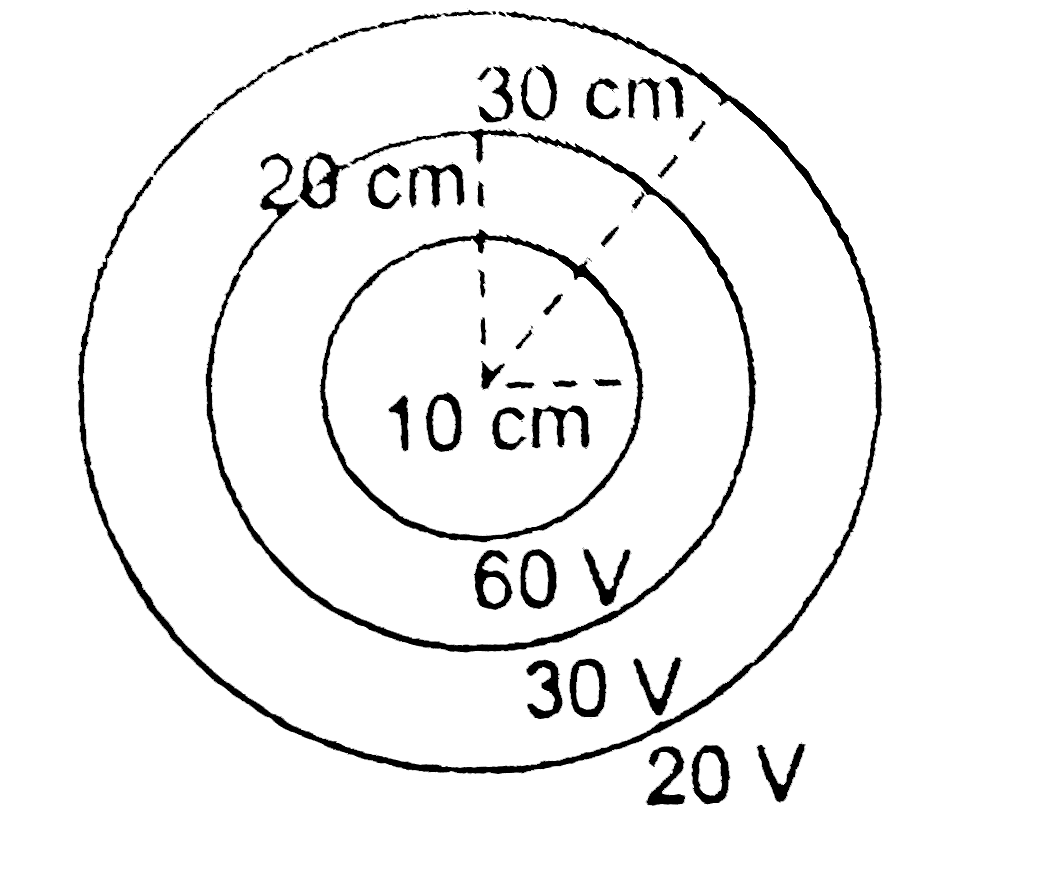
Some equi-potential surfaces are shown in figure. What can you say about the magnitude and the direction of the electric field ?

Text Solution

Verified by Experts
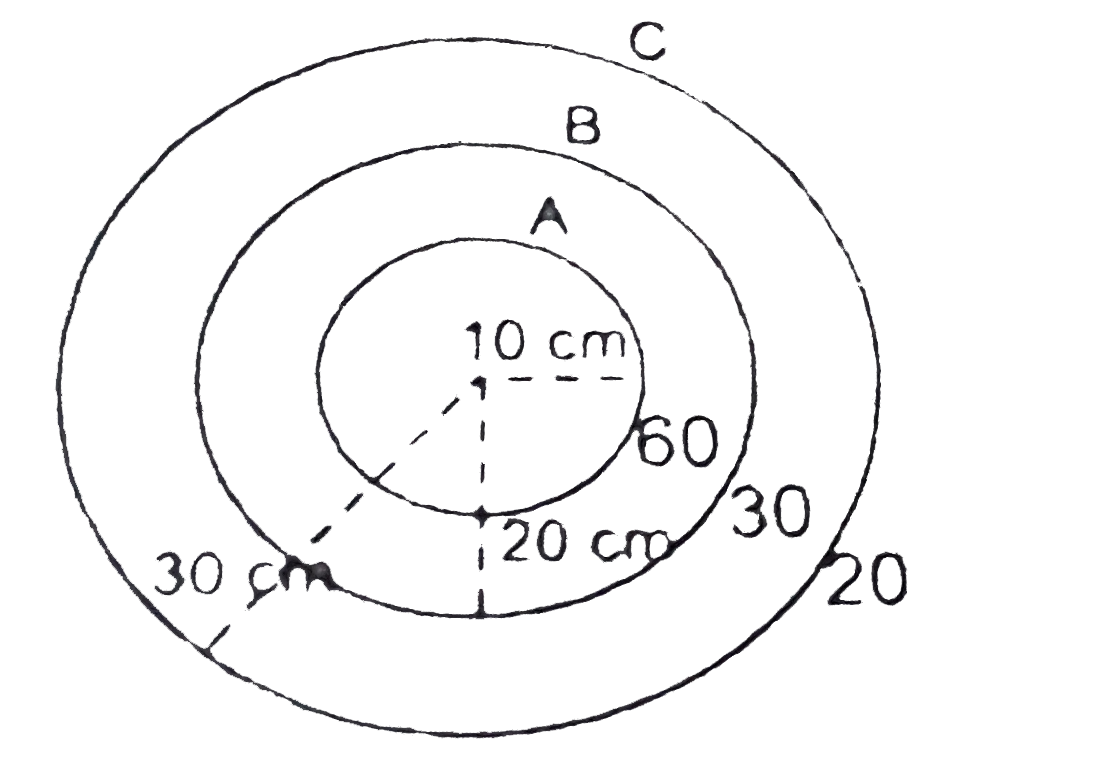
We know, that the electric field is always perpendicular to equipotential surfac. So, making electric field lines perpendicular to the surface, we find that these lines are originating from the centre. So, the field is similar to that due to a point charge placed at the centre. So, comparing the given potentials with that due to point charge, we have,
`V=(KQ)/r" "implies" "KQ=V_(A)r_(A)=V_(B)r_(B)=V_(C)r_(C)=6 V-m`
Hence, electric field at distance r can be given by
`E=(KQ)/r^(2)=6/r^(2) V//m`
As the electric field lines are directed towards the decreasing potential. So, electric field is along radially outward direction.
Promotional Banner

Topper's Solved these Questions

  • ELECTROSTATICS

    RESONANCE|Exercise Exercise-1 Section (A)|9 Videos
  • ELECTROSTATICS

    RESONANCE|Exercise Exercise-1 Section (B)|12 Videos
  • ELECTROSTATICS

    RESONANCE|Exercise HLP|39 Videos
  • ELECTROMAGNETIC INDUCTION

    RESONANCE|Exercise A.l.P|19 Videos
  • EXPERIMENTAL PHYSICS

    RESONANCE|Exercise PART -II|10 Videos

Similar Questions

Explore conceptually related problems

Some equipotential surfaces are shown in figure. What can you say about the magnitude and the direction of the electric field ?

Some equipotential surfaces are shown in figure .The electric filed strength is

For the given figure the direction of electric field at A will be

Some equipotential surfaces are shown in figure . The magnitude and direction of electric field is

Some equipotential surface are shown in the figure. Find the value of electric field :-

What can you say about the area of two congruent figures?

RESONANCE-ELECTROSTATICS-Problems
  1. A charges Q is placed at each of the two opposite corners of a square....

    Text Solution

    |

  2. An infinitely large non-conducting sheet of thickness t and uniform vo...

    Text Solution

    |

  3. Figure shows a uniformly charged thin non-conducting sphere of total c...

    Text Solution

    |

  4. Figure shows two concentric spheres of radii R(1) and R(2) (R(2) gt R(...

    Text Solution

    |

  5. A solid non conducting sphere of radius R and uniform volume density r...

    Text Solution

    |

  6. Three identical spheres, each having a charge q and radius R. are kept...

    Text Solution

    |

  7. A uniform electric field of 20 N/C exists in the vertically downward d...

    Text Solution

    |

  8. An electric field of 10 N/C exists along the x-axis in space. Calculat...

    Text Solution

    |

  9. Some equi-potential surfaces are shown in figure. What can you say abo...

    Text Solution

    |

  10. A point charge of charge -q and mass m is released with negligible spe...

    Text Solution

    |

  11. Four small point charges (each of equal magnitude q) are placed at fou...

    Text Solution

    |

  12. If V=x^(2)y+y^(2)z then find vec(E) at (x, y, z)

    Text Solution

    |

  13. Magnitude of electric field only on the x-coordinate as vec(E)=20/x^(2...

    Text Solution

    |

  14. If E=2r^(2) then find V(r)

    Text Solution

    |

  15. A charge Q is uniformly distributed over a rod of length l. Consider a...

    Text Solution

    |

  16. A charge Q is placed at the centre of a cube. Find the flux of the ele...

    Text Solution

    |

  17. An isolated conducting sphere of charge Q and radius R is grounded by ...

    Text Solution

    |

  18. An isolated conducting sheet of area A and carrying a charge Q is plac...

    Text Solution

    |

  19. Two uncharged and parallel conducting sheets, each of area A are place...

    Text Solution

    |

  20. A positive charge q is placed in front of conducting solid cube at a d...

    Text Solution

    |

