Home
Class 12
PHYSICS
A uniform electric field E=91xx10^(-6) V...

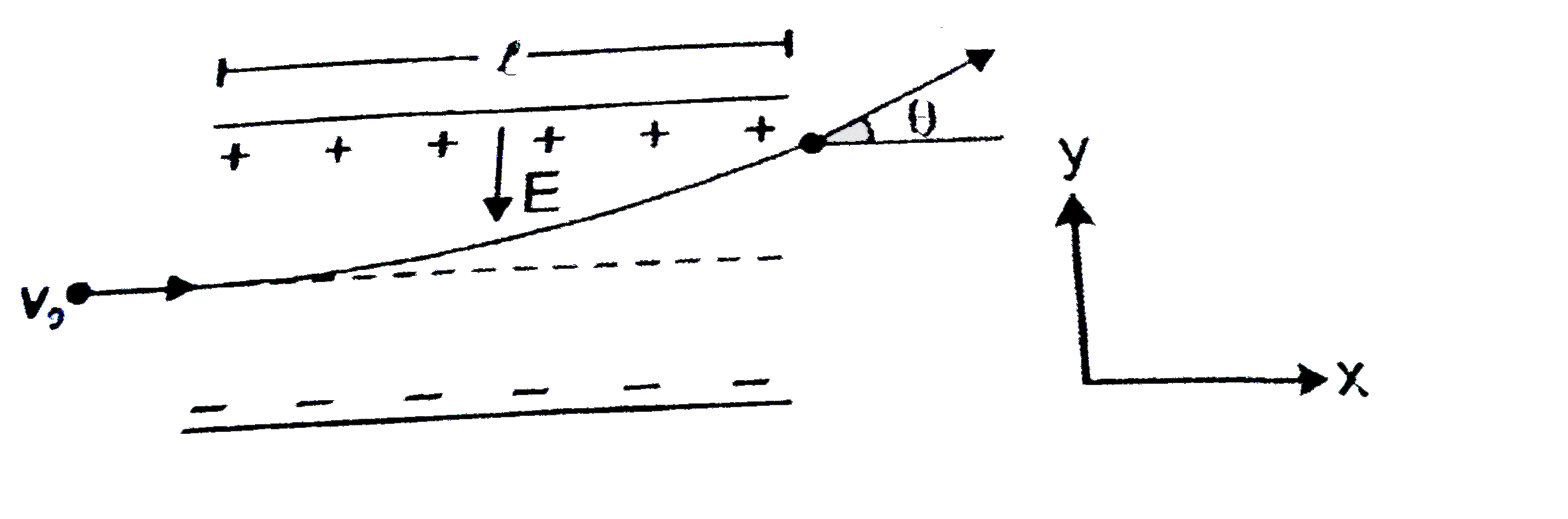
A uniform electric field `E=91xx10^(-6) V//m` is created between two parallel, charged plates as shown in figure. An electron enters the field symmetrically between the plates with a speed `v_(0)=4xx10^(3) m//s`. The length of each plates is `l=1m`. Find the angle of deviation of the path of the electron as it comes out of the field. (Mass of the electron is `m=9.1xx10^(-31) kg` and its charge is `e=-1.6xx10^(-19) C`).

Text Solution

Verified by Experts

The correct Answer is:

The electron deviates by an angle
`theta="tan"^(-1) (eEl)/(mv_(0)^(2))` (from x-axis)`=45^(º)`
Promotional Banner

Topper's Solved these Questions

  • ELECTROSTATICS

    RESONANCE|Exercise Exercise-1 Section (C)|14 Videos
  • ELECTROSTATICS

    RESONANCE|Exercise Exercise-1 Section (D)|5 Videos
  • ELECTROSTATICS

    RESONANCE|Exercise Exercise-1 Section (A)|9 Videos
  • ELECTROMAGNETIC INDUCTION

    RESONANCE|Exercise A.l.P|19 Videos
  • EXPERIMENTAL PHYSICS

    RESONANCE|Exercise PART -II|10 Videos

Similar Questions

Explore conceptually related problems

A uniform electric field E is created between two parallel ., charged plates as shown in figure . An electron . enters the field symmetrically between the plataes with a . speed v_0. The length of each plate is l. Find the angle of . deviation of the path of the electron as it comes out . of the field.

A uniform electric field E is established between two parallel charged plates as shown in figure. An electron enter the field symmetrically between the plates with a speed u. The length of each plate is l. if the electron does not stricke any of the plates, find the angle of deviation of the electron as it comes out of the field at the outer end of plates. [tan^(-1) ((eEl)/(mu^(2)))]

A uniform electric field 'E' exists between two parallel plates having opposite having opposite charge on each plates. An electron enters the field between the plates with speed v_0 as shown in the figure. If length of each plate is l then angle with which electron deviates from its initial path is (m is mass of electron ) (##AAK_TST_05_NEET_YEAR(19)_PHY_E05_133_Q01##)

An electron is moving with a velocity of 10^(7) m s^(-1) . Find its energy in electron volts. (Mass of electron =9.1xx10^(-31) kg and charge of electron =1.6xx10^(-19) C )

An electron is projected with an initial velocity of 10^(7)ms^(-1) into an electric field between two parallel plates 1 cm apart. The electron enters the field at a point midway between the plates. If the electron just misses the positivity charged plate as it emerges from the field, find the magnnitude of the electric density between the plates. (Length of each plate is 2 cm, mass of electron= 9xx10^(-31) kg and charge of electron =1.6xx10^(-19) C)

Calculate the speed of the electron in the first Bohr orbit given that h=6.6xx10^(-34) Js, m=9.11xx10^(-31) kg and e=1.603xx10^(-19) C .

The mass of an electron is 9.1xx10^(-31)kg . If its K.E. is 3.0xx10^(-25) J , calculate its wavelength

What is the uncertainty in velocity of an electron if the uncertainty in its position is 10^(-10) m ? Mass of the electron is 9.1 xx 10^(-31) kg and h = 6.6 xx 10^(-34) m^(2) s^(-1) ?
