Home
Class 12
PHYSICS
A charge +q is carried from point A( r, ...

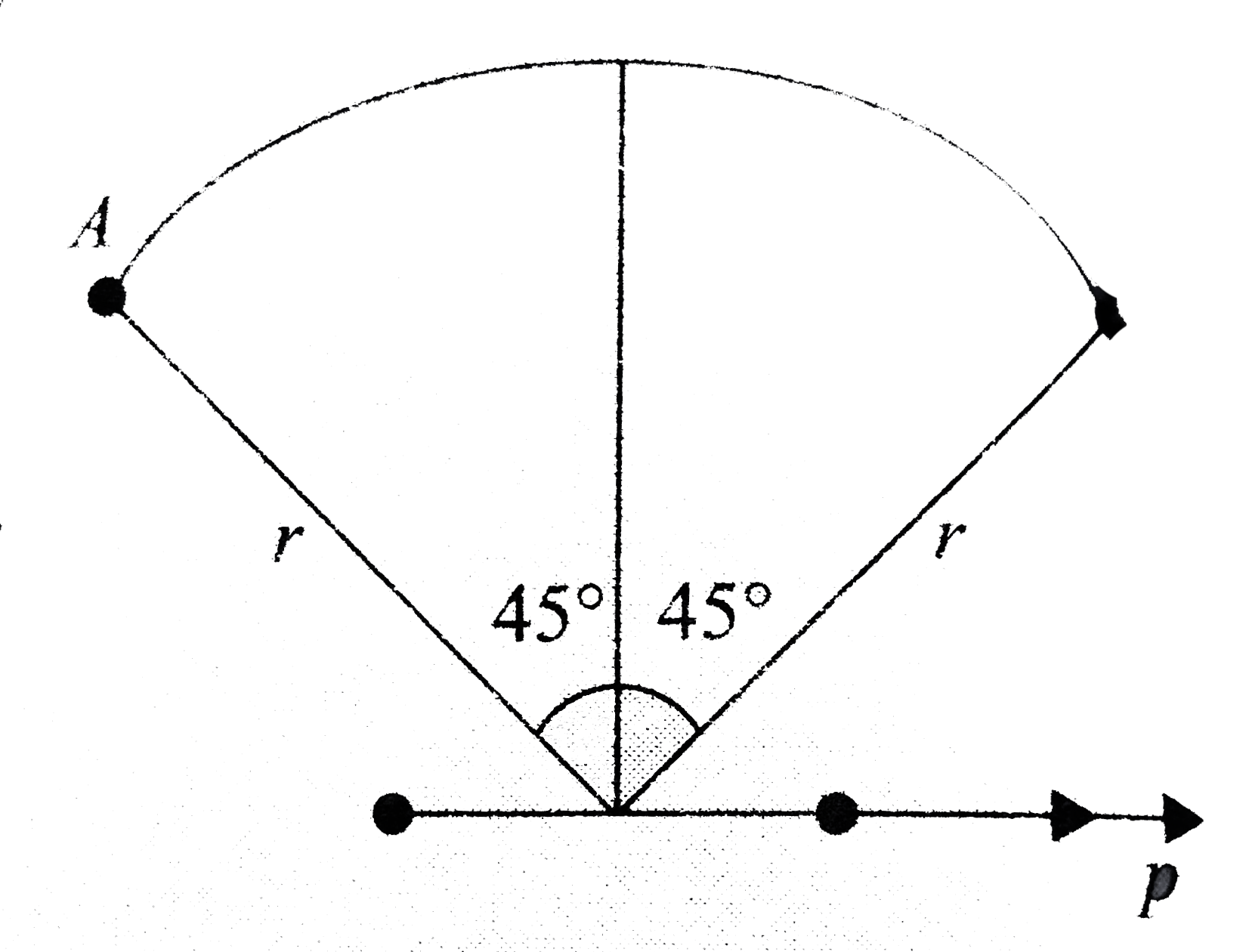
A charge +q is carried from point `A( r, 135^(@))` to point `B(r, 45^(@))` following a path, which is a quadrant of circle of radius r ( Fig. 3.97). If the dipole moment is P, find the work done by the external agent (assume short dipole).
.

Text Solution

Verified by Experts

The correct Answer is:

`(sqrt(2)qP)/(4 pi epsi_(0) r^(2))`
Promotional Banner

Topper's Solved these Questions

  • ELECTROSTATICS

    RESONANCE|Exercise Exercise-1 Section (I)|5 Videos
  • ELECTROSTATICS

    RESONANCE|Exercise Exercise-1 Section (J)|7 Videos
  • ELECTROSTATICS

    RESONANCE|Exercise Exercise-1 Section (G)|7 Videos
  • ELECTROMAGNETIC INDUCTION

    RESONANCE|Exercise A.l.P|19 Videos
  • EXPERIMENTAL PHYSICS

    RESONANCE|Exercise PART -II|10 Videos

Similar Questions

Explore conceptually related problems

A dipole of dipole moment P is kept at the centre of a ring of radius R and charge Q the dipole moment has direction along the ring due to the dipole is :

A charge q is moved from A to B in the region of a fixed ideal dipole p. Find the work done on the charge (Assume gravity free space ).

A charge q is moved from a point A above a dipole moment p to a point B below the dipole on equatorial plane without acceleration. Find the work done in the process.

The work done in carrying a charge q once round a circle of radius r with a charge Q at the centre is

There is a ball of radius r having uniformly distributed volume charge Q on it and there is a spherical shell of radius r having uniformly distributed surface charge Q on it. The two spheres are far apart. (a) A point charge q is moved slowly from the centre of the shell (through a small hole in it.) to the centre of the ball. Find work done by the external agent in the process. (b) The two spheres are brought closer so that their centers are separated by 4r. Now calculate the amount of work needed in slowly moving a point charge q from the centre of the shell to the centre of the ball. Assume that charge on one ball does not alter the charge distribution of the other. Does your answers in (a) and (b) differ? Why?

P Q R S is a rectangle inscribed in a quadrant of a circle of radius 13 c mdot A is any point on P Qdot If P S=5c m ,\ then find a r\ (\ R A S)
