

Home
Class 12
PHYSICS
Consider an equilateral triangle ABC of ...

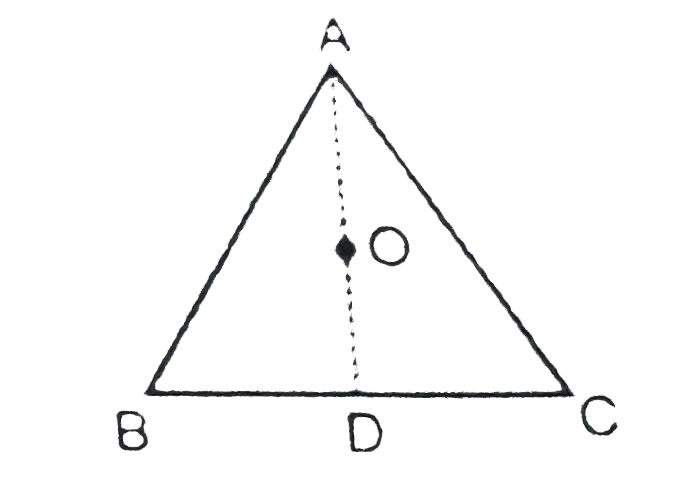
Consider an equilateral triangle ABC of side 2a in the plane of the paper as shown. The centroid of the triangle is O. Equal charges (Q) are fixed at the vertices A, B and C In what follows consider all motion and situations to be confined the plane of the paper.

(a) A test charge (q), of same sign as Q is placed on the median AD at a point at a distance `delta` below O. Obtain the force `(vec(F))` felt by the test charge.
(b) Assuming `delta lt lt a` discuss the motion of the test charge when it is released.
(c) Obtain the force `(vec(F)_(D))` on this test charge if it is placed at the point D as shown in the figure.
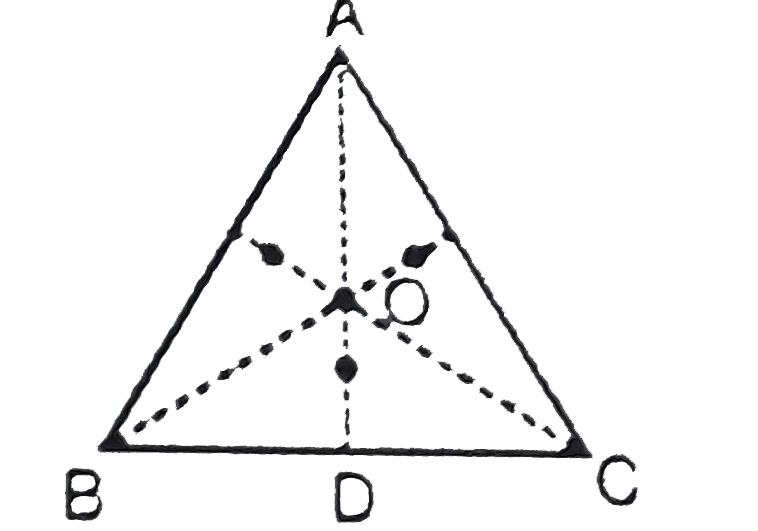
(d) In the figure below mark the approximate locations of the equilibrium point (s) for this system. Justify your answer.
(e) Is the equilibrium at O stable or unstable if we displace the test in the direction of OP ? The line PQ is parallel to the base BC. Justify your answer.
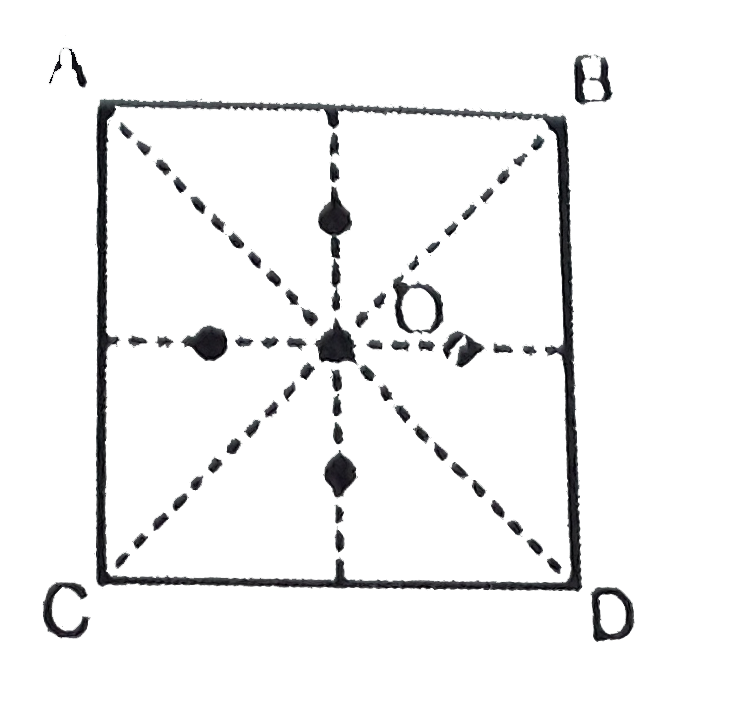
(f) Consider a rectangle ABCD. Equal charges are fixed at the vertices A, B, C and D. O is the centroid. In the figure below mark the approximate locations of all the neutral points of the system for a test charge with same sign as the charges on the vertices. Dotted lines are drawn for the reference.
(g) How many neutral points are possible for a system in which N charges are placed at the N vertices of a regular N sided polygon ?

Text Solution

Verified by Experts

(a) `vec(F)=(2KQq(a/sqrt(3)-delta))/((a^(2)+(a/sqrt(3)-delta)^(2))^(3//2))-(KQq)/(((2a)/sqrt(3)+delta))` Here `K=1//4 pi epsi_(0)` and direction is upward (towards A)
(b) Using binomial approximation, `vec(F)=KQq (9 sqrt(3))/16 delta/a^(3)` (upward) which is linear in `delta`. Hence charge will oscillate simple harmonically about O when relaesed.
(c) `vec(F)_(D)=(KQq)/(3a^(2))` (downward)
(d) For small `delta` force on the test charge is upwards while for large `delta` (eq. at D) force is downwards. So there is a neutral point between O and D. By symmetry there will be neutral points on other medians also. In figure x. Below all possible (4) neutral points are shown by.

(e) Let the distance along P be x and O to be at (0, 0). electric potential of a test charge along OP can be written as `V(x)=(Kq)/sqrt(x^(2)+(4//3))+(KQ)/sqrt((x+1)^(2)+(1//3))+(KQ)/sqrt((x-1)^(2)+(1//3))~~KQ sqrt(3/4) (3+9/16 x^(2))`
We can see that `V(x) prop x^(2)`, hence it is stable equilibrium.
(f) Equilibrium points are indicated by

(g) `N+1`
Promotional Banner

Topper's Solved these Questions

  • ELECTROSTATICS

    RESONANCE|Exercise Part - II|23 Videos
  • ELECTROMAGNETIC INDUCTION

    RESONANCE|Exercise A.l.P|19 Videos
  • EXPERIMENTAL PHYSICS

    RESONANCE|Exercise PART -II|10 Videos

Similar Questions

Explore conceptually related problems

Equal charges q are placed at the vertices A and B of an equilatral triangle ABC of side a . The magnitude of electric field at the point C is

The electric field at the centroid of an equilateral triangle carrying an equal charge q at each of the vertices is :

Calculate the electrostatic potential energy for a system of three point charges q placed at the corners of an equilateral triangle of side ‘a’.

Consider the charges q,q and -q placed at the vertices of an equilateral triangle of each side l. What is the force on each charge ?

Three charges are placed at the vertex of an equilateral triangle as shown in figure. The value of Q, for which the electrostatic potential energy of the system is zero, is

As shown in the figure, charges +q and -q are placed at the vertices B and C of an isoscles triangle. The potential at the vertex A is

Three charges +Q each are placed at the corners A,B and C of an equilateral triangle. At the circumcenre, O the electric field wil be

Three point charges q are placed at three vertices of an equilateral triangle of side a. Find magnitude of electric force on any charge due to the other two.

RESONANCE-ELECTROSTATICS-HLP
  1. Three point charges q, 2q and 8q are to be placed on a . 9cm long st...

    Text Solution

    |

  2. The field potentail in a certain region of space depends only on the...

    Text Solution

    |

  3. A conducting sphere S1 of radius r is attached to an insulating handle...

    Text Solution

    |

  4. The electric field strength depends only on the x and y coordinates a...

    Text Solution

    |

  5. A solid non conducting sphere of radius R has a non-uniform charge dis...

    Text Solution

    |

  6. Two electric charges q and - 2 q are placed at a distance 6 m apart on...

    Text Solution

    |

  7. Two small metallic balls of radii R(1) & R(2) are kept in vacuum at a ...

    Text Solution

    |

  8. A ball of radius R carries a positive charge whose volume density dep...

    Text Solution

    |

  9. Consider an equilateral triangle ABC of side 2a in the plane of the pa...

    Text Solution

    |

  10. An electrostatic field line leaves at angle alpha from charge q(1) and...

    Text Solution

    |

  11. Figure shown two infinitely large conducting plates A and B. If electr...

    Text Solution

    |

  12. In a neutral conducting hollow sphere of inner and outer radii 5 cm an...

    Text Solution

    |

  13. Figure shows a system of three concentric metal shells, A, B and C wit...

    Text Solution

    |

  14. A point charge q is brought slowly from infinity and is placed at the ...

    Text Solution

    |

  15. Consider two solid dielectric spheres of radius a, separated by a dist...

    Text Solution

    |

  16. A triangle is made from thin insulating rods of different lengths, and...

    Text Solution

    |

  17. A square of side d, made from a thin insulating plate, is uniformly ch...

    Text Solution

    |

  18. A point charge q is located between two mutually perpendicular conduct...

    Text Solution

    |

  19. A point charge q is located at a distance l from an infinite condutin...

    Text Solution

    |

  20. A very long straight thread is oriented at right angles to an inifinit...

    Text Solution

    |