Home
Class 12
PHYSICS
In Fig. there are two sliders and they ...

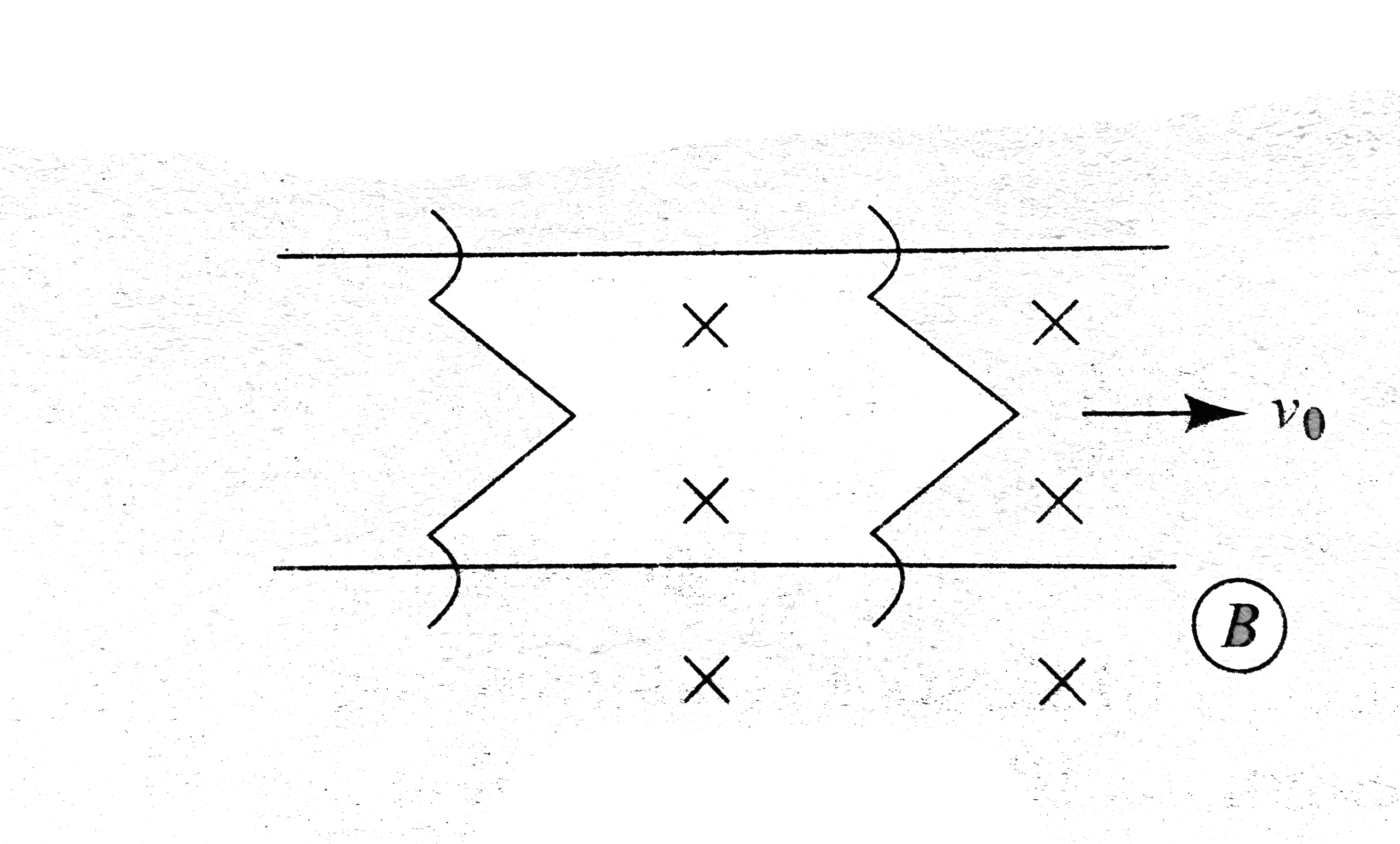
In Fig. there are two sliders and they can slide on two frictionless parallel wires in uniform magnetic field `B`, which is present everywhere. The mass of each slider is `m`, resistance `R` and initially these are at reat. Now, if one slider is given a velocity `v_(0) = 16ms^(-1)`, what will be the velocity (in `ms^(-1`)) of other slider after long time ? (neglect the emf self-inducetion)

A

`(v_(0))/(4)`

B

`(v_(0))/(2)`

C

`v_(0)`

D

zero

Text Solution

Verified by Experts

The correct Answer is:

B
Promotional Banner

Topper's Solved these Questions

  • KINEMATICS

    FIITJEE|Exercise SECTION (II) : (SUBJECTIVE )|33 Videos
  • KINEMATICS

    FIITJEE|Exercise SECTION(II) : MCQ ( SINGLE CORRECT)|47 Videos
  • KINEMATICS

    FIITJEE|Exercise NUMERICAL BASED QUESTIONS|3 Videos
  • HEAT AND TEMPERATURE

    FIITJEE|Exercise NUMERICAL BASES QUESTIONS|1 Videos
  • LAWS OF MOTION

    FIITJEE|Exercise COMPREHENSION-III|2 Videos

Similar Questions

Explore conceptually related problems

A conducting bar of mass m and length l moves on two frictionless parallel rails in the presence of a constant uniform magnetic field of magnitude B directed into the page as shown in the figure . The bar is given an initial velocity v_(0) towards the right at t = 0. Then the

A conducting bar mass m and length l moves on two frictionless parallel conducting rails in the presence of a uniform magnetic field B_(0) directed into the paper. The bar is given an initial velocity v_(0) to the right and is released at t = 0 . The velocity of the bar as a function of time is given by

A bar of mass m and length l moves on two frictionless parallel rails in the presence of a uniform magnetic field directed into the plane of the paper. The bar is given and initial velocity v_(i) to the right and released. Find the velocity of bar, induced emf across the bar and the current in the circuit as a function of time

Two infinite parallel wire, having the cross sectional area 'a' and resistivity 'k' are connected at a junction point 'p' (as shown in the figure). A slide wire of negligible resistance and having mass 'm' and length 'l' can slide between the parallel wires, without any frictional resistance. If the system of wires is introduced to a magnetic field of intensity 'B' (into the plane of paper) and the slide wire is pulled with a force which varies with the velocity of the slide wire as F=F_(0)v , then find the velocity of the slide wire as a function of the distance travelled. (The slide wire is initially at origin and has a velocity v_(0) )

A magnetic field B = B_(0) sin (omega t) hat k covers a large region where a wire AB slides smoothly over two parallel conductors separated by a distance d, Fig. The wires are in the x-y plane. The wire AB (of length d) has resistance R and parallel wires have negligible resistance. If AB is moving with velocity upsilon , what is the current in the circuit ? What is the force needed to keep the wire moving at constant velocity ?

In a certain region uniform electric field E and magnetic field B are present in mutually opposite directions. At the instant t=0 , a particle of mass m carrying a charge q is given velocity v_(0) at angle theta , with the y- axis, in the yz plane. The time after which the speed of the particle would be minimum is equal to

Consider parallel conducting rails separated by a distance l. There exists a uniform magnetic field B perpendicular to the plane of the rails as shown in Fig. Two conducting wires each of length l are placed so as to slide on parallel conducting rails. One of the wires is given a velocity v_(0) parallel to the rails. Till steady state is achieved, loss in kinetic energy of the system is

A conducting rod of length l slides at constant velocity v on two parallel conducting rails, placed in a uniform and constant magnetic field B perpendicular to the plane of the rails as shown in Fig.3.49. A resistance R is connected between the two ends of the rails. (a) Idenify the cause which produces change in magnetic flux. (b) Identify the direction of current in the loop. ( c) Determine the emf induced in the loop. (d) Compute the electric power dissipated in the resistor. (e) Calcualte the mechenical power required to pull the rod at a cinstant velovity.

Consider the situation shown in the figure. The wire PQ has mass m , resistance r and can slide 0n the smooth, horizontal parallel rails separated by a distance l . The resistance of the rais is negiligible. A uniform magnetic field B exists in the reactangular region and a resistance R connects the rail outside the field region. At t=0 , the wire PQ is pushed toward right with a speed v_(0) . Find (a) the current in the loop at an instant when the speed of the wire PQ is v (b) the acceleration of the wire as this instant (c) the velocity v as a function of x (d) the maximum distance the wire will move (e) the velocity as a function of time

FIITJEE-KINEMATICS-SECTION(I): MCQ (SINGLE CORRECT)
  1. Choose the incorrect statement about the coefficient of restitution

    Text Solution

    |

  2. A trolley was moving horizontally on a smooth ground with velocity v w...

    Text Solution

    |

  3. In Fig. there are two sliders and they can slide on two frictionless ...

    Text Solution

    |

  4. A smooth circular table is surrounded by a rim whose interior is verti...

    Text Solution

    |

  5. A balloon of mass M with a light rope having monkey on the rope is in ...

    Text Solution

    |

  6. A bowler tbrows a ball horizontally along east direction with speed of...

    Text Solution

    |

  7. A solid spherical ball of radius R collides with a rough horizontal s...

    Text Solution

    |

  8. A smooth hoop lie as on a smooth horizontal table and is fixed. A part...

    Text Solution

    |

  9. A ball is projected from the ground with speed u at an angle alpha wit...

    Text Solution

    |

  10. Three particles A, B and C of equal masses, moving with the same speed...

    Text Solution

    |

  11. Two particles are projected simultaneously in the same vertical plane ...

    Text Solution

    |

  12. Let vec( a) (1) and vec( a) (2) are the acceleration of wedges A and B...

    Text Solution

    |

  13. A pendulum of mass m hangs from a support fixed to a trolley which is ...

    Text Solution

    |

  14. Let A, B, C, D be points on a vertical line such that AB = BC = CD. If...

    Text Solution

    |

  15. A man runs along a straight road. Naturally he leans a little in the f...

    Text Solution

    |

  16. A cat runs along a straight line with constant velocity of magnitude v...

    Text Solution

    |

  17. A rod of length l forming an angle theta with the horizontal strikes a...

    Text Solution

    |

  18. A projectile is fired at an angle of 30^(@) to the horizontal such tha...

    Text Solution

    |

  19. The magnitude of radius vector of a point varies with time as r = beta...

    Text Solution

    |

  20. In one dimensional motin, a 1 kg body experiences a force, which is li...

    Text Solution

    |
