Text Solution
Verified by Experts



Topper's Solved these Questions
Similar Questions
Explore conceptually related problems
CENGAGE-INVERSE TRIGONOMETRIC FUNCTIONS-Question Bank
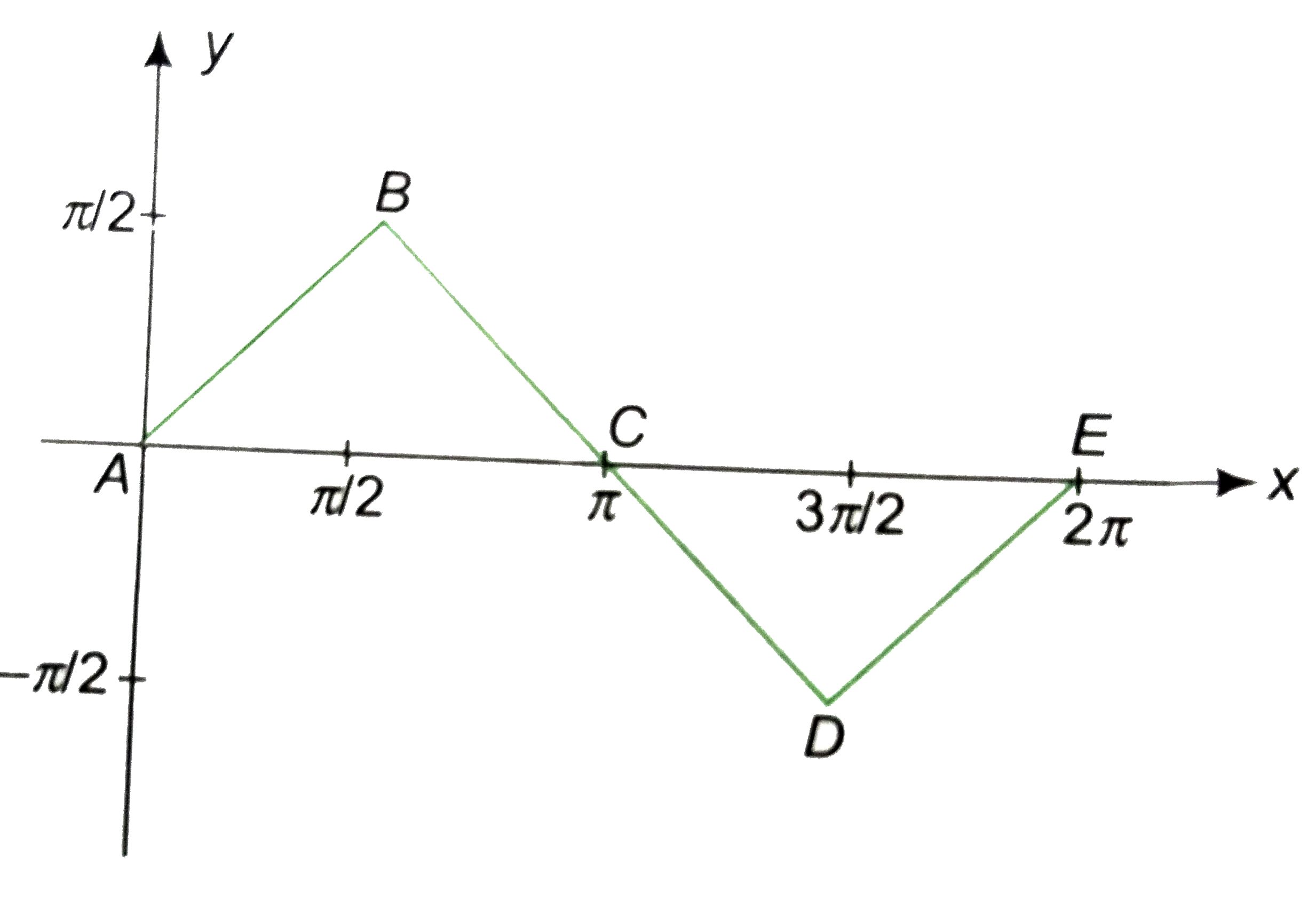
- Find the area bounded by y sin^(-1) (sin x) and x-axis for x in [0, 10...
Text Solution
|
- If alpha and beta are the two zeroes of the equation 3 cos ^-1(...
Text Solution
|
- If log pi x gt 0 then the absolute value of log 1/pi(sin ^-1 (2 x)/...
Text Solution
|
- If sin ^-1(sin 4)^-1+cos ^-1(cos 8)+tan ^-1(tan 6)+cot ^-1 .(cot 10)=...
Text Solution
|
- Total number of ordered pairs (x, y) satisfying |y|=cos x and y=sin...
Text Solution
|
- Find the number of points x in[-pi/2, (3 pi)/2] satisfying the equ...
Text Solution
|
- If the equation sin ^-1(x^2+x+1)+cos ^-1(lambda x+1)=pi/2 has exactly ...
Text Solution
|
- Number of values of x satisfying the equation cos ^-1(x^2-.5 x+6)=...
Text Solution
|
- Given f(x)=tan ^-1(cot x)+cot ^-1(tan x),(pi/2 lt x lt pi) , then ...
Text Solution
|
- If all the roots of the equation x^3-3 x=0 satisfy the equation (alpha...
Text Solution
|
- If the solution set of inequality (cosec^-1 x^2)-2 cosec^-1 x ge pi/6(...
Text Solution
|
- Find the sum of the values of x satisfying the equation tan ^-1((2 ...
Text Solution
|
- Number of values of x satisfying the equation cos ((4 pi)/3-cos ^-1...
Text Solution
|
- If the value of expression sin ^-1(sin 2013^(circ))+cos ^-1(cos.2013^...
Text Solution
|
- Let f:[0,3 pi] rarr[-pi/2, pi/2] be defined by f(x)=sin ^-1(sin x)...
Text Solution
|
- function f(x)=(arccot x/2+operatornamearccot x/3)/(arctan x/2+arctan ...
Text Solution
|
- If m and M are the least and the greatest value of (cos ^-1 x)^2...
Text Solution
|
- Solution of the equation cot (overset (4) underset (r =1) sum cot ^-1...
Text Solution
|
- If the equation sin ^-1 x=cosec^-1 x is satisfied for alpha and beta, ...
Text Solution
|
- Let f(x)=sin ^5 x-cos ^2 x and g(x)=cot ^-1(x^2+x+1) . Number of...
Text Solution
|
- The value of 3 sin (1/2 arc cos 1/9) +4 cos (1/2 arc cos 1/8) equal t...
Text Solution
|