Home
Class 12
MATHS
If (b2-b1)(b3-b-1)+(a2-a1)(a3-a1)=0, the...

If `(b_2-b_1)(b_3-b-1)+(a_2-a_1)(a_3-a_1)=0`, then prove that the circumcenter of the triangle having vertices `(a_1,b_1),(a_2,b_2)` and `(a_3,b_3)` is `((a_2+a_3)/(2),(b_2+b_3)/(2))`.

Text Solution

Verified by Experts
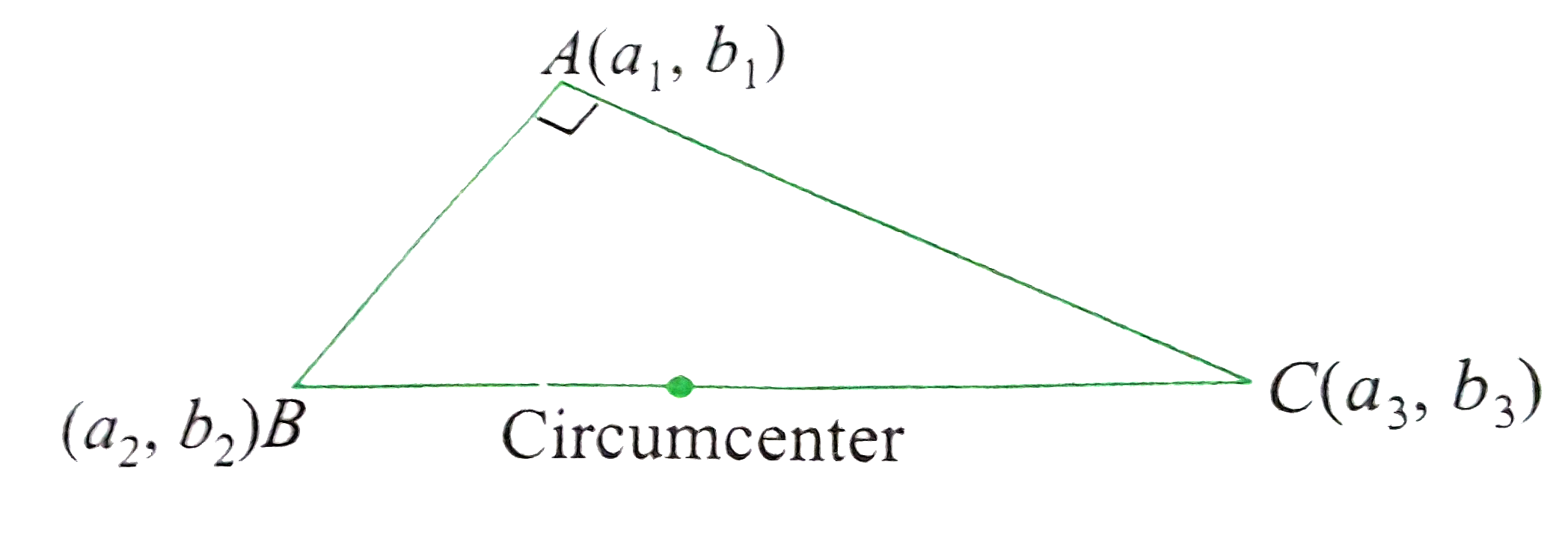
Given `(b_2-b_1)(b_3-b_1)+(a_2-a_1)(a_3-a_1)=0`

or `(b_2-b_1)(b_3-b_1)=-(a_2-a_1)(a_3-a_1)`
or `((b_2-b_1)/(a_2-a_1))((b_3-b_1)/(a_3-a_1))=-1`
or `("slope of AB")xx("slope of AC") =-1`
Therefore, the triangle is right -angled at point `(a_1,b_2)`. Hence, the circumcenter is the midpoint of `(a_2b_2)` and `(a_3,b_3)` which is `((a_2+a_3)/(2),(b_2+b_3)/(2))`
Promotional Banner

Topper's Solved these Questions

  • COORDINATE SYSYEM

    CENGAGE|Exercise Exercise 1.1|6 Videos
  • COORDINATE SYSYEM

    CENGAGE|Exercise Exercise 1.2|8 Videos
  • COORDINATE SYSTEM

    CENGAGE|Exercise Multiple Correct Answers Type|2 Videos
  • CROSS PRODUCTS

    CENGAGE|Exercise DPP 2.2|13 Videos

Similar Questions

Explore conceptually related problems

|(x_1,y_1,1),(x_2,y_2,1),(x_3,y_3,1)|=|(a_1,b_1,1),(a_2,b_2,1),(a_3,b_3,1)| then the two triangles with vertices (x_(1), y_(1)), (x_(2), y_(2)), (x_(3), y_(3)) and (a_(1), b_(1)), (a_(2), b_(2)), (a_(3), b_(3)) are

If the points (a_1, b_1),\ \ (a_2, b_2) and (a_1+a_2,\ b_1+b_2) are collinear, show that a_1b_2=a_2b_1 .

If |x_1y_1 1x_2y_2 1x_3y_3 1|=|a_1b_1 1a_2b_2 1a_3b_3 1| then the two triangles with vertices (x_1, y_1),(x_2,y_2),(x_3,y_3) and (a_1,b_1),(a_2,b_2),(a_3,b_3) are equal to area (b) similar congruent (d) none of these

Prove by vector method that (a_1b_1+a_2b_2+a_3b_3)^2lt+(a_1^2+a_2^2+a_3^2)(b_1^2+b_2^2+b_3^2)

In direct proportion a_1/b_1 = a_2/b_2

If the equation of the locus of a point equidistant from the points (a_1,b_1) and (a_2,b_2) is (a_1-a_2)x+(b_2+b_2)y+c=0 , then the value of C is

Prove that the value of each the following determinants is zero: |[a_1,l a_1+mb_1,b_1],[a_2,l a_2+mb_2,b_2],[a_3,l a_3+m b_3,b_3]|

The determinant |(b_1+c_1,c_1+a_1,a_1+b_1),(b_2+c_2,c_2+a_2,a_2+b_2),(b_3+c_3,c_3+a_3,a_3+b_3)|=

The equation A/(x-a_1)+A_2/(x-a_2)+A_3/(x-a_3)=0 where A_1,A_2,A_3gt0 and a_1lta_2lta_3 has two real roots lying in the invervals. (A) (a_1,a_2) and (a_2,a_3) (B) (-oo,a_1) and (a_3,oo) (C) (A_1,A_3) and (A_2,A_3) (D) none of these

