Home
Class 12
MATHS
A rod of length k slides in a vertical p...

A rod of length `k` slides in a vertical plane, its ends touching the coordinate axes. Prove that the locus of the foot of the perpendicular from the origin to the rod is `(x^2+y^2)^3=k^2x^2y^2dot`

Text Solution

Verified by Experts
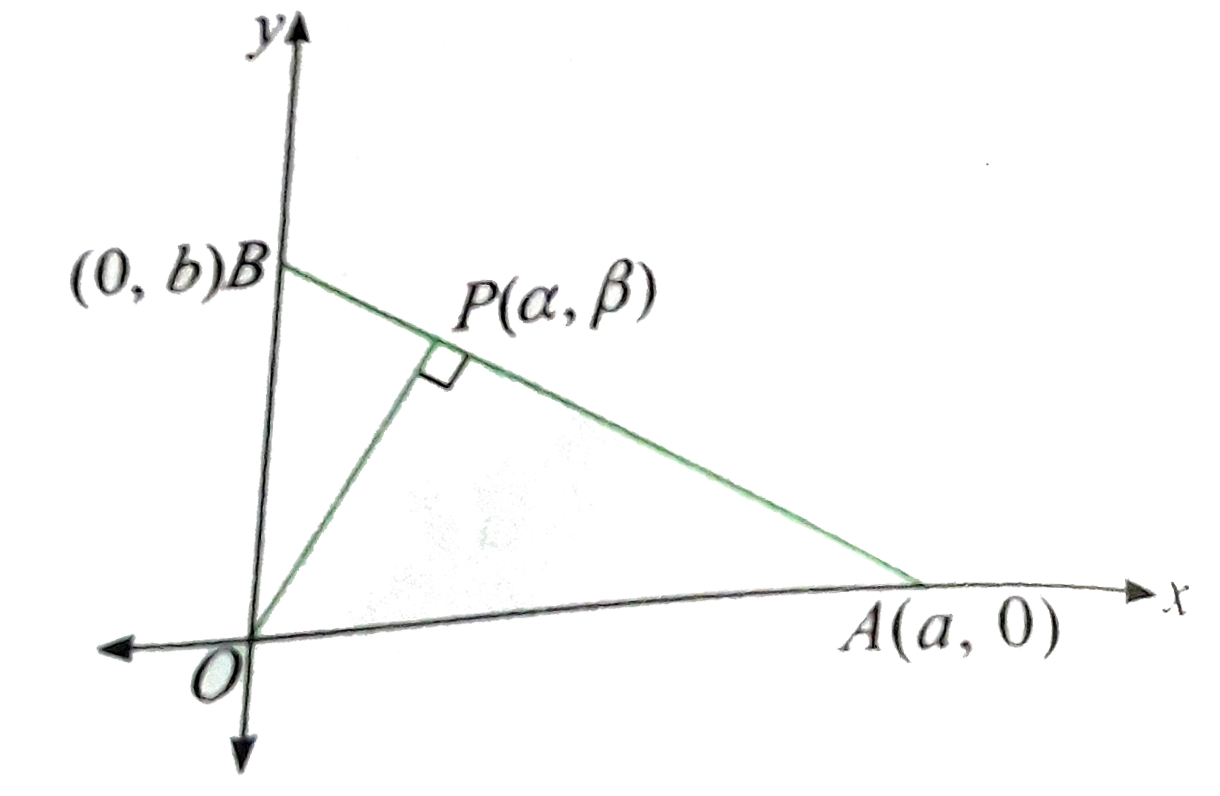
(Slope of OP). (Slope of BP)` =-1 `
or `(beta)/(alpha).(beta-b)/(alpha-0).=-1`
or `b=(alpha^2+beta^2)/(beta)`
and (Slope of OP).(Slope of AP)`=-1`
or `(beta)/(alpha).(beta)/(alpha-alpha).=-1`
`therefore a=(alpha^2+beta^2)/(alpha)`
Now, `a^2+b^2=k^2`
`therefore (a^2_beta^2)^3=k^2a^2beta^2`
`therefore (x^2+y^2)^3=k^2x^2y^2`
Promotional Banner

Topper's Solved these Questions

  • COORDINATE SYSYEM

    CENGAGE|Exercise Exercise 1.1|6 Videos
  • COORDINATE SYSYEM

    CENGAGE|Exercise Exercise 1.2|8 Videos
  • COORDINATE SYSTEM

    CENGAGE|Exercise Multiple Correct Answers Type|2 Videos
  • CROSS PRODUCTS

    CENGAGE|Exercise DPP 2.2|13 Videos

Similar Questions

Explore conceptually related problems

A rod of length k slides in a vertical plane,its ends touching the coordinate axes.Prove that the locus of the foot of the perpendicular from the origin to the rod is (x^(2)+y^(2))^(3)=k^(2)x^(2)y^(2)

The foot of the perpendicular drawn from the origin to the plane x+y+z=3 is

Find the coordinates of the foot of perpendicular from of the origin to the plane 2x+6y-3z=63.

The locus of the foot of the perpendicular from the origin on each member of the family (4a+3)x-(a+1)y-(2a+1)=0

The locus of the foot of the perpendicular from the centre of the ellipse x^(2)+3y^(2)=3 on any tangent to it is

Foot of perpendicular drawn from the origin to the plane 2x-3y+4z=29 is

The locus of the foot of the perpendicular from the foci an any tangent to the ellipse x^(2)/a^(2) + y^(2)/b^(2) = 1 , is

the locus of the foot of perpendicular drawn from the centre of the ellipse x^(2)+3y^(2)=6 on any point:

