Home
Class 9
MATHS
line l is the bisector of an angle /A\ ...

line l is the bisector of an angle `/_A\ a n d/_B`is any point on l. BP and BQ are perpendiculars from B to the arms of `/_A`. Show that:
(i) `DeltaA P B~=DeltaA Q B`
(ii) BP = BQ or B is equidistant from the arms of `/_A`

Text Solution

Verified by Experts
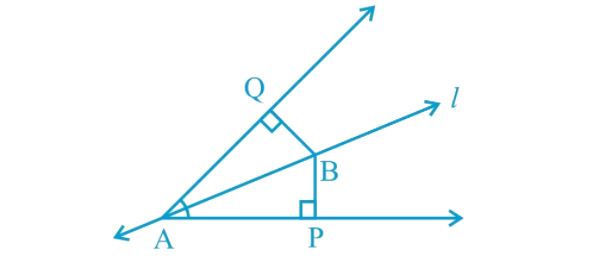

Given: l is the bisector of an angle `∠A` and `BP ⊥ AP` and `BQ ⊥ AQ`
To Prove: `ΔAPB ≅ ΔAQB `and `BP = BQ`
i) We can show two triangles APB and AQB are congruent by using AAS congruency rule and then show that the corresponding parts of congruent triangles will be equal. ...
Promotional Banner

Topper's Solved these Questions

Similar Questions

Explore conceptually related problems

In the given figure, line l is the bisector of an angle angleA and B is any point on l. If BP and BQ are perpendiculars from B to the arms of angleA , show that (i) DeltaAPB~=DeltaAQB (ii) BP = BQ, i.e., B is equidistant from the arms of angleA .

Line l is the bisector of an angleA and B is any point on I. BP and BQ are perpendiculars from B to the arms of angleA (see figure). Show that: DeltaAPB~=DeltaAQB

In Figure, line l is the bisector of angle A and B is any point on l . B P and B Q are perpendiculars from B to the arms of Adot Show that : A P B~=A Q B B P=B Q or B is equidistant from the arms of /_A . Figure

In Figure, line l is the bisector of angle A a n d B is any point on ldotB P a n d B Q are perpendiculars from B to the arms of Adot Show that: A P B ~= A Q B BP=BQ or B is equidistant from the arms of /_A

Line l is the bisector of an angleA and B is any point on I. BP and BQ are perpendiculars from B to the arms of angleA (see figure). Show that: BP=BQ or B is equidistant from the arms of angleA .

In the given figure, line I is the bisector of an angle A and B is any point on I. BP and BQ are perpendiculars from B to the arms of angleA . Show that B is equidistant from the arms of angleA .

ABCD is a parallelogram and AP and CQ are perpendiculars from vertices A and C on diagonal BD . Show that (i) DeltaA P B~=\ DeltaC Q D (ii) A P\ =\ C Q

In parallelogram ABCD, two points P and Q are taken on diagonal BD such that D P = B Q . Show that: (i) DeltaA P D~= DeltaC Q B (ii) A P = C Q (iii) DeltaA B C (iv) A Q = C P (v) APCQ is a parallelogram.

