Home
Class 12
CHEMISTRY
Following type of non-ionic detergents a...

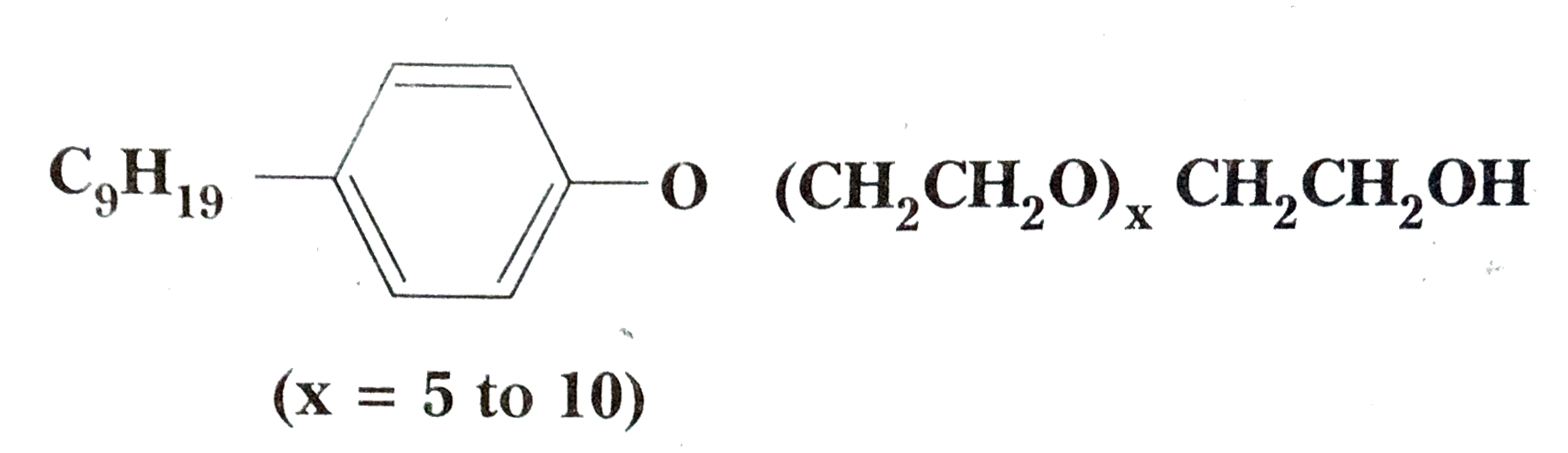
Following type of non-ionic detergents are present in liquid detergents,emulsifying agents and wetting agents.Label the hydrophilic and hydrophobic parts in the molecule Identify the functional group(s) present in the molecule.

Text Solution

Verified by Experts
Promotional Banner

Topper's Solved these Questions

  • CHEMISTRY IN EVERYDAY LIFE

    NCERT TELUGU|Exercise Exercises|27 Videos
  • CHEMISTRY IN ACTION

    NCERT TELUGU|Exercise SELF EVALUATION((C) Answer not exceeding sixty words :)|2 Videos
  • COORDINATION COMPOUNDS

    NCERT TELUGU|Exercise Exercises|32 Videos

Similar Questions

Explore conceptually related problems

How many types of functional groups are present in the following structure.

How many types of functional groups are present in the following structure.

In which of the following molecules chiral centre(s) is/are not present

It is not possible to measure the atomic radius precisely since the electron cloud surrounding the atom doesnot have sharp boundary. One practical approach to estimate the size of an atom of a non-metallic element is to measure the distance between two atoms when they are bound together by a single bond in a covalent molecule and then dividing by two. For metals we define the term "metallic radius" which is taken as half the internuclear distance separating the metal cores in the metallic crystal. The vander Waal's radius represents the overall size of the atoms which includes its valence shell in a nonbonded situation. It is the half of the distance between two similar atoms in separate molecules in a solid. The atomic radius decreases across a period and increases down the group. Same trends are observed in case of ionic radius. Ionic radius of the species having same number of electrons depends on the number of protons in their nuclei. Which of the following statement is correct?

It is not possible to measure the atomic radius precisely since the electron cloud surrounding the atom doesnot have sharp boundary. One practical approach to estimate the size of an atom of a non-metallic element is to measure the distance between two atoms when they are bound together by a single bond in a covalent molecule and then dividing by two. For metals we define the term "metallic radius" which is taken as half the internuclear distance separating the metal cores in the metallic crystal. The vander Waal's radius represents the overall size of the atoms which includes its valence shell in a nonbonded situation. It is the half of the distance between two similar atoms in separate molecules in a solid. The atomic radius decreases across a period and increases down the group. Same trends are observed in case of ionic radius. Ionic radius of the species having same number of electrons depends on the number of protons in their nuclei. Which one among the following sets of ions represents the collection of isoelectronic species?

Numerous forms of the periodic table have been devised from time to time. A modern version which is most convenient and widely used is the long or extended from of periodic table. The aufbau principle and the electronic configuration of atoms provide a theoretical foundation for the periodic classification. The horizontal rows are called periods. There are altogether seven periods. The first period consists of 2 elements. The subsequent periods consists of 8, 8,18, 18 and 32 elements respectively. The seventh period is incomplete and like the sixth period would have maximum of 32 elements. Elements having similar outer electronic configurations in their atoms are grouped in vertical columns. These are referred to as groups or families. According to the recommendations of IUPAC, the groups are numbered 1 to 18 replacing the older notation of groups 0, IA, IIA, ....VIIA, VIII, IB.....VIIB. Each successive period in the periodic table is associated with the filling up next higher principal energy level following aufbau sequence. The number of elements in each period is twice the number of atomic orbitals available in the energy level that is being filled. All the elements are classified into four blocks, i.e., s-block, p-block, d-block, and f-block depending on the type of atomic orbitals that are being filled with electrons. An element belongs to group 17 with atomic number is 17. What is the atomic number of the element belonging to same group and present in fifth period?

Structural isomers have different covalent linkage of atoms. Stereoisomers are compounds that have same sequence of covalent bonds but differ in the relative dispositions of their atoms in space. Geometri cal and optical isomers are the two important types of configurational isomers. The compound with double bonds or ring structure have restricted rotation, so exist in two geometrical forms. The double bonds in larger rings (ring size 10 carbon large) can also cause geometrical isomerism. The optical isomers rotate the plane of plane-polarised light. A sp^(3) -hybridised carbon atom bearing four different types of substituents is called an asymmetric centre or chiral centre. A chiral object or molecule cannot be superimposed on its mirror image. Stereoisomers that are mirror images of each other are called enantiomers. The stereosomers that the pot mirror images of each other are called diastereomers. Diasteremers have different physical properties. A racemic mixture is optically inactive and contains equal amounts of both the enantiomers. Resolution refers to method of separating a racemic mixture. Into two pure enantiomers. A meso compound is an optically inactive stereoisomer, which is achiral due to the presence of an internal plane of symmetry or centre of symmetry within the molecule. The number of chiral centres present in the following compounds is

The type of hybridisation present on "S" in SO_2 and SO_3 molecules respectively

NCERT TELUGU-CHEMISTRY IN EVERYDAY LIFE-Exercises
  1. Following type of non-ionic detergents are present in liquid detergent...

    Text Solution

    |

  2. Why do we need to classify the drug in different ways?

    Text Solution

    |

  3. Explain the term target molecules or drug targets as used in medicinal...

    Text Solution

    |

  4. Name the marcomolecules that are chosen as drug targets.

    Text Solution

    |

  5. Why should not medicines be taken without consulting doctors ?

    Text Solution

    |

  6. Define the term chemotherapy.

    Text Solution

    |

  7. Which forces are involved in holding the drug to the drug to active si...

    Text Solution

    |

  8. While antacids and antiallergic drugs interface with the function of h...

    Text Solution

    |

  9. Low level of noradrenaline in the cause of depression.What type of dru...

    Text Solution

    |

  10. What is meant by the term broad spectrum antibiotics?Explain.

    Text Solution

    |

  11. How do antiseptics differ from disinfectants?Does the same substance b...

    Text Solution

    |

  12. Why are cimetidine and ranitidine better antacids than sodium hydrogen...

    Text Solution

    |

  13. Name a substance which can be used as an antiseptic as well disindecta...

    Text Solution

    |

  14. What are the main constituents of dettol?

    Text Solution

    |

  15. What is tincture of iodine?What is its use?

    Text Solution

    |

  16. What are food predervatives?Give example.

    Text Solution

    |

  17. Why is the use if aspartame limited to cold foods and drinks?

    Text Solution

    |

  18. What are artificail sweerening agents?Give example.

    Text Solution

    |

  19. Name the sweetening agent used in the prepration of seets for a diabet...

    Text Solution

    |

  20. What problem does arise in using alitame as artificial sweetener?

    Text Solution

    |

  21. How are synthetic detergents better than soaps?

    Text Solution

    |

