Home
Class 11
PHYSICS
All surfaces are smooth Find the horizon...

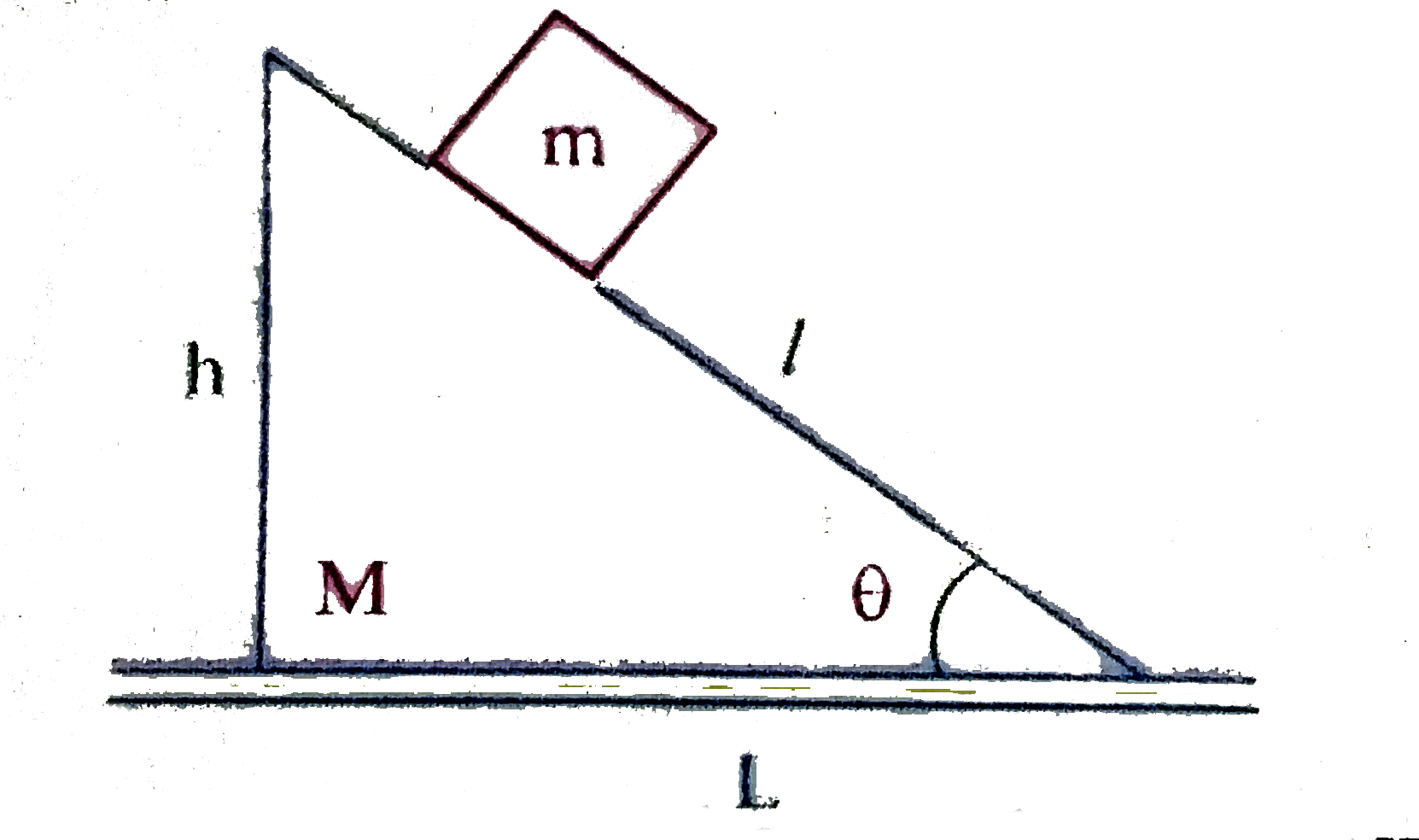
All surfaces are smooth Find the horizontal displacements of the block and the wedge when the block slides down from top to bottom
.

Text Solution

Verified by Experts

When the block slides down on the smooth wedge, the wedge moves backwards. In the horizontal direction there is no external force , `vec(F_(x))=0`
`therefore vec(P_(x))="consant"`
`vec(P_(f))=vec(P_(i))" (along x - axis), "m vecu+MvecV=vec0`
`x_(1)=` forward distance moved by the block along X - axis.
`x_(2)=` backward distance moved by the wedge along X - axis.
`m vecu=-MvecV`,
`m(x_(1))/(t)=M(x_(2))/(t)`
`mx_(1)=Mx_(2), x_(1)=(ML)/(M+m)=(Mlcos theta)/(M+m)`
`x_(2)=(mL)/(M+m)=(ml cos theta)/(M+m)`
Promotional Banner

Topper's Solved these Questions

  • LAW OF MOTION

    NARAYNA|Exercise EVALUATE YOURSELF - 1|11 Videos
  • LAW OF MOTION

    NARAYNA|Exercise EVALUATE YOURSELF - 2|11 Videos
  • KINETIC THEORY OF GASES

    NARAYNA|Exercise LEVEL-III(C.W)|52 Videos
  • MATHEMATICAL REVIEW & PHYSICAL WORLD

    NARAYNA|Exercise C.U.Q|13 Videos

Similar Questions

Explore conceptually related problems

A triangular wedge W having mass M is placed on an incline plane with its face AB horizontal. Inclination of the incline is theta . On the flat horizontal surface of the wedge there lies an infinite tower of rectangular blocks. Blocks 1, 2, 3, 4 ………. have masses M , (M)/(2) , (M)/(4) , (M)/(8) ......... respectively . All surfaces are smooth. Find the contact force between the block 1 and 2 after the system is released from rest. Also find the acceleration of the wedge.

Assuming all the surfaces to be smooth, find the acceleration of the triangular block of mass M when the block of mass m slides on it.

A block of mass m is initially lying on a wedge of mass M with an angle of inclination theta as shown in figure. Calculate the displacement of the wedge when the block is released and reaches to the bottom of the wedge.

A block is placed on the top of a plane inclined at 37^@ with horizontal. The length of the plane is 5m . The block slides down the plane and reaches the bottom. a. Find the speed of the block at the bottom if the inclined plane is smooth. b. Find the speed of the block at the bottom if the coefficient of friction is 0.25 .

A block is released on the convex surface of a hemispherical wedge as shown in Fig. Determine the displacement of the wedge when the block reaches the angular position theta

A block of mass m is released from the top of a wedge of mass M as shown in figure. Find the displacement of wedges on the horizontal ground when the block reaches the bottom of the wedges. Neglect friction everywhere.

In the figure shown the pulley is smooth . The spring and the string are light. The block 'B' slides down from the top along the fixed rought wedge of inclination theta . Assuming that the block reaches the end of the wedge. Find the speed of the block at the end. Take the coefficient of friction between the block and the wedge to be mu and the spring was relaxed when the block was relased from the top of the wedge.

A wooden wedge of mass 10 m has a smooth groove on its inclined surface. The groove is in shape of quarter of a circle of radius R = 0.55 m . The inclined face makes an angle theta =cos^(-1)((sqrt(11))/(5)) with the horizontal A block 'A' of mass m is palced at the top of the groove and given a gentle push so as to slide along the groove. There is no friction between the wedge and the horizontal ground on which it has been placed. Neglect width of the groove. (a) Find the magnitude of displacement of the wedge by the instant the block A reaches the bottom of the groove (b) Find the velocity of a wedge at the instant the block A reaches the bottom of the groove.

Figure shows an irregular wedge of mass m placed on a smooth horizontal surface. Part BC is rough. If the coefficient of friction between the block and wedge is mu , and the block comes to rest with respect to wedge at a point E on the rough surface then BE will be

All surfaces are smooth in the adjoining figure. Find F such that block remains stationary with respect to wedge.

NARAYNA-LAW OF MOTION-EXERCISE - IV
  1. All surfaces are smooth Find the horizontal displacements of the block...

    Text Solution

    |

  2. When a body is stationary:

    Text Solution

    |

  3. The inertia of a moving object depends on:

    Text Solution

    |

  4. A thief stole a box full of valuable articles of weight W and while ca...

    Text Solution

    |

  5. There are three Newton's laws of motion namely I, II and III : we can ...

    Text Solution

    |

  6. Two blocks m(1) = 5 g and m(2)= 10 g are hung vertically over a light ...

    Text Solution

    |

  7. In the figure a smooth pulley of negligible weight is suspended by a s...

    Text Solution

    |

  8. Two masses 2 kg and 3 kg are attached to the end of the string passed ...

    Text Solution

    |

  9. Two bodies of mass 6 kg and 4 kg are tied to a string as shown in the ...

    Text Solution

    |

  10. The pulley arrangements shown in figure are identical, the mass of the...

    Text Solution

    |

  11. A string of negligible mass going over a clamped pulley of mass m supp...

    Text Solution

    |

  12. Two masses of 8 kg and 4 kg are connected by a string as shown in figu...

    Text Solution

    |

  13. An empty plastic box of mass m is found to accelerate up at the rate o...

    Text Solution

    |

  14. A monkey is decending from the branch of a tree with constant accelera...

    Text Solution

    |

  15. Fig. shows a system of three masses being pulled with a force F. the m...

    Text Solution

    |

  16. Fig. shows a block of mass m(1) resting on a smooth surface. It is con...

    Text Solution

    |

  17. A 100 kg block is suspended with the help of three strings A, B and C....

    Text Solution

    |

  18. A frictionless inclined plane of length l having inclination theta is ...

    Text Solution

    |

  19. Friction

    Text Solution

    |

  20. A box is placed on an inclined plane and has to be pushed down.The ang...

    Text Solution

    |

  21. Figure shows two block A and B pushed against the wall with the force ...

    Text Solution

    |

