Home
Class 11
PHYSICS
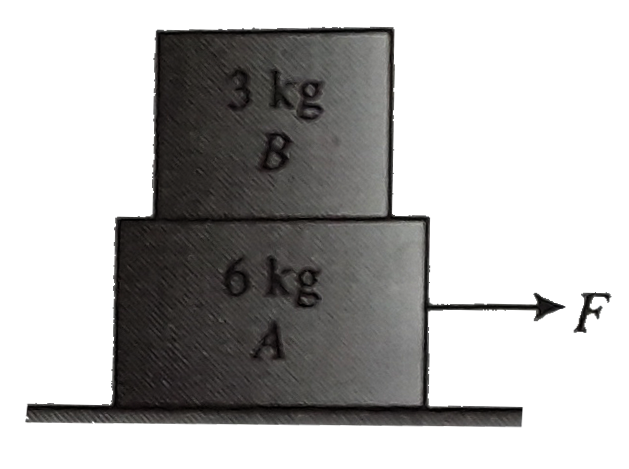
Two block A and B of masses 6 kg and 3 k...

Two block A and B of masses `6 kg` and `3 kg ` rest on a smooth horizontal surface as shown in figure If coefficient of friction between A and Bb is `0.4` the maximum horizontal force which can make them move without separation is

A

72 N

B

40 N

C

36 N

D

20 N

Text Solution

Verified by Experts

The correct Answer is:

C
Promotional Banner

Topper's Solved these Questions

  • LAW OF MOTION

    NARAYNA|Exercise EVALUATE YOURSELF - 5|8 Videos
  • LAW OF MOTION

    NARAYNA|Exercise C.U.Q|73 Videos
  • LAW OF MOTION

    NARAYNA|Exercise EVALUATE YOURSELF - 3|6 Videos
  • KINETIC THEORY OF GASES

    NARAYNA|Exercise LEVEL-III(C.W)|52 Videos
  • MATHEMATICAL REVIEW & PHYSICAL WORLD

    NARAYNA|Exercise C.U.Q|13 Videos

Similar Questions

Explore conceptually related problems

Two block A and B of masses 5 kg. and 3 kg. respectively rest on smooth horizontal surface with B over A. The coefficient of friction between A and B. 0.5 the maximum horizontal force that can be applied to A so that there will be motion of A and B without separation is :-

Two blocks A and B of masses 10 kg and 15 kg are placed in contact with each other rest on a rough horizontal surface as shown in the figure. The coefficient of friction between the blocks and surface is 0.2. A horizontal force of 200 N is applied to block A. The acceleration of the system is ("Take g"=10ms^(-2))

A block is kept on a rough horizontal surface as shown. Its mass is 2 kg and coefficient of friction between block and surface (mu)=0.5. A horizontal force F is acting on the block. When

Two blocks of masses 4 kg and 6 kg are kept on a rough horizontal surface as shown. If the acceleration of 6 kg block is 5n , then n is :

A block A of mass 2 kg is placed over smooth block B of mass 4 kg which is placed over a smooth horizontal floor The coefficient of friction between A and B is 0.4 when a horizontal forces of magnitude 10 N is applied on A the acceleration of block of A and B are

Two blocks of mass 2kg and 1kg are at rest on a smooth surface as shown. There is friction between 2kg and 1kg block with mu = 0.5 . Find maximum force to be applied on 1 kg for the two blocks to move together.

Two block (A) 2kg and (B) 5kg rest one over the other on a smooth horizontal plane. The cofficient of static and dynamic friction between (A) and (B) is the sae and equal to 0.60. The maximum horizontal force that can be applied to (B) in order that both (A) and (B) do not have any relative motion:

Two blocks A and B of respective masses 6 kg and 4 kg are connected with a string passing over a light friction less pulley as shown in the figure . The coefficient of friction between the block A and horizontal surface is 0.4 . Then the minimum mass of block C which should be placed over A to prevent it from moving is :

In the arrangement shown in figure, m_A = m_B = 2kg. String is massless and pulley is frictionless. Block B is resting on a smooth horizontal surface, while friction coefficient beteen block A and B is mu=0.5 . the Maximum horizontal force F that can be applied so that block A does not slip over block B is.
