Home
Class 11
CHEMISTRY
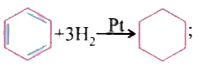
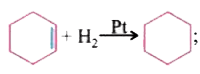
DeltaH=-x" k.cal/mole" DeltaH=-y" k....

`DeltaH=-x" k.cal/mole"`
`DeltaH=-y" k.cal/mole"`
The correct relation among the following is

A

`x=y`

B

`y=3x`

C

`3x-y="36 k.cal"`

D

`x-3y="36 k.cal"`

Text Solution

Verified by Experts

The correct Answer is:

C

Reasonance Energy `=DeltaH_("exp")-DeltaH_("cal")`
Promotional Banner

Topper's Solved these Questions

  • HYDROCARBONS

    NARAYNA|Exercise EXERCISE - 3|25 Videos
  • HYDROCARBONS

    NARAYNA|Exercise EXERCISE - 4|18 Videos
  • HYDROCARBONS

    NARAYNA|Exercise EXERCISE - 2 (H.W) (PROPERTIES OF ALKENES)|74 Videos
  • GENERAL ORGANIC CHEMISTRY

    NARAYNA|Exercise Matrix-Match type questions|7 Videos
  • HYDROGEN & ITS COMPOUCDS

    NARAYNA|Exercise Interger type questions|10 Videos

Similar Questions

Explore conceptually related problems

The reaction A to B , DeltaH=+24 kJ//"mole" . For the reaction B to C , DeltaH=-18 kJ//"mole" . The decreasing order of enthalpy of A , B , C follow the order

For the reaction 2A (g) + B(g) to C (g) Delta U^(@) = 20 kcal/mole, Delta S^(@) = 100 cal/kmole at 300 K. Hence Delta G^(@) in kcal is __________ [R = 2 cal mol^(-1) K^(-1)]

While analyzing driving forces for a chemical reaction it is observed that energy and entropy are true forces. The entropy is a typical state function owing to the possibility of calculation of its absolute value. The absolute values of entropies can be compared an calculating by knowing the residual entropies at 0 K and by calculating the change due to change of state. Using the given information and data for a particular substance x answer the questions that follow : Useful data : (p) Standard melting point and boiling point of x is 200 K and 400 K respectively. (q) DeltaH_("fusion")^(@) = 10 kcal//"mole" and DeltaH_(vap)^(@) = 80 kcal//"mole" . (r) C_(p.m)(s) x = 0.1T cal//K "mole" , C_(p.m) (l) x = 0.05 Tcal//K "mole S_(m.40 K)^(@)s_(x) = 5 cal//"mole" Which of the following options regarding absolute molar entropies of x is/are correct?

For the reaction 2A(g)+3B(l)rarrC(g)+4D(l),DeltaH=300"cal//mol" Calculate DeltaU (in calories) of reaction when 3 moles of A (g) react with 4 moles of B (l) at 27^(@)C. (R=2"cal//mol"-K)

While analyzing driving forces for a chemical reaction it is observed that energy and entropy are true forces. The entropy is a typical state function owing to the possibility of calculation of its absolute value. The absolute values of entropies can be compared an calculating by knowing the residual entropies at 0 K and by calculating the change due to change of state. Using the given information and data for a particular substance x answer the questions that follow : Useful data : (p) Standard melting point and boiling point of x is 200 K and 400 K respectively. (q) DeltaH_("fusion")^(@) = 10 kcal//"mole" and DeltaH_(vap)^(@) = 80 kcal//"mole" . (r) C_(p.m)(s) x = 0.1T cal//K "mole" , C_(p.m) (l) x = 0.05 Tcal//K "mole S_(m.40 K)^(@)s_(x) = 5 cal//"mole" Which of the following statement is/are true ?

For a reaction: 2A(g)+B(g)toC(g), DeltaU^(@)=30kcal//"mole" , DeltaS^(@)=100cal//K"mole". "What will be the value of" DeltaG_(reaction)^(@)at 400K? [R=2cal//K"mole"]" "[DeltaC_(p_(reaction))=0]

AtoB , DeltaH=4 kcal mol^(-1) , DeltaS=10 cal mol^(-1)K^(-1) . Reaction is spontaneous when temperature is

The value of DeltaH_(O-H) is 109Kcal//mol . The enthalpy of formation of 1 mole of water in gaseous state will be