Home
Class 12
CHEMISTRY
When degenerate d-orbitals of an isolate...

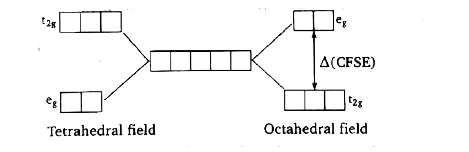
When degenerate d-orbitals of an isolated atom/ion come under influence of magnetic field of ligands, the degeneray is lost. The two set `t_(2g)(d_(xy),d_(yz),d_(xz)) and e_(g) (d_(x^(2))-d_(x^(2)-y^(2))` are either stabilized or destabilized depending upon the nature of magnetic field. it can be expressed diagrammatically as:

Value of CFSE depends upon nature of ligand and a spectrochemical series has been made experimentally, for tetrahedral complexes, `Delta` is about 4/9 times to `Delta_(0)` (CFSE for octahedral complex). this energy lies in visible region and i.e., why electronic transition are responsible for colour. such transition are not possible with `d^(0) and d^(10)` configuration.
Q. The extent of crystal field splitting in octahedral complexes of the given metal with particular weak field ligand are:

A

the nature of the metal cation

B

nature of the ligands

C

geometry of the complex

D

all of these

Text Solution

Verified by Experts

The correct Answer is:

D
Promotional Banner

Topper's Solved these Questions

  • CO-ORDINATE COMPOUNDS

    NARAYNA|Exercise Exercise-3|38 Videos
  • CHEMISTRY OF HEAVY METALS

    NARAYNA|Exercise Passage 13|1 Videos
  • COORDINATION COMPLEXES

    NARAYNA|Exercise Compreshession type question|12 Videos

Similar Questions

Explore conceptually related problems

When degenerate d-orbitals of an isolated atom/ion come under influence of magnetic field of ligands, the degeneray is lost. The two set t_(2g)(d_(xy),d_(yz),d_(xz)) and e_(g) (d_(x^(2))-d_(x^(2)-y^(2)) are either stabilized or destabilized depending upon the nature of magnetic field. it can be expressed diagrammatically as: Value of CFSE depends upon nature of ligand and a spectrochemical series has been made experimentally, for tetrahedral complexes, Delta is about 4/9 times to Delta_(0) (CFSE for octahedral complex). this energy lies in visible region and i.e., why electronic transition are responsible for colour. such transition are not possible with d^(0) and d^(10) configuration. Q. The d-orbitals, which are stabillized in an octahedral magnetic field, are:

When degenerate d-orbitals of an isolated atom/ion come under influence of magnetic field of ligands, the degeneray is lost. The two set t_(2g)(d_(xy),d_(yz),d_(xz)) and e_(g) (d_(x^(2))-d_(x^(2)-y^(2)) are either stabilized or destabilized depending upon the nature of magnetic field. it can be expressed diagrammatically as: Value of CFSE depends upon nature of ligand and a spectrochemical series has been made experimentally, for tetrahedral complexes, Delta is about 4/9 times to Delta_(0) (CFSE for octahedral complex). this energy lies in visible region and i.e., why electronic transition are responsible for colour. such transition are not possible with d^(0) and d^(10) configuration. Q. Ti^(3+)(aq) . is purple while Ti^(4+)(aq) . is colourless because:

When degenerate d-orbitals of an isolated atom/ion come under influence of magnetic field of ligands, the degeneray is lost. The two set t_(2g)(d_(xy),d_(yz),d_(xz)) and e_(g) (d_(x^(2))-d_(x^(2)-y^(2)) are either stabilized or destabilized depending upon the nature of magnetic field. it can be expressed diagrammatically as: Value of CFSE depends upon nature of ligand and a spectrochemical series has been made experimentally, for tetrahedral complexes, Delta is about 4/9 times to Delta_(0) (CFSE for octahedral complex). this energy lies in visible region and i.e., why electronic transition are responsible for colour. such transition are not possible with d^(0) and d^(10) configuration. Q. For an octahedral complex, which of the followin d-electron configuration will give maximum CFSE?

When degenerate d-orbitals of an isolated atom/ion come under influence of magnetic field of ligands, the degeneray is lost. The two set t_(2g)(d_(xy),d_(yz),d_(xz)) and e_(g) (d_(x^(2))-d_(x^(2)-y^(2)) are either stabilized or destabilized depending upon the nature of magnetic field. it can be expressed diagrammatically as: Value of CFSE depends upon nature of ligand and a spectrochemical series has been made experimentally, for tetrahedral complexes, Delta is about 4/9 times to Delta_(0) (CFSE for octahedral complex). this energy lies in visible region and i.e., why electronic transition are responsible for colour. such transition are not possible with d^(0) and d^(10) configuration. Q. Which of the following is correct arrangement of ligand in terms of the Dq values of their complexes with any particularr 'hard' metal ion:

NARAYNA-CO-ORDINATE COMPOUNDS -Exercise-4
  1. Mohr's salt on dissociation in water gives

    Text Solution

    |

  2. Complex compound is made up of

    Text Solution

    |

  3. When degenerate d-orbitals of an isolated atom/ion come under influenc...

    Text Solution

    |

  4. The reducing power of the metal decreases in the order:

    Text Solution

    |

  5. Which of these species has same number of unpaired electrons with weak...

    Text Solution

    |

  6. Why are low spin tetrahedral complexes not formed ?

    Text Solution

    |

  7. Value of CFSE, in tetrahedral complex having 3d^4 configuration of met...

    Text Solution

    |

  8. The non -existant metal carbonyl among the following is

    Text Solution

    |

  9. The pi - bounded organometallic compound which has ethylene as one of ...

    Text Solution

    |

  10. If X' is a Anti cancerous drug which of the following conversions will...

    Text Solution

    |

  11. Which of the following configuration will not give John- teller distor...

    Text Solution

    |

  12. Which of the following does not have a metal carbon bond?

    Text Solution

    |

  13. Fe(4)[Fe(CN)(6)](3) a blue coloured complex. Average oxidation number ...

    Text Solution

    |

  14. Magnetic moment (spin only) of octahedron complex having SFSE=-0.8Delt...

    Text Solution

    |

  15. Given that maximum absorption for d-d transition in [Ti(H2O)(6)]^(3+) ...

    Text Solution

    |

  16. The CFSE for octahedral [CoCl(6)]^(4-) is 18,000 cm^(-1). The CFSE for...

    Text Solution

    |

  17. Which of the following ion does not exist

    Text Solution

    |

  18. Low spin complex of d^6-cation in an octahedral field will have the fo...

    Text Solution

    |

  19. Which of the following complex (Werner presentation) have minimum elec...

    Text Solution

    |

  20. Which of the following octahedral complexes shown geometrical as well ...

    Text Solution

    |
