Home
Class 12
MATHS
Let z(1), z(2), z(3) are the vertices of...

Let `z_(1)`, `z_(2)`, `z_(3)` are the vertices of `DeltaABC`, respectively, such that `(z_(3)-z_(2))/(z_(1)-z_(2))` is purely imaginery number. A square on side `AC` is drawn outwardly. `P(z_(4))` is the centre of square, then

A

`|z_(1)-z_(2)|=|z_(2)-z_(4)|`

B

`arg((z_(1)-z_(2))/(z_(4)-z_(2)))+arg((z_(3)-z_(2))/(z_(4)-z_(2)))=+(pi)/(2)`

C

`arg((z_(1)-z_(2))/(z_(4)-z_(2)))+arg((z_(3)-z_(2))/(z_(4)-z_(2)))=0`

D

`z_(1)`, `z_(2)`, `z_(3)` and `z_(4)` lie on a circle

Text Solution

Verified by Experts

The correct Answer is:
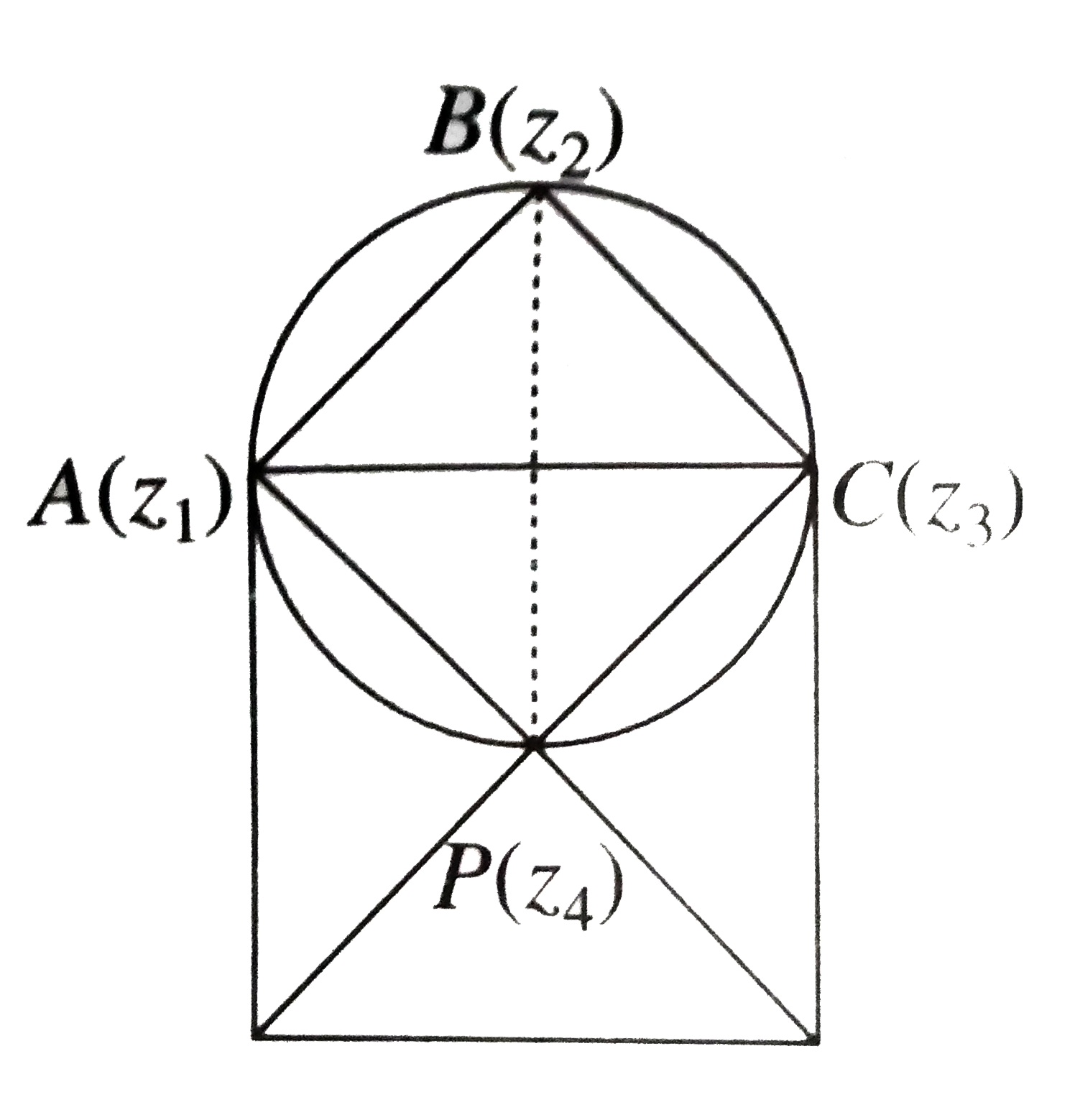
C, D

`(c,d)` `P` is centre of square `implies AP=PC` and `/_APC=(pi)/(2)`
`/_ABC` is also `(pi)/(2)`.
`implies ABCP` is cyclic quadrilateral
`impliesA,B,C,P` lie on a circle.
`implies` In circl chord, `AP=PC`
`implies` arc `AP=` are `PC`
`implies/_ABP=/_PBC`
`implies BP` is angular bisector.
Let `arg((z_(1)-z_(2))/(z_(4)-z_(2)))=-alpha`........`(i)`
`impliesarg((z_(3)-z_(2))/(z_(4)-z_(2)))=alpha`..........`(ii)`
Add `(i)` and `(ii)`, `arg((z_(1)+z_(2))/(z_(4)-z_(2)))+arg((z_(3)-z_(2))/(z_(4)-z_(2)))=0`
Promotional Banner

Topper's Solved these Questions

  • COMPLEX NUMBERS

    CENGAGE|Exercise Single correct Answer|62 Videos
  • COMPLEX NUMBERS

    CENGAGE|Exercise Matching Column|1 Videos
  • CIRCLES

    CENGAGE|Exercise Question Bank|32 Videos
  • CONIC SECTIONS

    CENGAGE|Exercise Solved Examples And Exercises|91 Videos

Similar Questions

Explore conceptually related problems

If z_(1)z_(2),z_(3) and z_(4) taken in order vertices of a rhombus, then proves that Re((z_(3)-z_(1))/(z_(4)-z_(2))) = 0

If z_(1),z_(2),z_(3) are the vertices of triangle such that |z_(1)-i|=|z_(2)-i|=|z_(3)-i| and z_(1)+z_(2)=3i-z_(3) then area of triangle is

If z_(1),z_(2),z_(3) are the vertices of an equilateral triangle,then value of (z_(2)-z_(3))^(2)+(z_(3)-z_(1))^(2)+(z_(1)-z_(2))^(2)

If z_(1);z_(2) and z_(3) are the vertices of an equilateral triangle; then (1)/(z_(1)-z_(2))+(1)/(z_(2)-z_(3))+(1)/(z_(3)-z_(1))=0

If z_(1),z_(2),z_(3) are the vertices of an equilational triangle ABC such that |z_(1)-i|=|z_(2)- i| = |z_(3)-i|, then |z_(1)+z_(2)+z_(3)| equals to

If z_1,z_2,z_3 are vertices of a triangle such that |z_1-z_2|=|z_1-z_3| then arg ((2z_1-z_2-z_3)/(z_3-z_2)) is :

Let A(z_(1)),B(z_(2)),C(z_(3)) be the vertices of an equilateral triangle ABC in the Argand plane, then the number (z_(2)-z_(3))/(2z_(1)-z_(2)-z_(3)) , is

If z_(1),z_(2) and z_(3) are the vertices of a right angledtriangle in Argand plane such that |z_(1)-z_(2)|=3,|z_(1)-z_(3)|=5 and z_(2) is the vertex with the right angle then

CENGAGE-COMPLEX NUMBERS-Question Bank
  1. Let z(1), z(2), z(3) are the vertices of DeltaABC, respectively, such ...

    Text Solution

    |

  2. It is given that complex numbers z(1) and z(2) satisfy |z(1) |=2 and |...

    Text Solution

    |

  3. If omega is any complex number such that z omega=|z|^(2) and |z-bar(z)...

    Text Solution

    |

  4. If m is the minimum value of |z|+|2 z-omega| where |omega|=1, then 4 m...

    Text Solution

    |

  5. If (2-3 i) is a root of the equation x^(3)-b x^(2)+25 x div d=0 (where...

    Text Solution

    |

  6. If the area 'bounded by the locus of z satisfying arg (z)=0, Im((1+sqr...

    Text Solution

    |

  7. The circle |z+3|=1 touches |z-sqrt(7) i|=r. Then sum of possible value...

    Text Solution

    |

  8. Let i=sqrt(-1). The absolute value of product of the real part of the ...

    Text Solution

    |

  9. If |z(1)|=1,|z(2)|=2,|z(3)|=3 and |9 z(1) z(2)+4 z(1) z(3)+z(2) z(3)|...

    Text Solution

    |

  10. [(-1+i sqrt(3))/(2)]^(6)+[(-1-i sqrt(3))/(2)]^(6)+[(-1+i sqrt(3))/(2)]...

    Text Solution

    |

  11. Let A=(a in R |. the equation (1+2 i) x^(3)-2(3+i) x^(2)+(5- 4i) x+2 a...

    Text Solution

    |

  12. If |Z-i| le 2 and Z(1)=5+3 i , then the maximum value of |i Z+Z(1)...

    Text Solution

    |

  13. If P is the affix of z in the Argand diagram and P moves so that (z-i)...

    Text Solution

    |

  14. The imaginary part of complex number z satisfying l floor |Z-I-2i|le 1...

    Text Solution

    |

  15. Number of complex numbers z satisfying z^(3)=bar(z) is

    Text Solution

    |

  16. Let z=9+b i where b is non zero real and i^(2)=-1. If the imaginary pa...

    Text Solution

    |

  17. The value of e (CiS)(-i)-operatorname(CiS)(i)) is equal to

    Text Solution

    |

  18. Number of complex numbers z such that |z|=1 ( and ) |(z)/(bar(z))+...

    Text Solution

    |

  19. The straight line (1+2 i) z+(2 i-1) bar(z)=10 i on the complex plane, ...

    Text Solution

    |

  20. If m and n are the smallest positive integers satisfying the relation ...

    Text Solution

    |

  21. (sqrt[3](3)+(3^(5 / 6)) i)^(3) is an integer where i=sqrt(-1). The abs...

    Text Solution

    |

