Home
Class 12
CHEMISTRY
An aromatic organic compound 'A' with fo...

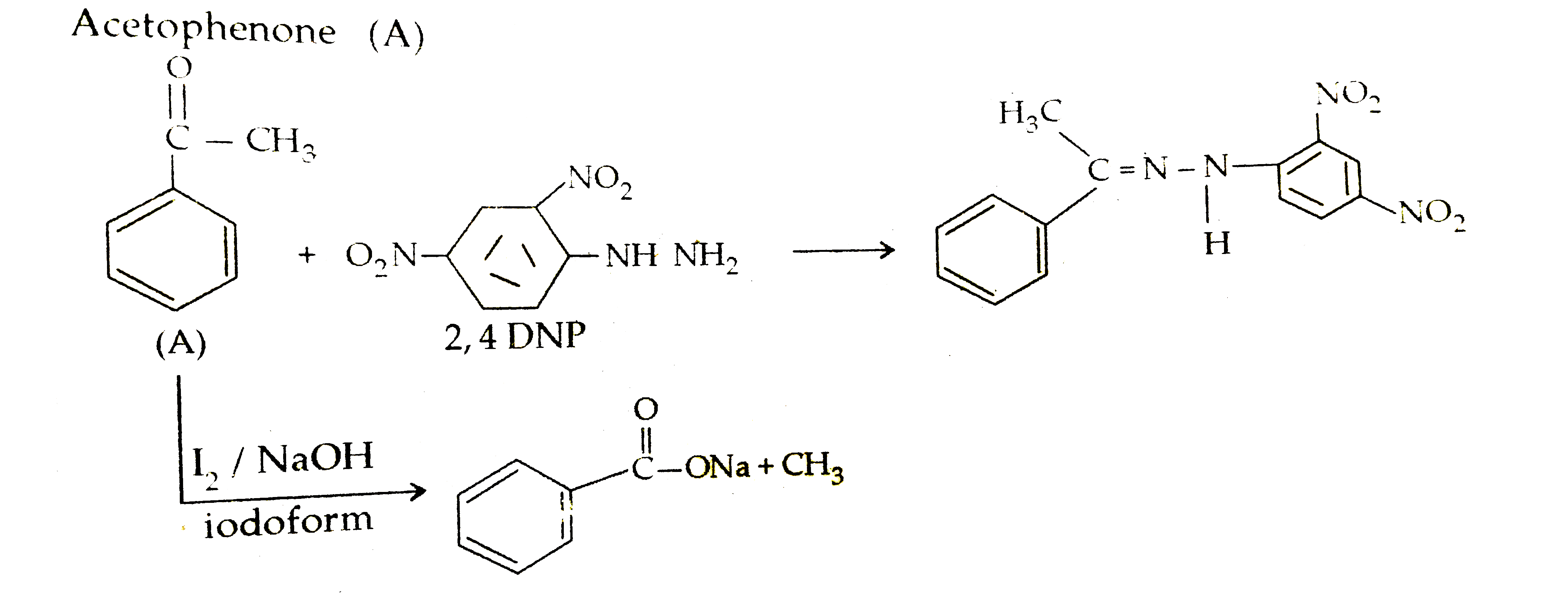
An aromatic organic compound 'A' with formula `C_8H_8O` gives positive DNP and iodofrom tests. It neither reduces Tollens' reagent nor does it decolourise bromine water. Write the structure of 'A'. 1

Text Solution

Verified by Experts
Promotional Banner

Topper's Solved these Questions

  • XII BOARDS

    XII BOARDS PREVIOUS YEAR|Exercise Questions|31 Videos
  • XII BOARDS

    XII BOARDS PREVIOUS YEAR|Exercise OUTSIDE DELHI (SET-I)|35 Videos
  • XII BOARDS

    XII BOARDS PREVIOUS YEAR|Exercise Set - 1 Comptt.|30 Videos
  • SAMPLE PAPER 2019

    XII BOARDS PREVIOUS YEAR|Exercise SECTION: D|1 Videos

Similar Questions

Explore conceptually related problems

An organic compound A with molecular formula C_(9)H_(10)O gives positive DNP and iodoform tests. It does not reduce. Tollen's reagent or Fehling reagent and does not decolourless bromine water or Bayer's reagent. On drastic oxidation with chronic acid, compound A gives a carboxylic acid having molecular formula C_(7)H_(6)O_(2) . Deduce the structur eof organic compound A and write all the chemical reactions involved.

An organic compound containing (x) with molecular formula C_(8)H_(8)O forms an oragne-red precipitate with 2,- -DNP reagent and gives yellow precipitate on heating with ioxdine in the presence of sodium hydroxide. It neither reduces Tollen's Fehlling's reagent, nor does it decolouries bromine water or Baeyer's reagent. On drastic oxidation with chromic acid, it gives a carboxylic acid (Y) having molcular formula C_(7)H_(6)O_(2) . Identify the compounds X and Y.

A compound 'X' has a formula C_(3)H_(6) . It decolourises bromine water. Write the chemical name of 'X'.

An organic compound (A) C_(6)H_(12)O reacts with hydroxylamine to give an oxime. It also reduces Tollen's reagent and undergoes cannizzaro's reaction. What is the structure of (A)? Write down the different reactions involved.

An organic compound (A) with molecular formula C_8H_8 O forms an orange red precipitate with 2,4 -DNP reagent and gives yellow precipitate on heating with iodine in the presence of sodium hydroxide . It neither reduces Tollen's reagent or Fehling's solution , nor does it decolourise bromine water or Baeyer's reagent. On drastic oxidation with chromic acid, it gives a carboxylic acid (B) having molecular formulae C_7H_6O_2 . Identify the compound (A) and (B) and explain the reactions involved .

An organic compound 'P' with jmolecular formula C_(8)H_(8)O forms an organic red ppt with 2,4-DNP gives yellow ppt. on heating with I_(2) in presence of NaOH . It neither reduces tollen's or fehling reagent nor does it decolourise Br_(2) water or baeyer's reagent. On drastic oxidation with chromic acid (H_(2)CrO_(4)) it gives an acid (Q) having molecular formula C_(7)H_(6)O_(2) . Q. Identify compound P:

XII BOARDS PREVIOUS YEAR-XII BOARDS-General Instrucations
  1. Why is adsorption always exothermic ?

    Text Solution

    |

  2. Predict the major product formed when sodium ethoxide reacts with tert...

    Text Solution

    |

  3. An aromatic organic compound 'A' with formula C8H8O gives positive DNP...

    Text Solution

    |

  4. For the reaction AtoB, the rate of reaction becomes three times when t...

    Text Solution

    |

  5. Write the coordination isomer of [Cu(NH3)4][PtCl4].

    Text Solution

    |

  6. A current of 1.50 A was passed through an electrolytic cell containin...

    Text Solution

    |

  7. The conductivity of a 0.01 M solution of acetic acid at 298 k is 1.65...

    Text Solution

    |

  8. Draw the structure of the following : (i) XeF2 (ii) BrF5

    Text Solution

    |

  9. Which one of the following compounds is more reactive towards S(N)2 re...

    Text Solution

    |

  10. Identify the following : (i) Transition metal of 3d series that exhi...

    Text Solution

    |

  11. Why a mixture of carbon disulphide and acetone shows positive deviatio...

    Text Solution

    |

  12. Consider the following reaction : Cu(s)+2Ag^(+)(aq)to 2Ag(s) +Cu^(2+)(...

    Text Solution

    |

  13. Write the role of : (i) NaCn in the extraction of gold from its ore....

    Text Solution

    |

  14. (i) Complete the following equations : (a) 2MnO(4)^(-)+ 5SO(3)^(2-)+...

    Text Solution

    |

  15. Write the preparation of following : (i) KMnO4 from K2MnO4 (ii) Na...

    Text Solution

    |

  16. Do as directed : (i) Arrange the following compounds in the increasi...

    Text Solution

    |

  17. Give the formula of monomers involved in the formation of the followin...

    Text Solution

    |

  18. Write IUPAC name for each of the following complexes : (i) [Ni(NH3)6...

    Text Solution

    |

  19. (i) Complete the following reaction and suggest a suitable mechanism f...

    Text Solution

    |

  20. Explain the following : (i) Amino acids behave like salts rather tha...

    Text Solution

    |

