Home
Class 12
PHYSICS
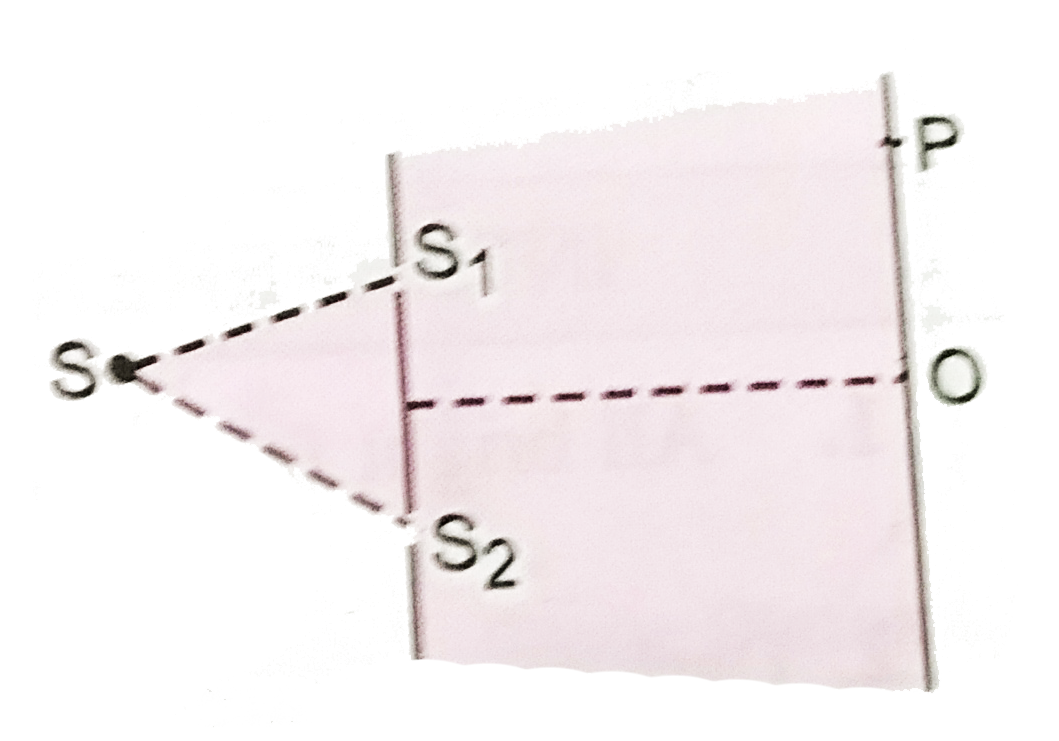
Fig. shows an experimental set up simill...

Fig. shows an experimental set up simillar to Young's double slit experiment to observe interference of light. Here `SS_(2) - SS_(1) = lambda//4`. Write down the conditions of (i) Contstructive interference
(ii) Destructive interference at any point `P` in terms of path diff. `(S_(2)P - S_(1)P)`. Does the central fringe observed in the above set up lie above or below `O` ? Give reason.

Text Solution

Verified by Experts

Initial path difference between sources `S_1 and S_2`
`SS_2 - SS_1 = lambda/4`
Let `OP = x`, the path difference between disturbances
from `S_1 and S_2 = (xd)/(D)`
Total path difference = `lambda/4 + (xd)/D`
For constructive interference,
`lambda/4 + (xd)/D = n lambda`
`= (xd)/(D) = lambda (n - 1/4) " ".......(i)`
For destructive interference,
`lambda/4 + (xd)/D = (2n - 1) lambda/2`
`(xd)/D = ((2 n lambda)/2 - lambda/2 - lambda/4)`
`= lambda (n - 1/2 - 1/4) = lambda (n - 3/4)`
(b) For central fringe putting n = 0 in (1) we get
`(xd)/D = lambda ((-1)/(4))`
`x = (lambda D)/(4d)`
The negative sign indicates that the central fringe lies below the central point.
Promotional Banner

Topper's Solved these Questions

  • WAVE OPTICAL

    MODERN PUBLICATION|Exercise Revision Exercises (Long Answer Questions)|9 Videos
  • WAVE OPTICAL

    MODERN PUBLICATION|Exercise Revision Exercises (Numerical Problems)|31 Videos
  • WAVE OPTICAL

    MODERN PUBLICATION|Exercise Revision Exercises (Fill in the Blanks)|10 Videos
  • SEMICONDUCTOR ELECTRONICS METERIALS DEVICES AND SIMPLE CIRCUITS

    MODERN PUBLICATION|Exercise CHAPTER PRACTICE TEST FOR BOARD EXAMINATION|12 Videos

Similar Questions

Explore conceptually related problems

The figure shows a modified Young’s double slit experimental set-up. Here S S_(2)-S S_(1)=lambda//4 . (a) Write the condition for constructive interference. (b) Obtain an expression for the fringe width.

The figure shows a modified Young's double slit experimental set-up. Here SS_(2)-SS1=lamda//4. (a) Write the condition for constructive interference. (b) Obtain an expression for the fringe width.

In Young's double-slit experiment, the point source is placed slightly off the central axis shown in Fig. 2.45. a. Find the nature and order of the interference at point P. b. Find the nature and order of the interference at point. O.

At two point P and Q on screen in Young's double slit experiment, waves from slits S_(1) and S_(2) have a path difference of 0 and (lamda)/(4) respectively. The ratio of intensities at P and Q will be:

(a) In Young's double slit experiment, derive the condition for (i) constructive interference and (ii) destructive interference at a point on the screen. (b) A beam of light consisting of two wavelengths, 800 nm and 600 nm is used to obtain the interference frings in a Young's double slit experiment on a screen placed 1.4 m away. If the two slits are separated by 0.28 mm, calculate the least distance from the central bright maximum where the bright fringes of the two wavelengths coincide.

Let S_(1) and S_(2) be the two slits in Young's double-slit experiment. If central maxima is observed at P and angle /_ S_(1) P S_(2) = theta , then fringe width for the light of wavelength lambda will be

In Young's double slit experiment, an interference pattern is obtained on a screen by a light of wavelength 6000Å , coming from the coherent sources S_1 and S_2 . At certain point P on the screen third dark fringe is formed. Then the path difference S_1P-S_2P in microns is

MODERN PUBLICATION-WAVE OPTICAL-Revision Exercises (Short Answer Questions)
  1. In a Young's double slit interference experiment, the ratio of intensi...

    Text Solution

    |

  2. What is the relation between phase difference and path difference ? Th...

    Text Solution

    |

  3. The ratio of amplitude of two waves producing interference pattern is ...

    Text Solution

    |

  4. Explain what is meant by diffraction of light. Describe a simple exper...

    Text Solution

    |

  5. (i) Write the condition under which light source can be said to be coh...

    Text Solution

    |

  6. (a) If one of two identical slits producing interference in Young's ex...

    Text Solution

    |

  7. What is interference ? In Young's double-slit experiment, show that th...

    Text Solution

    |

  8. Fig. shows an experimental set up simillar to Young's double slit expe...

    Text Solution

    |

  9. (a) The ratio of the widths of two slits in Young's double-slit experi...

    Text Solution

    |

  10. In Young's double slit experiment, what is the effect on the interfern...

    Text Solution

    |

  11. For a single slit of width ''a'' the first minimum of the interference...

    Text Solution

    |

  12. (a) Show using a proper diagram how unpolarised light can be linearly...

    Text Solution

    |

  13. What is meant by diffraction of light? Show graphically the relative i...

    Text Solution

    |

  14. (a) Write the factors by which the resolving power of a telescope can ...

    Text Solution

    |

  15. Resolving power of a microscope is

    Text Solution

    |

  16. What will be the ratio of the resolving powers of two convex lenses us...

    Text Solution

    |

  17. State and explain Brewster's law of polarization.

    Text Solution

    |

  18. What is polarisation of light? Explain polarisation by scattering.

    Text Solution

    |

  19. What are polaroids? Give their applications.

    Text Solution

    |

  20. (a) Using the phenomenon of polarisation, show how transverse nature o...

    Text Solution

    |
