Text Solution

Verified by Experts

The correct Answer is:

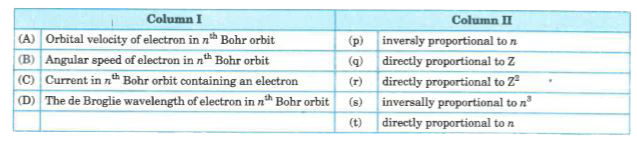
A-p,q ; B-r,s ; C-r,s ; D-t

Orbital velocity of electron in `n^(th)` Bohr orbit
`v_n=v_0 Z/n`
`therefore A to` (q,p)
angular speed of electron in `n^(th)` Bohr orbit
`omega_r=omega_0Z^2/n^3`
`therefore B to `(r,s)
Current in `n^(th)` Bohr orbit due to electron :
`I=(ev_n)/(2pir_n) =(I_0Z^2)/n^3`
`therefore C to ` (r,s)
de Broglie wavelength of electron in `n^(th)` orbit
`therefore D to` (t) `lambda=h/p=((2h^2epsilon_0)/(me^2))n (because P="me"^2/(2epsilon_0hn))`
Promotional Banner

Topper's Solved these Questions

  • ATOMS

    MODERN PUBLICATION|Exercise COMPETITION FILE (Integers )|9 Videos
  • ATOMS

    MODERN PUBLICATION|Exercise COMPETITION FILE (Ncert Exemplar Problems )|13 Videos
  • ATOMS

    MODERN PUBLICATION|Exercise COMPETITION FILE ( Matching )|1 Videos
  • ALTERNATING CURRENT

    MODERN PUBLICATION|Exercise CHAPTER PRACTICE TEST|16 Videos
  • CURRENT ELECTRICITY

    MODERN PUBLICATION|Exercise Chapter Practice Test|15 Videos
MODERN PUBLICATION-ATOMS -COMPETITION FILE (Matrix match )
  1. Text Solution

    |

  2. Text Solution

    |
