Home
Class 12
PHYSICS
Obtain the maximum kinetic energy of bet...

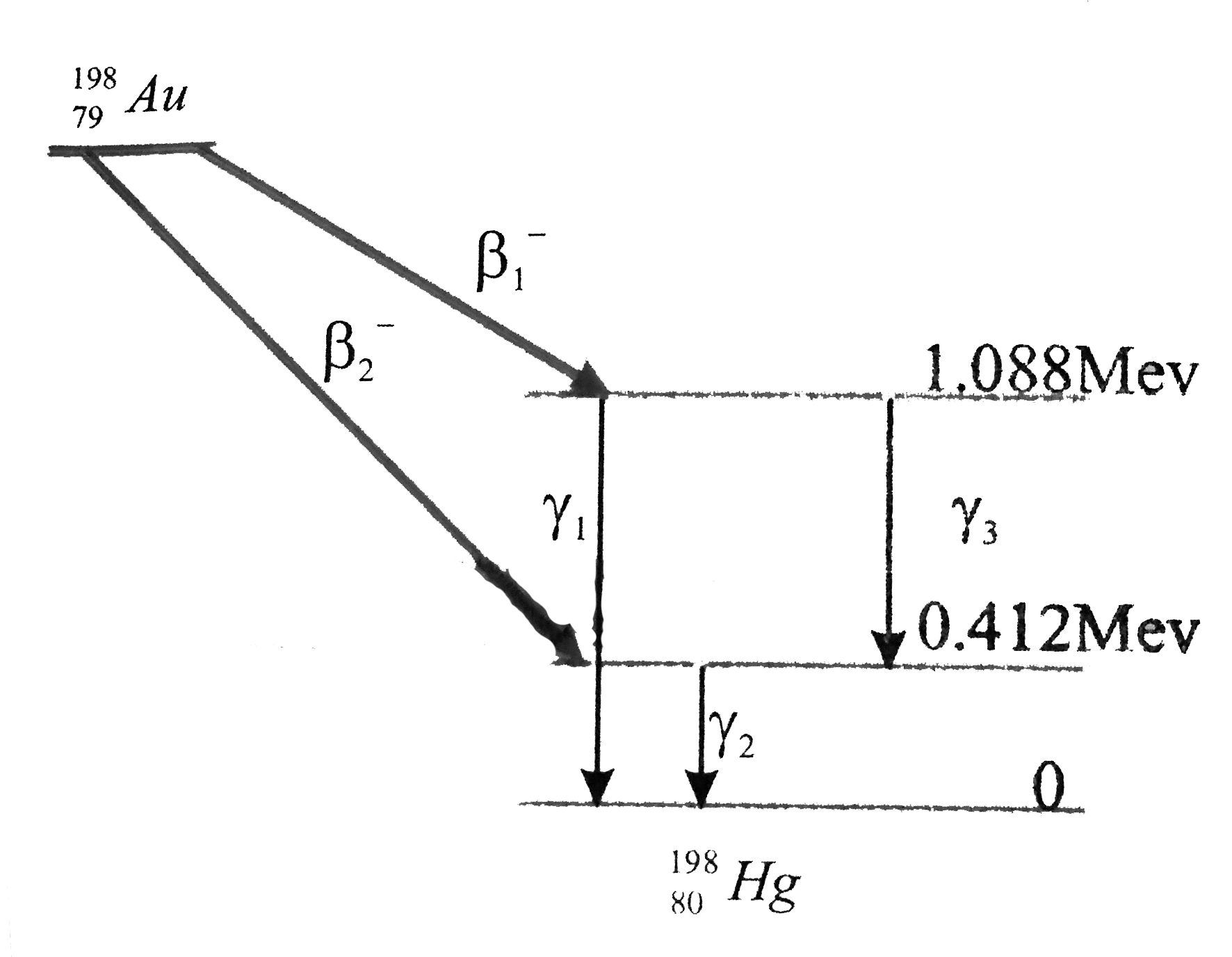
Obtain the maximum kinetic energy of `beta`-particles, and the radiation frequencies of `gamma` decays in the decay scheme shown in Fig. `14.6`. You are given that `m(.^(198)Au)=197.968233 u, m(.^(198)Hg)=197.966760 u`

Text Solution

Verified by Experts

Beta decay equation for `""_(79)Au^(198)` is
`""_(79)Au^(198) to ""_(80)Hg^(198) + _(-1)e^(0) + barv +Q`
But `Q=(m_(N)(""_(79)Au^(198))-[m_(N)(""_(80)Hg^(198))+m_(e)]c^(2)`
(Ignoring rest mass of antineutrino) where mN represents nuclear mass. In terms of atomic masses
`Q=(m(""_(79)Au^(198))-79m_(e))-(m(""_(80)Hg^(198))-80m_(e))+m_(e))c^(2)`
`=(m(""_(79)Au^(198))-m(""_(80)Hg^(198))c^(2)`
Hence, K.E. of particles.
`Q =(m(""_(79)Au^(198))-(m(""_(80)Hg^(198))u xx c^(2)`
`=0.001473 xx 931.5 MeV = 1.3721` MeV
In `beta_(1)^(-)` transition, energy shared by
`""_(80)Hg^(198) = 1.088 MeV` (from the given figure)
Max kinetic energy of `beta_(1)` (particle ignoring kinetic energy of `barv`)
`=1.3721-1.088`
`=0.2841` MeV
In `beta_(2)^(-)` transition, K.E. shared by
`""_(80)Hg^(198)=0.412` MeV (from the given figure)
Mass kinetic energy of `beta_(2)^(-)` particle.
`=1.3721 - 0.412 = 0.9601` MeV
For `lambda_(1)` transition, energy is given as follows:
`hv_(1)=1.088 MeV`
`=1.088 xx 1.6 xx 10^(-13)` J
Corresponding frequency is calculated as follows:
`v_(1) = (1.088 xx 1.6 xx 10^(-13))/h`
`=2.6273 xx 10^(20)` Hz
For `gamma_(2)` transition, energy is given as follows:
`hv_(2)=0.412` MeV
`=0.412 xx 1.6 xx 10^(-13)` J
Corresponding frequency is calculated as follows:
`v_(2)=(0.412 xx 1.6 xx 10^(-13))/h = (0.412 xx 1.6 xx 10^(-12))/(6.626 xx 10^(-34))`
`=0.99488 xx 10^(20)` Hz
For `gamma_(2)`
`hv_(3)=hv_(1)-hv_(2)=((hv_(1)-hv_(2))/h) = v_(1)-v_(2)`
`=2.62730 xx 10^(20) - 0.99488 xx 10^(20)`
`=1.63242 xx 10^(20)` Hz.
Promotional Banner

Topper's Solved these Questions

  • NUCLEI

    MODERN PUBLICATION|Exercise NCERT FILE SOLVED (NCERT EXEMPLAR PROBLEMS SUBJECTIVE QUESTIONS) (VERY SHORT ANSWER TYPE QUESTIONS)|5 Videos
  • NUCLEI

    MODERN PUBLICATION|Exercise NCERT FILE SOLVED (NCERT EXEMPLAR PROBLEMS SUBJECTIVE QUESTIONS (SHORT ANSWER TYPE QUESTIONS))|5 Videos
  • NUCLEI

    MODERN PUBLICATION|Exercise NCERT FILE SOLVED (TEXTBOOK EXERCISES)|22 Videos
  • MOVING CHARGES AND MAGNETISM

    MODERN PUBLICATION|Exercise CHAPTER PRACTICE TEST|13 Videos
  • RAY OPTICS AND OPTICAL INSTRUMENTS

    MODERN PUBLICATION|Exercise CHAPTER PRACTICE TEST|14 Videos

Similar Questions

Explore conceptually related problems

Calculate the kinetic energy of beta -particles and the radiation frequencies corresponding to the gamma -decays shown in figure. Given, mass of ._12Mg^27 atom =26.991425 amu and mass of ._13Al^27 atom = 26.990080 amu

Calculate the maximum kinetic energy of the bera particle emitted in the following decay scheme: ^12N rarr 12C **+e^(+)+v ^12C rarr ^12C + gamma(4.43 MeV). The atomic mass of 12N is 12.018612 u.

Calculate the maximum energy that a beta particle can have in the following decay: ._(8)O^(19) to ._(9)F^(19)+._(-1)e^(0)+barV Given, m(._(8)O^(19))=19.003576u, m(._(9)F^(19))=18.998403u, m(._(-1)e^(0))=0.000549u

Gold ._(79)^(198)Au undergoes beta^(-) decay to an excited state of ._(80)^(198)Hg . If the excited state decays by emission of a gamma -photon with energy 0.412 MeV , the maximum kinetic energy of the electron emitted in the decay is (This maximum occurs when the antineutrino has negligble energy. The recoil enregy of the ._(80)^(198)Hg nucleus can be ignored. The masses of the neutral atoms in their ground states are 197.968255 u for ._(79)^(198)Hg ).

A nucleus ""_(10)Ne^(23) undergoes beta - decay and becomes ""_(11)Na^(23) . Calculate the maximum kinetic energy of electrons emitted assuming that the daughter nucleus and antineutrino carry negligible kinetic energy. Given mass of ""_(10)Ne^(23) = 22.994466 u and mass of ""_(11)Na^(23) = 22.989770 m

Consider one of the fission reactions of U^(235) by thernmal neutrons : ._(92)U^(235) + n rarr ._(38)Sr^(94) + ._(54)Ce^(140) + 2n The fission fragments are, however, not stable. They unaergo successive beta- decays unit ._(38)Sr^(94) becomes ._(40)Zr^(94) and ._(54)Xe^(140) becomes ._(58)Ce^(140) . Estimate the total energy released in the process. Is all that energy available as kinetic energy of the fission products (Zr and Ce)? You are given that m (U^(235)) = 255.0439 am u," " m_(n) = 1.00866 am u " " m(Zr^(94)) = 93.9065 am u, " " m(Ce^(140)) = 139.9055 am u

Consider the beta decay ^198 Au rarr ^198 Hg ** + Beta^(-1) + vec v . where ^198 Hg^** represents a mercury nucleus in an excited state at energy 1.088 MeV above the ground state. What can be the maximum kinetic energy of the electron emitted? The atomic mass of ^198 Au is 197.968233 u and that of ^198 Hg is 197.966760 u .
