A
B
C
D
Text Solution
Verified by Experts
The correct Answer is:
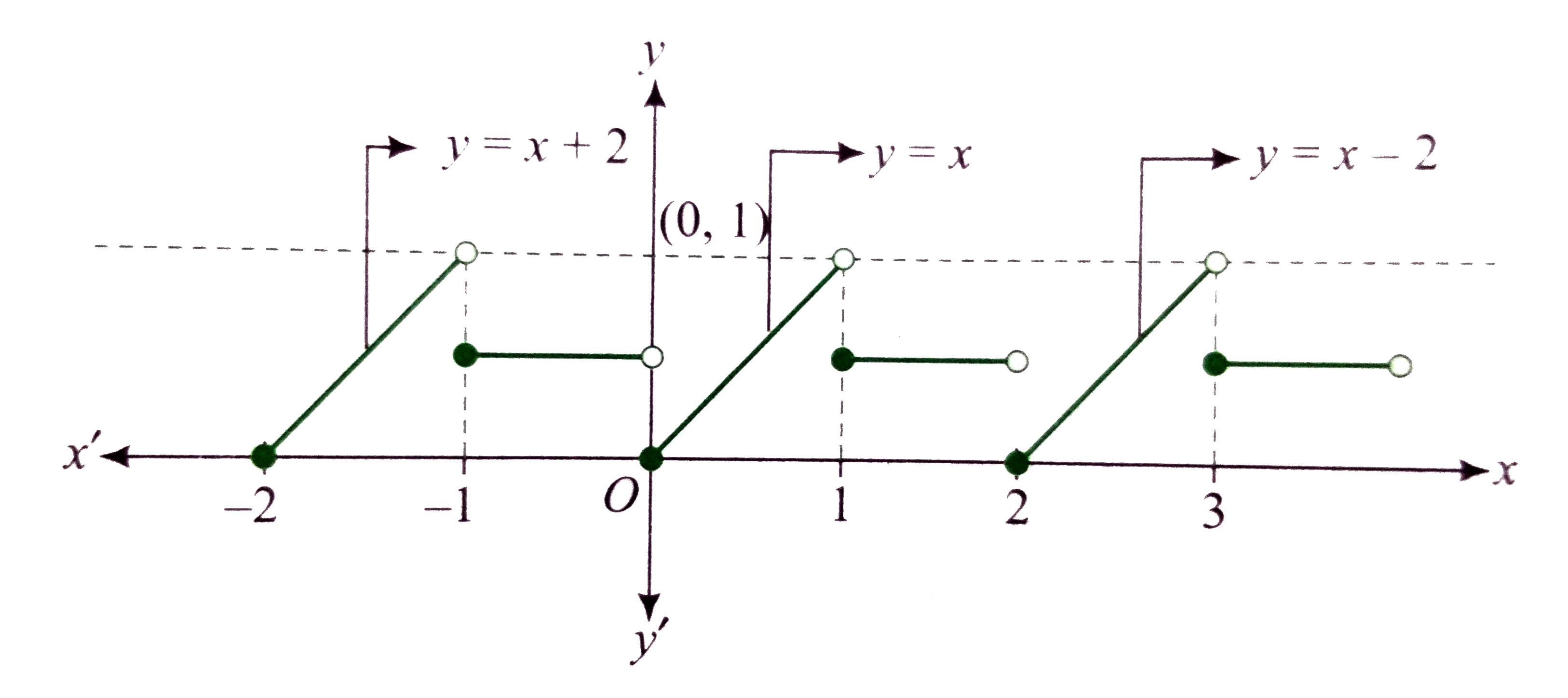



Topper's Solved these Questions
RELATIONS AND FUNCTIONS
CENGAGE|Exercise Exercise (Comprehension)|32 VideosRELATIONS AND FUNCTIONS
CENGAGE|Exercise Exercise (Matrix)|9 VideosRELATIONS AND FUNCTIONS
CENGAGE|Exercise Exercise (Single)|125 VideosQuadratic Equations, Inequalities, Modulus and Logarithms
CENGAGE|Exercise Question Bank|31 VideosSCALER TRIPLE PRODUCTS
CENGAGE|Exercise DPP 2.3|11 Videos
Similar Questions
Explore conceptually related problems
CENGAGE-RELATIONS AND FUNCTIONS-Exercise (Multiple)
- Let f(x)={x^2-4x+3,x<3x-4,xgeq3 a n dg(x)={x-3,x<4x^2+2x+2,xgeq4 the...
Text Solution
|
- Let f(x)="max"(1+s in x ,1,1-cosx),x in [0,2pi],a n dg(x)=max{1,|x-1|}...
Text Solution
|
- Consider the function y =f(x) satisfying the condition f(x+1/x)=x^2+1...
Text Solution
|
- Consider the real-valued function satisfying 2f(sinx)+f(cosx)=xdot the...
Text Solution
|
- If f: R^+rightarrowR^+ is a polynomial function satisfying the functio...
Text Solution
|
- f(x)=x^2-2a x+a(a+1),f:[a ,oo)rightarrow[a ,oo)dot If one of the solut...
Text Solution
|
- Which of the following function is/are periodic?
Text Solution
|
- Let f(x)=(3)/(4)x+1,f^(n)(x) be defined as f^(2)(x)=f(f(x)), and for n...
Text Solution
|
- lf the fundamental period of function f(x)=sinx + cos(sqrt(4-a^2))x is...
Text Solution
|
- f(x)=sin^(-1)[e^(x)]+sin^(-1)[e^(-x)] where [.] greatest integer funct...
Text Solution
|
- [2x]-2[x]=lambda where [.] represents greatest integer function and {....
Text Solution
|
- The set of all values of x satisfying {x}=x[xx] " where " [xx] repres...
Text Solution
|
- The function 'g' defined by g(x)= sin(sin^(-1)sqrt({x}))+cos(sin^(-1)s...
Text Solution
|
- If the function / satisfies the relation f(x+y)+f(x-y)=2f(x),f(y)AAx ,...
Text Solution
|
- Let f(x)+f(y)=f(xsqrt(1-y^2)+ysqrt(1-x^2))[f(x) is not identically zer...
Text Solution
|
- Let f: RvecR be a function defined by f(x+1)=(f(x)-5)/(f(x)-3)AAx in ...
Text Solution
|
- Let a function f(x), x ne 0 be such that f(x)+f((1)/(x))=f(x)*f((1)...
Text Solution
|
- Let f be a differential function such that f(x)=f(2-x) and g(x)=f(1 +x...
Text Solution
|
- The figure illustrates the graph of the function y=f(x) defined in [-3...
Text Solution
|
- If graph of a function f(x) which is defined in [-1, 4] is shown in th...
Text Solution
|