Home
Class 12
MATHS
Let f(x)= maximum {x^2, (1-x)^2, 2x(1 - ...

Let `f(x)=` maximum `{x^2, (1-x)^2, 2x(1 - x)}` where `x in [0, 1].` Determine the area of the region bounded by the curve `y=f(x)` and the lines `y = 0,x=0, x=1.`

Text Solution

Verified by Experts

`f(x)="Maximum "{x^(2),(1-x^(2)),2x(1-x)}`
We draw the graphs of
`y=x^(2)" (1)"`
`y=(1-x^(2))" (2)"`
`y=2x(1-x)" (3)"`
Solving (1) and (3), we get `x^(2)=2x(1-x)`
`"or "3x^(2)=2xrArrx=0 or x=2//3.`
Solving (2) and (3) we get `(1-x)^(2)=2x(1-x)`
`rArr" "x=1//3 and x=1,`
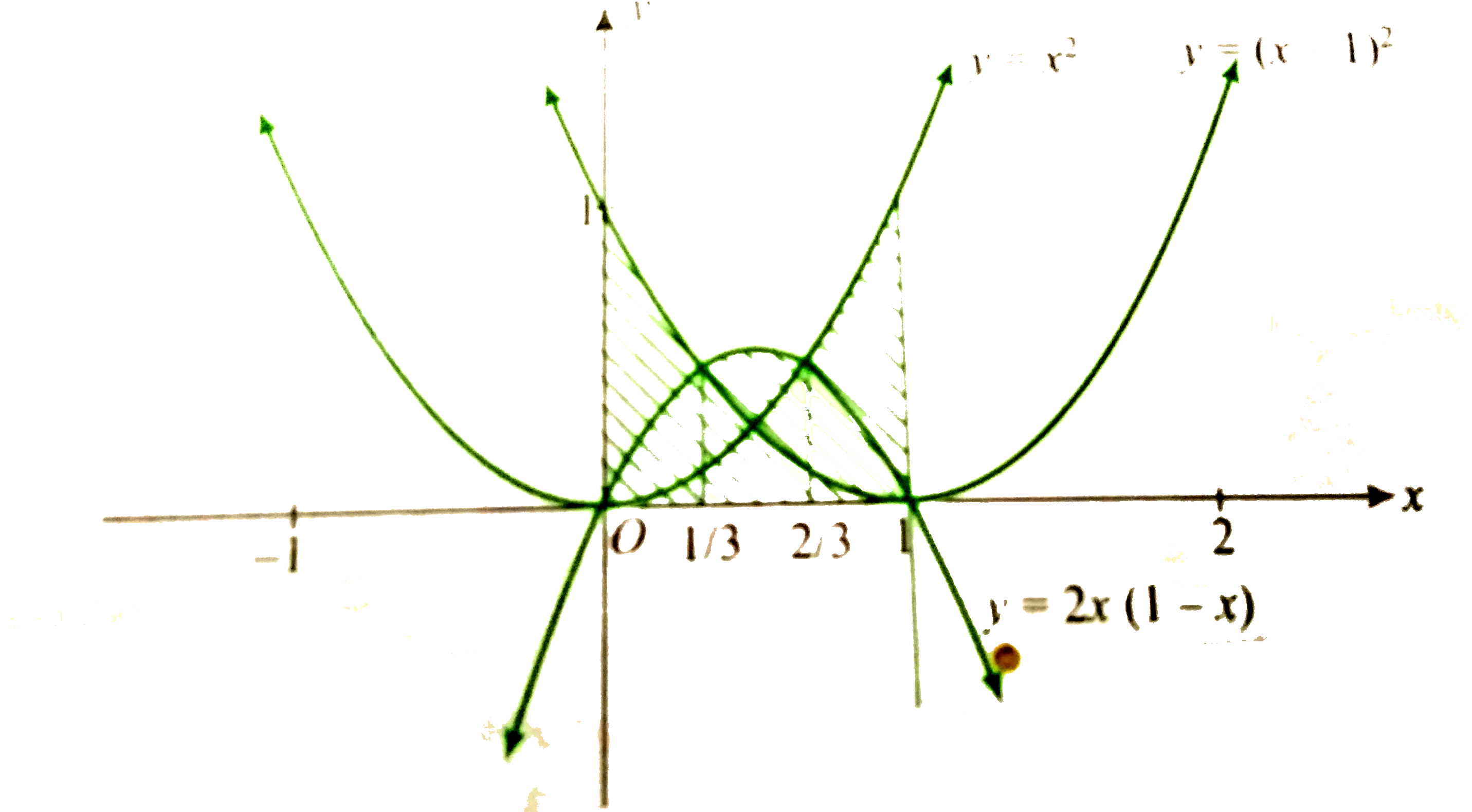
From the figure, it is clear that
`f(x){{:((1-x^(2)), "for ", 0le x le 1//3),(2x(1-x),"for ", 1//3 le x le 2//3),(x^(2), "for ", 2//3 lt x le 1):}`
The required area A is given by
`A=int_(0)^(1)f(x)dx`
`=f_(0)^(1//3)(1-x)^(2)dx+f_(1//3)^(2//3)2x(1-x)dx+int_(2//3)^(1)x^(2)dx`
`=-[(1)/(3)(1-x)^(3)]_(0)^(1//3)+[(x^(2)-(2x^(3))/(3))]_(1//3)^(2//3)+[(x^(3))/(3)]_(2//3)^(1)`
`=-(1)/(3)((2)/(3))^(3)+(1)/(3)+((2)/(3))^(2)-(2)/(3)((2)/(3))^(3)-((1)/(3))^(2)+(2)/(3)((1)/(3))^(3)+(1)/(3)-(1)/(3)((2)/(3))^(3)`
`=(17)/(27)` sq. units.

Promotional Banner

Topper's Solved these Questions

  • AREA

    CENGAGE|Exercise Exercise 9.1|9 Videos
  • AREA

    CENGAGE|Exercise Exercise 9.2|14 Videos
  • APPLICATIONS OF DERIVATIVES

    CENGAGE|Exercise Question Bank|29 Videos
  • AREA UNDER CURVES

    CENGAGE|Exercise Question Bank|20 Videos

Similar Questions

Explore conceptually related problems

Find the area of the region bounded by the curve xy=1 and the lines y=x,y=0,x=e

Find the area of the region bounded by the curve (y-1)^2=4(x+1) and the line y= x-1

The area of the region bounded by the curves 2x=y^(2)-1 and x=0

The area of the region bounded by the curve y=2x+3 ,x-axis and the lines x=0 and x=2 is

Find the area of the region bounded by the curve y^(2)=x and the lines x=1,x=4 and the x-axis.

Let f(x)=M a xi mu m{x^2,(1-x)^2,2x(1-x)}, where 0lt=xlt=1. Determine the area of the region bounded by the curves y=f(x) ,x-axis ,x=0, and x=1.

The area of the region bounded by the curve C :y=(x+1)/(x^(2)+1) nad the line y=1 , is

The area of the region bounded by the curves y^(2)=4a^(2)(x-1) and the lines x = 1 and y = 4a, is

Find the area of the region bounded by the curve y = x^(2) , the X−axis and the given lines x = 0 , x = 3

Find the area of the region bounded by the curve y = x^2 , the x-axis, and the lines x = 1 and x = 3.
