The givne curves are
`x^(2)+y^(2)=4 ("circle")" (1)"`
`x^(2)=-sqrt(2)y ("parabola, concave downward")" (2)"`
`x=y ("straight line through origin")" (3)"`
Solving equations (1) and (2), we get
`y^(2)-sqrt(2)y-4=0`
`rArr" "y=2sqrt(2) or -sqrt(2)`
`rArr" "x^(2)=2 ("rejecting "y=2sqrt(2) as x^(2) " is positive ")`
`"or "x = pm sqrt(2).`
Therefore, points of intersection of (1) and (2) are `B (sqrt(2),-sqrt(2)), A(-sqrt(2),-sqrt(2))`.
Solving (1) and (3), we get
`2x^(2)=4 or x^(2)=2 or x = pmsqrt(2) or y =pm sqrt(2).`
Therefore, points of intersection are `(-sqrt(2),-sqrt(2)),(sqrt(2),sqrt(2)).`
Thus, all the three curves pass through the same point `A(-sqrt(2),-sqrt(2))`.
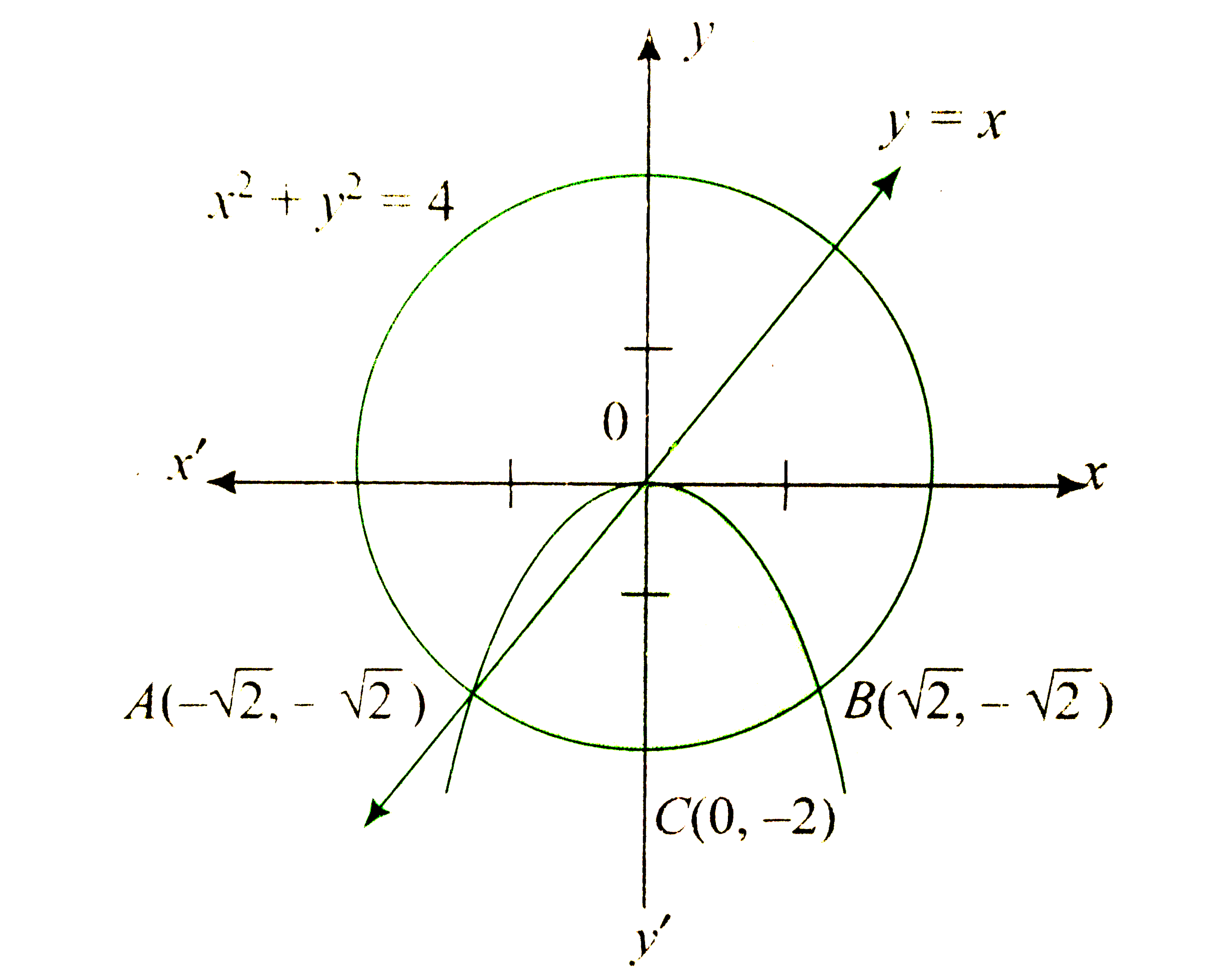
Now, Required area = Area of the shaded region
`=int_(-sqrt(2))^(0) (x-(-sqrt(4-x^(2))))dx+int_(0)^(sqrt(2))(-(x^(2))/(sqrt(2))-(-sqrt(4-x^(2))))dx`
`=2int_(0)^(sqrt(2))sqrt(4-x^(2))dx+int_(-sqrt(2))^(0)x dx - int_(0)^(sqrt(2))(x^(2))/(sqrt(2))dx`
`=2[(x)/(2)sqrt(4-x^(2))+(4)/(2)sin ^(-1)""(x)/(2)]_(0)^(sqrt(2))+[(x^(2))/(2)]_(-sqrt(2))^(0)-[(x^(2))/(3sqrt(2))]_(0)^(sqrt(2))`
`=2[(sqrt(2))/(2)sqrt(4-2)+2 sin^(-1)((sqrt(2))/(2))]+[(-2)/(2)]-[(2sqrt(2))/(3sqrt(2))]`
`=2[1+2(pi)/(2)]-1 -(2)/(3)=pi+(1)/(3)`sq. units.


