Home
Class 12
MATHS
A curve is given by b yy={(sqrt(4-x^2)),...

A curve is given by `b yy={(sqrt(4-x^2)),0lt=x<1sqrt((3x)),1lt=xlt=3.` Find the area lying between the curve and x-axis.

Text Solution

Verified by Experts

The correct Answer is:
`(1)/(6)(2pi-sqrt(3)+36)` sq. units

The given curve is
`y={{:(sqrt((4-x^(2)))",",0lexlt1),(sqrt((3x))",",1lexle3):}`
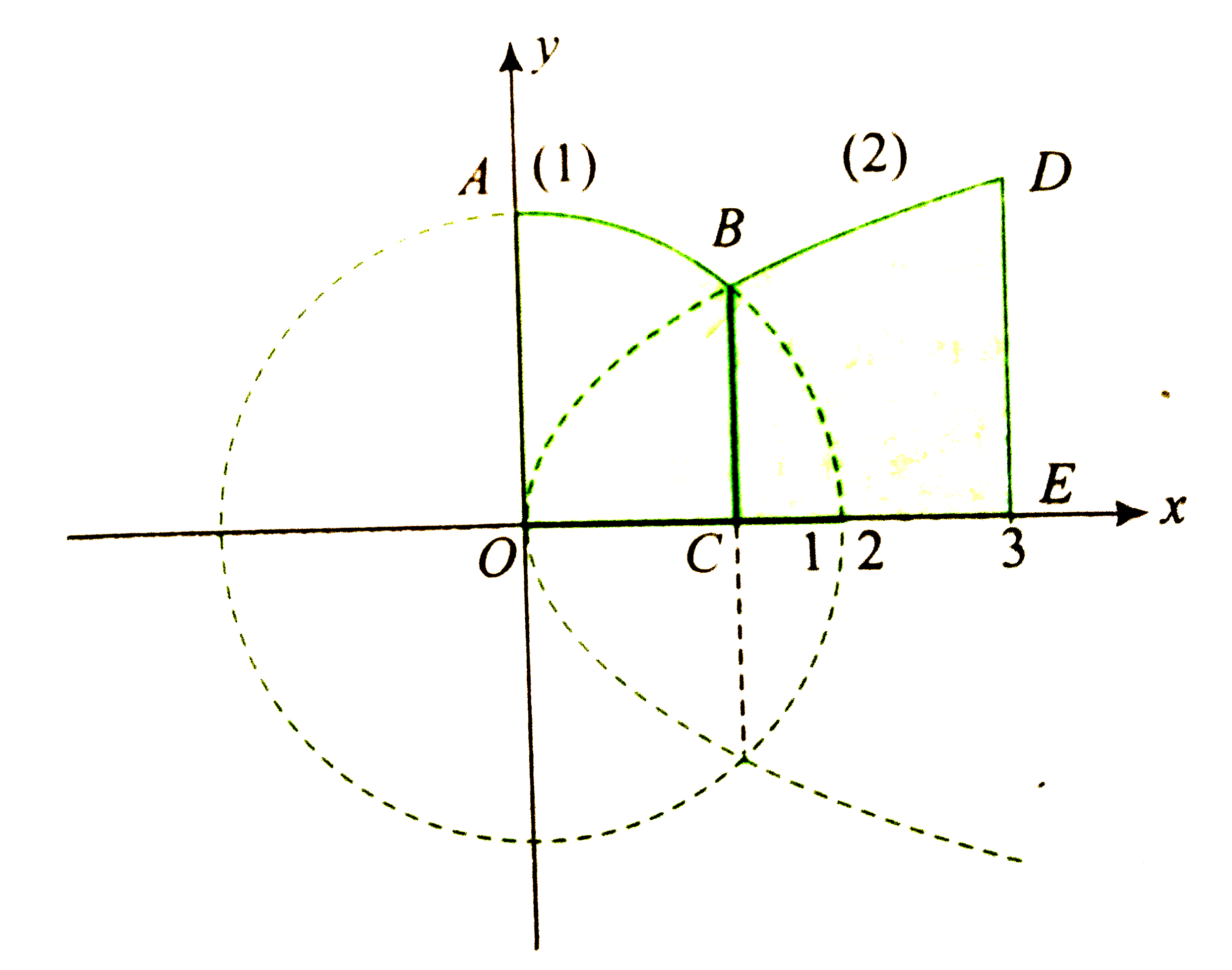
Obviously, the curve is the are of the circle `x^(2)+y^(2)=4" (1)"`
between `0lexlt1` and the are of parabola `y^(2)=3x" (2)"`
between `1lexle3`
Required area = shaded area
=Area OABCO+Area CBDEC
`=|int_(0)^(1)sqrt((4-x^(2)))dx|+|int_(1)^(3)sqrt(3x)dx|`
`|[(1)/(2)xsqrt((4-x^(2)))+(4)/(2)sin^(-1)((x)/(2))]_(0)^(1)|+|sqrt(3)[(2)/(3)x^(3//2)]_(1)^(3)|`
`=((sqrt(3))/(2)+(pi)/(3))+(2)/(3)(9-sqrt(3))`
`=(1)/(6)(2pi-sqrt(3)+36)` sq. units.
Promotional Banner

Topper's Solved these Questions

Similar Questions

Explore conceptually related problems

A curve is given by y={(sqrt(4-x^(2))),0<=x<1 and sqrt((3x)),1<=x<=3 Find the area lying between the curve and x -axis.

Discuss the continuity of the function f at x = 0 and x = 2, where f is given as : f(x) ={((sin3x)/(sin4x),; -1lt= x lt=0), (3x+3/4,; 0lt x lt2), ((x^2+x-6)/(x-2),; 2lt= x lt=4):}

Area under the curve y=sqrt(16-x^(2)) between x = 0 and x = 4 in the first quadrant is

The angle between the curves y=sin x and y = cos x, 0 lt x lt (x)/(2) , is

D={x:0<=4x^(2)<=1}

The points of discontinuity of the function f(x)={2sqrt(x)\ \ \ ,\ \ \ 0lt=xlt=1 ,\ \ \4-2x\ \ \ ,\ \ \ 1< x

If f(x) is continuous on [-2, 2], where f(x)={:{((sin ax)/(x)+2", for " -2 le x lt 0),(3x+5", for " 0 le x le 1),(sqrt(x^(2)+8)-b", for " 1 lt x lt 2):} , then a+b=

Area of the region bounded by the curve y={{:(x^(2)",",x lt0),(x",",x ge0):} and the line y=4 is

Verify Rolle's theorem for the following functions (i) f(x) = sqrt(4 - x^(2)) " in " [-2, 2] (ii) f(x) = log ((x^(2) + ab)/((a + b)x)] " in " [a, b], " where " 0 lt a ltb

Prove that sin^(-1). ((x + sqrt(1 - x^(2))/(sqrt2)) = sin^(-1) x + (pi)/(4) , where - (1)/(sqrt2) lt x lt(1)/(sqrt2)

