Home
Class 12
PHYSICS
The variation of electrostatic potential...

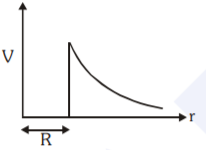
The variation of electrostatic potential with radial distance r from centre of positively charged metallic thin shell of radius R is given by graph

A

B

`##NEET_RE_20_PHY_33_O02##`

C

`##NEET_RE_20_PHY_33_O03##`

D

`##NEET_RE_20_PHY_33_O04##`

Text Solution

AI Generated Solution

The correct Answer is:

To solve the problem of the variation of electrostatic potential with radial distance \( r \) from the center of a positively charged metallic thin shell of radius \( R \), we will analyze the potential in three regions: inside the shell, on the surface, and outside the shell. ### Step-by-Step Solution: 1. **Understanding the Electric Field Inside the Shell:** - For a metallic shell, the electric field \( E \) inside the shell (for \( r < R \)) is zero. This is due to the property of conductors in electrostatic equilibrium, where charges reside on the surface and do not create an electric field inside. **Hint:** Recall that for a conductor in electrostatic equilibrium, the electric field inside is zero. 2. **Potential Inside the Shell:** - Since the electric field \( E = 0 \) inside the shell, the potential \( V \) remains constant throughout this region. The potential inside the shell is equal to the potential at the surface. **Hint:** Remember that if \( E = 0 \), then \( dV = -E \, dr \) implies \( dV = 0 \). 3. **Calculating the Potential on the Surface:** - The potential \( V \) at the surface of the shell (for \( r = R \)) can be calculated using the formula for the potential due to a point charge: \[ V(R) = \frac{1}{4 \pi \epsilon_0} \cdot \frac{Q}{R} \] - Here, \( Q \) is the total charge on the shell. **Hint:** Use the formula for the potential due to a point charge to find the potential at the surface. 4. **Potential Outside the Shell:** - For \( r > R \), the shell behaves like a point charge located at its center. The potential at a distance \( r \) from the center is given by: \[ V(r) = \frac{1}{4 \pi \epsilon_0} \cdot \frac{Q}{r} \] - This shows that the potential decreases as \( r \) increases. **Hint:** Remember that outside a charged shell, the potential behaves like that of a point charge. 5. **Summary of Potential Variation:** - **For \( r < R \)**: The potential \( V \) is constant and equal to \( V(R) \). - **For \( r = R \)**: The potential is \( V(R) = \frac{1}{4 \pi \epsilon_0} \cdot \frac{Q}{R} \). - **For \( r > R \)**: The potential \( V \) decreases as \( \frac{1}{r} \). ### Final Answer: The variation of electrostatic potential \( V \) with radial distance \( r \) from the center of the positively charged metallic thin shell is: - Constant for \( r < R \), - Equal to \( \frac{1}{4 \pi \epsilon_0} \cdot \frac{Q}{R} \) at \( r = R \), - Decreasing as \( \frac{1}{r} \) for \( r > R \).
Promotional Banner

Topper's Solved these Questions

  • PROPERTIES OF MATTER

    NEET PREVIOUS YEAR (YEARWISE + CHAPTERWISE)|Exercise All Questions|15 Videos
  • RE-NEET 2024

    NEET PREVIOUS YEAR (YEARWISE + CHAPTERWISE)|Exercise Question|50 Videos

Similar Questions

Explore conceptually related problems

The electrostatic field due to a point charge depends on the distance r as (l//r^(2)) . Similarly, indicates how each of the following quantities depends on r : (a) Intensity of light from a point source (b) Electrostatic potential due to a point source (c) Electrostatic potential due to a distance r from the center of a charged metallic sphere of radius R (r lt R) .

Two concentric spherical shells of radii r and R(rltR) have surface charge densities -sigma and +sigma respectively. The variation ofelectric potential V with distance x from the centre O of the shells plotted. Which of the following graphs best depict the variation qualitatively?

The dependence of electric potential V on the distance 'r' from the centre of a charged spherical shell is shown by :

The given graph shows variation (with distance r from centre) of:

The given graph shows variation (with distance r from centre) of:

Which one of the following graphs represents the variation of electric field with distance r from the centre of a charged spherical conductor of radius R?

The correct variation of gravitational potential V with radius r measured from the centre of earth of radius R is given by

The potential at a distance R//2 from the centre of a conducting sphere of radius R will be

NEET PREVIOUS YEAR (YEARWISE + CHAPTERWISE)-RE-NEET 2020-All Questions
  1. A liquid does not wet solid surface if angle of contact is

    Text Solution

    |

  2. A point mass m is moved in vertical circle of radius r with help of st...

    Text Solution

    |

  3. An object is placed on principal axis of concave mirror at distance of...

    Text Solution

    |

  4. Half life of radioactive sample undergoing alpha decayis 1.4 x 10^17s....

    Text Solution

    |

  5. If critical angle for TIR from medium to vacuum is 45 deg then velocit...

    Text Solution

    |

  6. A wheel with 20 metallic spokes each 1m long is rotated with a speed o...

    Text Solution

    |

  7. An ideal gas equation can be written as P = rho R T/ M0 where rho and ...

    Text Solution

    |

  8. The variation of electrostatic potential with radial distance r from c...

    Text Solution

    |

  9. Which of the following gate is called universal gate

    Text Solution

    |

  10. PV Diagram for ideal gas in piston cylinder assembly undergoing a ther...

    Text Solution

    |

  11. Power of biconvex lens is 10 diopters and radius of curvature of each ...

    Text Solution

    |

  12. Intrinsic semiconductor is converted into ntype extrinsic semiconducto...

    Text Solution

    |

  13. Barometer is constructed using liquid . What would be height of liquid...

    Text Solution

    |

  14. A wire of length l meter carrying current i ampere is bent in form of ...

    Text Solution

    |

  15. A paralel plate capacitor having cross sectional area A and seperation...

    Text Solution

    |

  16. What is depth at which value of acceleration due to gravity becomes 1/...

    Text Solution

    |

  17. Time intervals measured by clock give following readings: 1.25s, 1.24s...

    Text Solution

    |

  18. Three identical spheres each of mass M are placed at corners of right ...

    Text Solution

    |

  19. Equivalent resistance between A and B for mesh is

    Text Solution

    |

  20. Calculate acceleration of block and trolly system shown in figure. Coe...

    Text Solution

    |
