Home
Class 12
PHYSICS
Consider two point charges q(1) and q(2)...

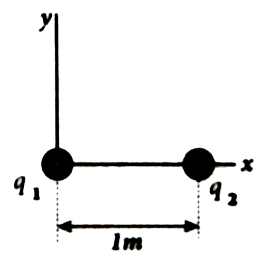
Consider two point charges `q_(1)` and `q_(2)` at rest as shown in the figure. They are separated by a distance of 1 m. Calculate the force experienced by the two charges for the following cases:
(a) `q_(1)=+2 mu` C and `q_(2)=+3mu C `
(b) `q_(1)=+2mu`C and `q_(2)=-3mu` C
(c) `q_(1)=+2muC ` and `q_(2)-3mu` C kept in water `(epsilon_(r)=80)`

Text Solution

Verified by Experts
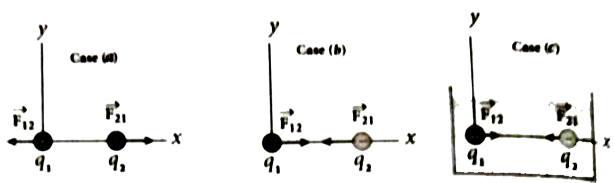

(a) `q_(1)=+2 mu` C and `q_(2)=+3muC` and r=1 m. Both are positive charges . So the force will be repulsive
Force experienced by the charge `q_(2)` due to `q_(1)` is given by
`vecF=(1)/(4piepsilon_(0))(q_(1)q_(2))/(r^(2))r_(12)`
Here `r_(12)` is the unit vector from `q_(1)` to `q_(2)` . Since `q_(2)` is located on the right of `q_(1)` we have `hatr_(12)=hati` , so that
`vecF_(n)=(9xx10^(9)xx2xx10^(-6)xx3xx10^(-6))/(1^(2))hati[(1)/(4piepsilon_(0))=9xx10^(9)]`
`= 54xx10^(-3)N hati`
According to Newton .s third law the force experienced by the charge `q_(1)` due to `q_(2)` is `vecF_(12)=-vecF_(21)`
So that `vecF_(12)=-54xx10^(-3)Nhati`
The directions of `vecF_(21)` and `vecF_(12)` are shown in the above figure in case (a)
(b) `q_(1)=+2muC, q_(2)=-3muC` and r=1 m. They are unlike charges . So the force will be attractive force experienced by the charge `q_(2)` due to `q_(1)` is given by
`vecF_(21)=(9xx10^(9)xx(2xx10^(-6))xx(-3xx10^(-6))/(1^(2))hatr_(12)=-54xx10^(-3)N hati("Using " hatr_(12)=hati)`
The charge `q_(2)` will experience an attractive force towards `q_(1)` which is in the negative x direction .
According to Newton.s third law the force experienced by the charge `q_(1)` due to `q_(2)` is `vecF_(12)=-vecF_(21)`
So that `vecF_(12)=54xx10^(-3)Nhati)`
The directions of `vecF_(21)` and `vecF_(12)` are shown in the figure (case (b)).
(c ) If these two charges are kept inside the water then the forrce experienced by `q_(2)` due to `q_(1)vecF_(21)^(w)=(1)/(4piepsilon)(q_(1)q_(2))/(r^(2))hatr_(12)" "` Since `epsilon=epsilon_(r)epsilon_(0)` ,
we have `vecF_(21)^(w) =(1)/(4piepsilon_(r)epsilon_(0))(q_(1)q_(2))/(r^(2)) hatr_(12)=(vecF_(21))/(epsilon_(r))`
Therefore `hatF_(21)^(w)=(-54xx10^(-3)N)/(80)hati=-0.675xx10^(-3)Nhati`
Promotional Banner

Topper's Solved these Questions

  • ELECTROSTATICS

    FULL MARKS|Exercise Textual Evaluation Solved (Multiple choice questions : )|15 Videos
  • ELECTROSTATICS

    FULL MARKS|Exercise Textual Evaluation Solved (II. Short Answer Questions : )|21 Videos
  • DUAL NATURE OF RADIATION AND MATTER

    FULL MARKS|Exercise ADDITIONAL QUESTIONS -( ADDITIONAL NUMERICAL PROBLEMS : )|10 Videos
  • MAGNETISM AND MAGNETIC EFFECTS OF ELECTRIC CURRENT

    FULL MARKS|Exercise ADDITIONAL QUESTIONS SOLVED - NUMERICAL PROBLEMS :|4 Videos

Similar Questions

Explore conceptually related problems

Two point charges q_(1) and q_(2) of magnitude + 10^(-8) c and -10^(-8) c respectively are placed 0.1 m apart calculate the electric field between the point charges

Five identical charges Q are placed equidistant on a semicircle as shown in the figure . Another point charge q is kept at the center of the circle of radius R. Calculate the electrostatic force experienced by the charge q.

Two points charges 20 mu C and 10muC are separated by 1m in air. Find the work done to separate them two metre apart.

Consider four equal charges q_(1),q_(2),q_(3) and q_(4)=q=+1muC located at four different points on a circle of radius 1m , as shown in the figure. Calculate the total force acting on the charge q_(1) due to all the other charges .

