Home
Class 12
PHYSICS
Two small -sized identical equally charg...

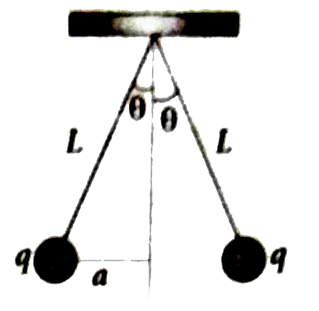
Two small -sized identical equally charged spheres each having mass 1 mg are hanging in equilibrium as shown in the figure . The length of each string is 10 cm and the angle `theta` is `7^(@)` with the vertical . Calculate the magnitude of the charge in each sphere . (Take g =`10ms^(-2))`

Text Solution

Verified by Experts
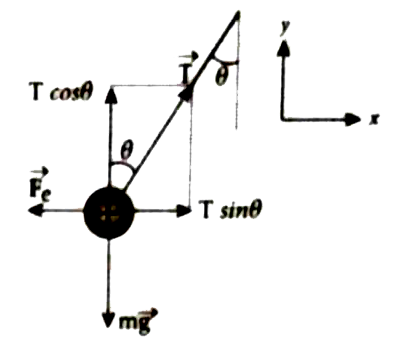
If the spheres are neutral the angle between them will be `0^(@)` when hanged vertically . Since they are positively charged spheres , there will be a repulsive force between them and they will be at equilibrium with each other at an angle of `7^(@)` with the vertiction. We can draw a free body diagram for one of the charged spheres and apply Newton.s second law for both vertical and horizontal directions . The free body diagram is shown. In the x -direction the acceleration of the charged sphere is zero . Using Newton.s second law `(vecF_(m)=mveca)` , we have T sin `thetahati-F_(e)hati=0`
T`sin theta=F_(e)`
Here T is the tension acting on the charge due to the string and `F_(e)` is the electrostatic force between the two charges . In the y -direction also the net acceleration experienced by the charge is zero . T `cos thetahatj-mg hatj=0`
Therefore T cos `theta =mg ` . By dividing equation (1) by equation (2) , `tan theta = (F_(e))/(mg)`
Since they are equally charged the magnitude of the electrostatic force is
`F_(e)= k""(q_(2))/(r^(2))` where k `=(1)/(4piepsilon_(0))`
Here r = 2a = 2L `sin theta`. By substituting these values in equation (3) ,
`tan theta = k(q^(2))/(mg(2L sin theta)^(2))`
Rearranging the equation (4) to get q
`q=2L sinthetasqrt(("mg tan" theta)/(k))=2xx0.1xxsin7^(@)xxsqrt(10^(-3)xx10xxtan7^(@))/(9xx10^(9))`
`q = 8.9xx10^(-9)C = 8.9nC`
Promotional Banner

Topper's Solved these Questions

  • ELECTROSTATICS

    FULL MARKS|Exercise Textual Evaluation Solved (Multiple choice questions : )|15 Videos
  • ELECTROSTATICS

    FULL MARKS|Exercise Textual Evaluation Solved (II. Short Answer Questions : )|21 Videos
  • DUAL NATURE OF RADIATION AND MATTER

    FULL MARKS|Exercise ADDITIONAL QUESTIONS -( ADDITIONAL NUMERICAL PROBLEMS : )|10 Videos
  • MAGNETISM AND MAGNETIC EFFECTS OF ELECTRIC CURRENT

    FULL MARKS|Exercise ADDITIONAL QUESTIONS SOLVED - NUMERICAL PROBLEMS :|4 Videos

Similar Questions

Explore conceptually related problems

A ball of mass 1 kg hangs in equlibrium from two stings OA and OB in the diagram calcualte the tensions in stings OA and OB take g=10ms^(-2)

Two small spheres, each having a mass of 20 g, are suspended form a common point by two insulating strings of length 40 cm each. The spheres are identically charged and the speration between the balls at equilibrium is found to be 4 cm . Find the charge on each sphere.

A regular hexagon of side 10cm has a charge 5muC at each of its vertices. Calculation the potential at the centre of the hexagon.

Two charged particles are placed at a distance 1.0 cm apart. What is the minimum possible magnitude of the electric force acting o each charge?

In the arrangement shown in figure, the string has a mass of 4.5 g. How much time will it take for a transverse disturbance produced at the floor to reach the pulley ? Take g=10ms^-2 .

Two blocks of masses 1 kg and 2kg are connect by a metal wire going over a smooth pulley as shown in figure. The breaking stress of the metal is 2xx10^9Nm^-2 . What should be the minimum radius of the wire used if it is not to break? Take g=10ms^-2

Three identical charges, each having a value 1.0 xx10^(-8)C, are placed at the corners of an equilateral triangle of side 20 cm find the electric field and potential at the centre of the triangle.

