Home
Class 12
PHYSICS
A block of mass m and positive charge q ...

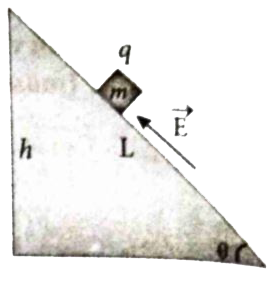
A block of mass m and positive charge q is placed on an insulated frictionless inclined plane as shown in the figure. A uniform electric field E is applied parallel to the inclined surface such that the block is at rest. Calculate the magnitude of the electric field E.

Text Solution

Verified by Experts
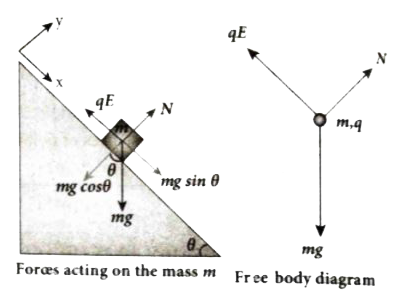
There are three forces that acts on the mass m:
(i) The downward gravitational force exerted by the Earth (mg)
(ii) The normal force exerted by the inclined surface (N)
(iii) The Coulomb force given by uniform electric field (qE)
The free body diagram for the mass ma is drawn below . A convenient inertial of the mass m is drawn below. A convenient inertial coordinate system is located in the inclined surface as shown in the figure. The mass m has zero net acceleration both in x and y -direction. Along x-direction applying Newton.s second law we have
`mg sin thetahati-qEhati=0`
`mg sin theta-qEhati=0`
or ,` E=(mg sin theta)/(q)`

Note that the magnitude of the electric field is drectly proportional to the mass m and inversely proportional to the charge q . It implies that if the mass is increased by keeping the charge constant then a strong electric field is required to stop the object from sliding . If the charge is increaed by keeping the mass constant then a weak electric field is sufficient to stop the mass from sliding down the plane . The electric field also can be expressed in terms of height and the length of the inclined surface of the plane
`E=(mgh)/(qL)`
Promotional Banner

Topper's Solved these Questions

  • ELECTROSTATICS

    FULL MARKS|Exercise Textual Evaluation Solved (Multiple choice questions : )|15 Videos
  • ELECTROSTATICS

    FULL MARKS|Exercise Textual Evaluation Solved (II. Short Answer Questions : )|21 Videos
  • DUAL NATURE OF RADIATION AND MATTER

    FULL MARKS|Exercise ADDITIONAL QUESTIONS -( ADDITIONAL NUMERICAL PROBLEMS : )|10 Videos
  • MAGNETISM AND MAGNETIC EFFECTS OF ELECTRIC CURRENT

    FULL MARKS|Exercise ADDITIONAL QUESTIONS SOLVED - NUMERICAL PROBLEMS :|4 Videos

Similar Questions

Explore conceptually related problems

A block of mass m having a charge q is placed on a smooth horizontal table and is connected to a wall through an unstressed spring of spring constant k as shown in figure . A horizontal electric field E parallel to the spring is switched on. Find the amplitude of the resulting SHM of the block.

A block of mass m slides along a frictionless surface as shown in the figure. If it is releases from rest from A what is its speed at B?

A charge q is placed at the centre of the open end of a cylindrical vessel . The flux of the electric field through the surface of the vessel is

A block of mass m containing a net positive charge q is placed on a smooth horizontal table which terminates in a vertical wall as shown in figure(29-E2). The distance of the block from the wall is d. A horizontal electric field E to towards right is switched on. Assuming elastic collisions find the time period of the resulting oscillatory motion. Is it a simple harmonic motion?

A positive charge q is placed in front of conducting solid cube at a distance d from its centre. Find the electric field at the centre of the cube due to the charges appearing on its surface.

A block of mass 2.0 kg is pushed down an inclined plane of inclination 37^0 with a force of 20N acting parallel to the incline. It is found that the block moves on the incline with an acceleration of 10 m/s^2 . If the block started from rest, find the work done by the applied force in the first second .

An electron of mass m and charge q is accelerated from rest in a uniform electric field of strength E. The velocity acquired by it as it travels a distance l is …..

A charge Q is placed at a distance a/2 above the centre of a horizontal, square surface of edge a as shown in figure. Find the flux of the electric field through the square surface.

