Home
Class 12
PHYSICS
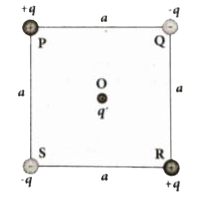
Four charges are arranged at the corners...

Four charges are arranged at the corners of the square PQRS of side a as shown in the figure . (a) Find the work required to assemble these charges in the given configuration . (b) Suppose a charge q is brought to the center of the square by keeping the four charges fixed at the corners how much extra work is required for this ?

Text Solution

Verified by Experts

(a) The work done to arrange the charges in the corners of the square is independent of the way they are arranged . We can follow any order.
(i) First the charge +q is brought to the corner P . This requires no work since no charge is already present `W_(p)` = 0
(ii) Work required to bring the charge `-q` to the corner Q `=(-q)xx` potential at a point Q due to `+q` located at a point P . `W_(Q)=-qxx(1)/(4piepsilon_(0))(q)/(q)=-(1)/(4piepsilon_(0)) (q^(2))/(a)`
(iii) Work required tpo bring the charge +q to the corner R q`xx` potential at the point R due to charges at the point P and Q .
`W_(r)=qxx(1)/(4piepsilon_(0))(-(q)/(a)+(q)/(sqrt(2a)))=(1)/(4piepsilon_(0))(q^(2))/(a)(-1+(1)/(sqrt(2)))`
(iv) Work required to bring the fourth charge -q at the position S = q`xx` potential at the point S due the all the three charges at the three charges at the point P,Q and R .
`W_(s)=-qxx(1)/(4piepsilon_(0))((q)/(a)+(q)/(a)-(q)/(sqrt(a)))=-(1)/(4piepsilon)(q)/(a)(2-(1)/(sqrt(2)))`
(b) Work required to bring the charge q to the center of the square =q `xx` potential at the center point O due to tall the four charges in the four corners . The potential created by the two +q charges are canceled by the potential created by the -q charges which are located in the opposite corners . Therefore the net electric potential at the center O due to all the charges in the corners is zero . Hence no work no work is required to bring any charge to the point O . Physically this implies that if any charge q when brought close to O then it moves to the point O without any external force.
Promotional Banner

Topper's Solved these Questions

  • ELECTROSTATICS

    FULL MARKS|Exercise Textual Evaluation Solved (Multiple choice questions : )|15 Videos
  • ELECTROSTATICS

    FULL MARKS|Exercise Textual Evaluation Solved (II. Short Answer Questions : )|21 Videos
  • DUAL NATURE OF RADIATION AND MATTER

    FULL MARKS|Exercise ADDITIONAL QUESTIONS -( ADDITIONAL NUMERICAL PROBLEMS : )|10 Videos
  • MAGNETISM AND MAGNETIC EFFECTS OF ELECTRIC CURRENT

    FULL MARKS|Exercise ADDITIONAL QUESTIONS SOLVED - NUMERICAL PROBLEMS :|4 Videos

Similar Questions

Explore conceptually related problems

Four charges are arranged at the comers of a square ABCD of side d, as shown in Fig. a. Find the work required to put together this arrangement b. A charge q_(0) is brought to the centre E of the square, the four charges being held fixed at its corners. How much extra work is needed to do this?n

Four charges, each of value q, are placed at the four corners of a square of side a. What is the potential at the centre of the square

Three charges, each equal to q, are placed at the three. corners of a square of side a . Find the electric field at. the fourth corner.

Four equal charges 2.0xx10^(-6) C each are fixed at the four corners of a square of side 5 cm. Find the coulomb force experienced by one of the charges due to the rest three.

A charge Q is placed at a distance a/2 above the centre of a horizontal, square surface of edge a as shown in figure. Find the flux of the electric field through the square surface.

Four electric charges +q, +q, -q and -q are placed at corners of a square of side 2L.(see figure).The electric potential at point A, midway between the two charges +q and +q is:

Four point charges are placed at the four corners of a square in the two ways (i) and (ii) as shown below: Will the i. electric field ii. electric potential, at the centre of the square, be the same or different in the two configurations and why?

Four point charges -Q,-q,2q and 2Q are placed , one at each corner of the square. The relation between Q and q for which the potential at the centre of the square is zero is :
