Home
Class 12
PHYSICS
Derive an expression for electrostatic p...

Derive an expression for electrostatic potential due to an electric dipole.

Text Solution

Verified by Experts
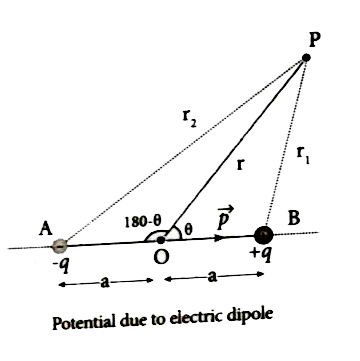
Electrostatic potential at a point due to an electric dipole: Consider two equal and opposite charges separated by a small distance 2a. The point P is located at a distance r from the midpoint of the dipole . Let `theta` be the angle between the line OP and dipole axis AB. Let `r_(1)` be the distance of point P from +q and `r_(2)` be the distance of point P from -q.
Potential at P due to charge +q = `(1)/(4piepsilon_(0))(q)/(r_(1)) `
Potential at P due to charge `-q=-(1)/(4piepsilon_(0))(q)/(r_(2))`
Total potential at the point P,
`V=(1)/(4piepsilon_(0))q((1)/(r_(1))-(1)/(r_(2)))`
Suppose if the point P is far away from the dipole such that `r gt gta ` then equation can be expressed in terms of r. By the cosine law for triangle BOP,
`r_(1)^(2)=r^(2)+a^(2)-2racos theta=r^(2)(1+(a^(2))/(r^(2))-(2a)/(r)cos theta)`
m
Since the point P is very far from dipole then `r gtgta `. As a result the term `(a^(2))/(r^(2))` is very small and can be neglected. Therefore
`r_(1)^(2)=r^(2)(1-2a(costheta)/(r)) " " ("or") " " r_(1)=r(1-(2a)/(r)costheta)^(1)/(2)(or)`
`(1)/(r_(1))=(1)/(r)(1-(2a)/(r)cos theta)^(1)/(2)`
since `(a)/(r) lt lt 1` , we can use binominal theorem and retain the terms up to first order
`(1)/(r_(1))=(1)/(r )(1+(a)/(r)cos theta)`
Similarly applying the cosine law for triangle AOP
`r_(2)^(2)=r^(2)+a^(2)-2ra cos(180-theta) " " "Since" cos (180-theta) = -costheta ` we get
`r_(2)^(2)=r^(2)+a^(2)+2racostheta`
Neglecting the term `(a^(2))/(r^(2))` ( because `rgtgta`)
`r_(2)^(2)r^(2)(1+(2acostheta)/(r)) " " ("or")" " r_(2)=r (1+(2a costheta)/(r))^(1)/(2) `
Using Binomial theorem , we get
`(1)/(r_(2))=(1)/(r) (1-a""costheta)/(r))`
Substituting equations (3) and (2) in equation (1)
`V= (1)/(4piepsilon_(0))q [(1)/(r)(1+a""(costheta)/(r))-(1)/(r) (1-a""(costheta)]= (q)/(4piepsilon_(0))[(1)/(r)(1+a""(costheta)/(r)-1+a""(costheta)/(r))]`
`V=(1)/(4piepsilon_(0))(2aq)/(r^(2))costheta`
But the electric dipole moment p = 2qa and we get,
`V=(1)/(4piepsilon)((pcostheta)/(r^(2))) `
Now we can write p cos `theta=vecp.vecr` where `hatr` is the unit vector from the point O to point P . Hence the electric potential at a point P due to an electric dipole is given by
`V=(1)/(4piepsilon_(0))(vec.vecr)/(r^(2)) (r gtgta )`
Equation ( 4) is valid for distances very large compared to the size of the dipole . But for a point dipole the equation ( 4) is valid for any distance.
Special cases:
Case (i) If the point P lies on the axial line of the dipole on the side of `+q` then theta =0 . Then the electric potential becomes
`V=(1)/(4piepsilon_(0))(P)/(r^(2))`
Case (ii) IF the point P lies on the axial line of the dipole on the side of -q then `theta 180^(@)` then `V=(1)/(4piepsilon_(0))(p)/(r^(2))`
Case (iii) If the point P lies on the equatorial line of the dipole then `theta=90^(@)` . Hence V= 0 .
Promotional Banner

Topper's Solved these Questions

  • ELECTROSTATICS

    FULL MARKS|Exercise EXERCISES|15 Videos
  • ELECTROSTATICS

    FULL MARKS|Exercise ADDITIONAL QUESTIONS SOLVED ( Multiple choice questions : )|57 Videos
  • ELECTROSTATICS

    FULL MARKS|Exercise Textual Evaluation Solved (II. Short Answer Questions : )|21 Videos
  • DUAL NATURE OF RADIATION AND MATTER

    FULL MARKS|Exercise ADDITIONAL QUESTIONS -( ADDITIONAL NUMERICAL PROBLEMS : )|10 Videos
  • MAGNETISM AND MAGNETIC EFFECTS OF ELECTRIC CURRENT

    FULL MARKS|Exercise ADDITIONAL QUESTIONS SOLVED - NUMERICAL PROBLEMS :|4 Videos

Similar Questions

Explore conceptually related problems

Derive an expression for electrostatic potential energy of the dipole in a uniform electric field .

Define 'electrostatic potential".

Define 'electrostatic potential''

FULL MARKS-ELECTROSTATICS -Textual Evaluation Solved ( III. Long Answer Questions: )
  1. How do we determine the electric field due to a continuous charge dist...

    Text Solution

    |

  2. Calculate the electric field due to a dipole on its axial line and equ...

    Text Solution

    |

  3. Derive an expression for the torque experienced by a dipole due to a ...

    Text Solution

    |

  4. Derive an expression for electrostatic potential due to a point charge...

    Text Solution

    |

  5. Derive an expression for electrostatic potential due to an electric di...

    Text Solution

    |

  6. Obtain an expression for potential energy due to a collectrion of thre...

    Text Solution

    |

  7. Derive an expression for electrostatic potential energy of the dipole ...

    Text Solution

    |

  8. Obtain Gauss law from Coulomb 's law .

    Text Solution

    |

  9. Obtain the expression for electric field due to an infinitely long cha...

    Text Solution

    |

  10. Obtain the expression for electric field due to an charged infinite pl...

    Text Solution

    |

  11. Obtain the expression for electric field due to an uniformly charge sp...

    Text Solution

    |

  12. Discuss the various properties of conductors in electrostatic equilibr...

    Text Solution

    |

  13. Explain the process of electrostatic induction .

    Text Solution

    |

  14. Explain dielectrics in detail and how an electric field is induced ins...

    Text Solution

    |

  15. Obtain the expression for capacitance for capacitance for a parallel p...

    Text Solution

    |

  16. Obtain the expression for the energy stored in a parallel plate capaci...

    Text Solution

    |

  17. Explain in detail the effect of a dielectric placed in a parallel plat...

    Text Solution

    |

  18. Derive the expression for resultant capacitance when capacitors are co...

    Text Solution

    |

  19. Explain in detail how charges are distributed in a conductor and the p...

    Text Solution

    |

  20. Explain in detail the construction and working of a Van de Graaff gene...

    Text Solution

    |

