Home
Class 12
PHYSICS
Obtain the expression for electric field...

Obtain the expression for electric field due to an infinitely long charged wire .

Text Solution

Verified by Experts
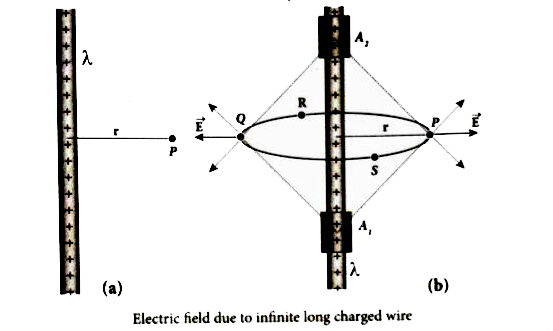
Electric field due to an infinitely long charged wire: Consider an infinitely long straight wire having uniform linear charge density `lambda`. Let P be a point located at a perpendicular distance r from the wire. The electric at the point P can be found using Gauss law . We choose two small charge element `A_(1)` and `A_(2)` on the wire which are at equal distance from the point P. The resultant electric field due to these two charge elements points radially away from the charged wire and the magnitude of electric field is same at all points on the circle of radius r. From this property. We can infer that the charged wire possesses a cylindrical symmetry.

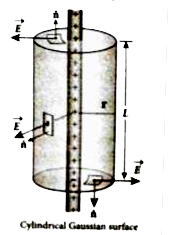
Let us choose a cylindrical Gaussian surface of radius r and length L . The total electric flux in this closed surface is
`Phi_(E) =oint vecE . d vecA`
`Phi_(E)=oint underset("Curved surface ")(oint)vecE.dvecA+ underset("Top surface")intvecE.dvecA+underset("Bottom surfac")int vecE.dvecA`
It is seen that for the curved surface `vecE` is perpendicular to `vecA` and `vecE.dvecA` = 0
Substituting these value in the equation (2) and applying Gauss law to the cylindrical surfaces we hav
`Phi_(E)= underset("Curved surface ")(int) EdA = (Q_("encl"))/(epsilon_(0))`
Since the magnitude of the electric field for the entire curved surface is constant E is taken out of the integration and `Q_("encl") ` given by
`Q_("encl") = lambdaL.`
`E underset("Curved surface ")(int) dA = (lambdaL)/(epsilon_(0))`

Here `Phi_(E) = underset("Curved surface ")(int) dA ` = total area of the curved surface = `2piL` . Substituting this in equation (4) We get
`E.2 pirL = (lambdaL)/(epsilon_(0))( or ) E = (1)/(2piepsilon_(0)) (lambda)/(r)`
In vector form `vecE = (1)/(2piepsilon_(0))(lambda)/(r) hatr `
The electric field due to the infinite charged wire depends on `(1)/(r) ` rather than `(1)/(r^(2))` for a point charge . Equation (6) indicates that the electric field ios always along the perpendicular direction ( r) to wire . In fact if `lambda gt ` 0 then `vecE ` points perpendicular outward `(hatr)` from the wire and if `lambda lt 0` then `vecE` points perpendicular inward `(-hatr)` .
Promotional Banner

Topper's Solved these Questions

  • ELECTROSTATICS

    FULL MARKS|Exercise EXERCISES|15 Videos
  • ELECTROSTATICS

    FULL MARKS|Exercise ADDITIONAL QUESTIONS SOLVED ( Multiple choice questions : )|57 Videos
  • ELECTROSTATICS

    FULL MARKS|Exercise Textual Evaluation Solved (II. Short Answer Questions : )|21 Videos
  • DUAL NATURE OF RADIATION AND MATTER

    FULL MARKS|Exercise ADDITIONAL QUESTIONS -( ADDITIONAL NUMERICAL PROBLEMS : )|10 Videos
  • MAGNETISM AND MAGNETIC EFFECTS OF ELECTRIC CURRENT

    FULL MARKS|Exercise ADDITIONAL QUESTIONS SOLVED - NUMERICAL PROBLEMS :|4 Videos

Similar Questions

Explore conceptually related problems

Obtain the expression for electric field due to an charged infinite plane sheet .

Obtain the expression for electric field due to an uniformly charge spherical shell.

Obtain an expression for electrical conductor.

The expression for electric field in vector form is

The electric field due to an infinitely long straight uniformly charged wire at a distance r is directly proportional to

Derive an expression for electric field due to the system of point charges?

FULL MARKS-ELECTROSTATICS -Textual Evaluation Solved ( III. Long Answer Questions: )
  1. How do we determine the electric field due to a continuous charge dist...

    Text Solution

    |

  2. Calculate the electric field due to a dipole on its axial line and equ...

    Text Solution

    |

  3. Derive an expression for the torque experienced by a dipole due to a ...

    Text Solution

    |

  4. Derive an expression for electrostatic potential due to a point charge...

    Text Solution

    |

  5. Derive an expression for electrostatic potential due to an electric di...

    Text Solution

    |

  6. Obtain an expression for potential energy due to a collectrion of thre...

    Text Solution

    |

  7. Derive an expression for electrostatic potential energy of the dipole ...

    Text Solution

    |

  8. Obtain Gauss law from Coulomb 's law .

    Text Solution

    |

  9. Obtain the expression for electric field due to an infinitely long cha...

    Text Solution

    |

  10. Obtain the expression for electric field due to an charged infinite pl...

    Text Solution

    |

  11. Obtain the expression for electric field due to an uniformly charge sp...

    Text Solution

    |

  12. Discuss the various properties of conductors in electrostatic equilibr...

    Text Solution

    |

  13. Explain the process of electrostatic induction .

    Text Solution

    |

  14. Explain dielectrics in detail and how an electric field is induced ins...

    Text Solution

    |

  15. Obtain the expression for capacitance for capacitance for a parallel p...

    Text Solution

    |

  16. Obtain the expression for the energy stored in a parallel plate capaci...

    Text Solution

    |

  17. Explain in detail the effect of a dielectric placed in a parallel plat...

    Text Solution

    |

  18. Derive the expression for resultant capacitance when capacitors are co...

    Text Solution

    |

  19. Explain in detail how charges are distributed in a conductor and the p...

    Text Solution

    |

  20. Explain in detail the construction and working of a Van de Graaff gene...

    Text Solution

    |