Home
Class 12
PHYSICS
Derive the expression for resultant capa...

Derive the expression for resultant capacitance when capacitors are connected in series and in parallel .

Text Solution

Verified by Experts
Capacitor in series and parallel:
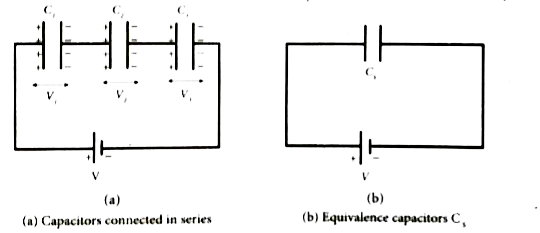
(i) Capacitor in series : Consider three capacitors of capacitance `C_(1), C_(2)` and `C_(3)` connected in series with a battery of voltage V as shown in the figure (a). As soon as the battery is connected to the capacitor in series the electrons of charge -Q are transferred from negative terminal to the right plate of ` C_(3)` which pushes the electrons of same amount `(-Q)` from left plate of `C_(3)` to the right plate of `C_(2)` due to electrostatic induction. Similarly the left plate of `C_(2)` pushes the charges of `(-Q)` to the right plate of `C_(1)` which induces the positive charge `(+O)` on the left plate of `C_(1)` . At the same time electrons of charge `(-Q)` are transferred from left plate of `C_(1)` to positive terminal of the battery .

By these processes each capacitor stores the same amount of charge Q. The capacitances of the capacitors are in general different so that the voltage across each capacitor is also different and are denoted as `V_(1) , V_(2)` and `V_(3)` respectively .
The total voltage across each capacitor must be equal to the voltage of the a battery.
`V=V_(1) +V_(2) +V_(3)`
Since Q=CV we have `V= (Q)/(C_(1))+(Q)/(C_(2))+(Q)/(C_(3))`
`= Q((1)/(C_(1))+(1)/(C_(2))+(1)/(C_(3)))`
If three capacitors in series are considered to form an equivalent single capacitor `C_(5)`
shown in figure (b) then we have `V= (Q)/(C_(s))`
Substituting this expression into equation (2) we get
`(Q)/(C_(s))=Q((1)/(C_(1))+(1)/(C_(2))+(1)/(C_(3)))`
`(1)/(C_(s))=(1)/(C_(1))+(1)/(C_(2))+(1)/(C_(3))`
Thus the inverse of the equivalent capacitance `C_(s)` of three capacitors connected in series is equal to the sum of the inverses of each capacitance . This equivalent capacitance `C_(s)` is always less than the smallest individual capacitance in the series.
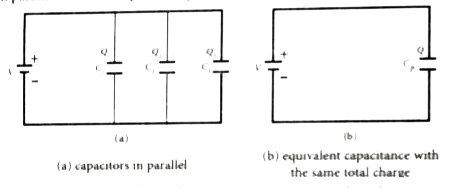
(ii) Capacitance in parallel : Consider three capacitors of capacitance `C_(1), C_(2) ` and `C_(3)` connected in parallel with a battery of voltage V as shown in figure (a)

Since corresponding sides of the capacitors are connected to the same positive and negative terminals of the battery the voltage across each capacitor is equal to the battery.s voltage . Since capacitance of the capacitors is different the charge stored in each capacitor is not the same . Let the charge stored in the three capacitors be `Q_(1), Q_(3)` and `Q_(3)` respectively . According to the law of conservation of total charge the sum of these three charges is equal to the charge Q transferred by the battery,
`Q=Q_(1)+Q_(2)+Q_(3)`
Now since Q= CV we have
`Q=C_(1)V+C_(2)V+C_(3)V`
If these three capacitors are considered to form a single capacitance `C_(p)` which stores the total charge Q as shown in the figure (b) then we can write Q= CPV . Substituting this in equation (2) 2we get
`C_(p)V= C_(1)V+C_(2)V+C_(3)V`
Thus the equivalent capacitance of capacitors connected in parallel is equal to the sum of the individual capacitances . The equivalent capacitance `C_(p)` in a parallel connected is always greater than than the largest individual capacitance. In a parallel connection it is equivalent as area of each capacitance adds to give more effective area such that total capacitance increases.
Promotional Banner

Topper's Solved these Questions

  • ELECTROSTATICS

    FULL MARKS|Exercise EXERCISES|15 Videos
  • ELECTROSTATICS

    FULL MARKS|Exercise ADDITIONAL QUESTIONS SOLVED ( Multiple choice questions : )|57 Videos
  • ELECTROSTATICS

    FULL MARKS|Exercise Textual Evaluation Solved (II. Short Answer Questions : )|21 Videos
  • DUAL NATURE OF RADIATION AND MATTER

    FULL MARKS|Exercise ADDITIONAL QUESTIONS -( ADDITIONAL NUMERICAL PROBLEMS : )|10 Videos
  • MAGNETISM AND MAGNETIC EFFECTS OF ELECTRIC CURRENT

    FULL MARKS|Exercise ADDITIONAL QUESTIONS SOLVED - NUMERICAL PROBLEMS :|4 Videos

Similar Questions

Explore conceptually related problems

Define capacitance of a capacitor.

Derive the expression for resultant spring constant when two springs having constant k_(1) and k_(2) are connected in series.

Derive the expression for resultant spring constant when two springs having constant k_(1) and k_(2) are connected in parallel.

With the help of a circuit diagram derive the formula for the resultant resistance of three resistance connected : (a) in series and (b) in parallel

The capacitance of a capacitor does not depend on

With the help of a circuit diagram derive the formula for the resultant resistance of three resistances connected in series.

FULL MARKS-ELECTROSTATICS -Textual Evaluation Solved ( III. Long Answer Questions: )
  1. How do we determine the electric field due to a continuous charge dist...

    Text Solution

    |

  2. Calculate the electric field due to a dipole on its axial line and equ...

    Text Solution

    |

  3. Derive an expression for the torque experienced by a dipole due to a ...

    Text Solution

    |

  4. Derive an expression for electrostatic potential due to a point charge...

    Text Solution

    |

  5. Derive an expression for electrostatic potential due to an electric di...

    Text Solution

    |

  6. Obtain an expression for potential energy due to a collectrion of thre...

    Text Solution

    |

  7. Derive an expression for electrostatic potential energy of the dipole ...

    Text Solution

    |

  8. Obtain Gauss law from Coulomb 's law .

    Text Solution

    |

  9. Obtain the expression for electric field due to an infinitely long cha...

    Text Solution

    |

  10. Obtain the expression for electric field due to an charged infinite pl...

    Text Solution

    |

  11. Obtain the expression for electric field due to an uniformly charge sp...

    Text Solution

    |

  12. Discuss the various properties of conductors in electrostatic equilibr...

    Text Solution

    |

  13. Explain the process of electrostatic induction .

    Text Solution

    |

  14. Explain dielectrics in detail and how an electric field is induced ins...

    Text Solution

    |

  15. Obtain the expression for capacitance for capacitance for a parallel p...

    Text Solution

    |

  16. Obtain the expression for the energy stored in a parallel plate capaci...

    Text Solution

    |

  17. Explain in detail the effect of a dielectric placed in a parallel plat...

    Text Solution

    |

  18. Derive the expression for resultant capacitance when capacitors are co...

    Text Solution

    |

  19. Explain in detail how charges are distributed in a conductor and the p...

    Text Solution

    |

  20. Explain in detail the construction and working of a Van de Graaff gene...

    Text Solution

    |