Home
Class 12
PHYSICS
Explain in detail how charges are distri...

Explain in detail how charges are distributed in a conductor and the principle behind the lightning conductor.

Text Solution

Verified by Experts
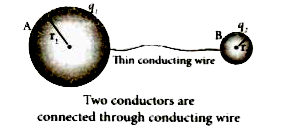
Distribution of charge in a conductor : Consider two conducting spheres A and B of radii `r_(1)` and `r_(2)` respectively connected to each other by a thin conducting wire as shown in the figure . The distacne between the spheres is much greater than the radii of either spheres.

If a charge Q is introduced into any one of the spheres this charge Q is redistributed into both the spheres such that the electrostatic potential is same in both the spheres . They are now uniformly charged and attain electrostatic equilibrium . Let `q_(1)` be the charge residing on the surface of sphere A and `q_(2)` is the charge residing on the surgace of sphere B such that `Q= q_(1) + q_(2)` . The charges are distributed only on the surface and there is no net charge inside the conductor . The electrostatic potential at the surface and there is no net charge inside the conductor . The electrostatic potential at the surface of the sphere A is given by
`V_(A) =(1)/(4epsilon_(0))(q_(2))/(r_(2))`
The electrostatic potential at the surface of the sphere B is given by
`V_(B) = (1)/(4piepsilon_(0))(q_(2))/(r_(2))`
The surface of the conductor is an equipotential. since the spheres are connected by the conducting wire the surface of both the spheres together form an equipotential surface . This implies that
`V_(A)= V_(B) "or " (q_(1))/(r_(1))=(q_(2))/(r_(2))`
Let us take the charge density on the surface of sphere A is `sigma_(1)` and charge density on the surface of sphere B is `sigma_(2)` . This implies that `q_(1)= 4pir_(1)^(2)sigma_(1)` and `q_(2)= 4pir_(2)^(2)sigma_(2)`. Substituting these values into equation (3) we get
`sigma_(1)r_(1)= sigma_(2)r_(2)`
from which we conclude that `sigmar` = constant
Thus the surface charge `sigma` is inversely proportional to the radius of the sphere . For a smaller radius the charge density will be larger and vice versa.
Lightning arrester or lightning conductor : This is a device used top protect tall buildings from lightning strikes . It works on the principle of action at points or corona discharge. The device consists of a long thick copper rod passing from top of the building to the ground . The upper end of the rod has a sharp spike or a sharp needle. The lower end of the rod is onnected to the copper plate which is buried deep into the ground . When a negatively charged cloud is passing above the building it induces a positive charge on the spike. Since the induced charge density on thin sharp spke is large it results in a corona discharge. This positive charge ionizes the surrounding air which in turn neutralizes the negative charge in the cloud. The negative charge pushed to the spikes passes through the copper rod and is safely diverted to the Earth . The lightning arrester does not stop the lightning rather it divers the lightning to the groung safety.
Promotional Banner

Topper's Solved these Questions

  • ELECTROSTATICS

    FULL MARKS|Exercise EXERCISES|15 Videos
  • ELECTROSTATICS

    FULL MARKS|Exercise ADDITIONAL QUESTIONS SOLVED ( Multiple choice questions : )|57 Videos
  • ELECTROSTATICS

    FULL MARKS|Exercise Textual Evaluation Solved (II. Short Answer Questions : )|21 Videos
  • DUAL NATURE OF RADIATION AND MATTER

    FULL MARKS|Exercise ADDITIONAL QUESTIONS -( ADDITIONAL NUMERICAL PROBLEMS : )|10 Videos
  • MAGNETISM AND MAGNETIC EFFECTS OF ELECTRIC CURRENT

    FULL MARKS|Exercise ADDITIONAL QUESTIONS SOLVED - NUMERICAL PROBLEMS :|4 Videos

Similar Questions

Explore conceptually related problems

Telsa invented lightning conductor.

Explain in detail the Maxwell Boltzmann distribution function.

How can we increase the capacitance of a conductor?

We are familiar with the semi conductors Silicon and Germanium . a. With a necessary schematic diagram , briefly explain the characteristics of an intrinsic semiconductor. b. Draw the energy bands of a n-type semiconductor. c The following figure represents a d . Draw a typically illuminated P-n junctions solar cell. e. LED convert............ energy to light.

FULL MARKS-ELECTROSTATICS -Textual Evaluation Solved ( III. Long Answer Questions: )
  1. How do we determine the electric field due to a continuous charge dist...

    Text Solution

    |

  2. Calculate the electric field due to a dipole on its axial line and equ...

    Text Solution

    |

  3. Derive an expression for the torque experienced by a dipole due to a ...

    Text Solution

    |

  4. Derive an expression for electrostatic potential due to a point charge...

    Text Solution

    |

  5. Derive an expression for electrostatic potential due to an electric di...

    Text Solution

    |

  6. Obtain an expression for potential energy due to a collectrion of thre...

    Text Solution

    |

  7. Derive an expression for electrostatic potential energy of the dipole ...

    Text Solution

    |

  8. Obtain Gauss law from Coulomb 's law .

    Text Solution

    |

  9. Obtain the expression for electric field due to an infinitely long cha...

    Text Solution

    |

  10. Obtain the expression for electric field due to an charged infinite pl...

    Text Solution

    |

  11. Obtain the expression for electric field due to an uniformly charge sp...

    Text Solution

    |

  12. Discuss the various properties of conductors in electrostatic equilibr...

    Text Solution

    |

  13. Explain the process of electrostatic induction .

    Text Solution

    |

  14. Explain dielectrics in detail and how an electric field is induced ins...

    Text Solution

    |

  15. Obtain the expression for capacitance for capacitance for a parallel p...

    Text Solution

    |

  16. Obtain the expression for the energy stored in a parallel plate capaci...

    Text Solution

    |

  17. Explain in detail the effect of a dielectric placed in a parallel plat...

    Text Solution

    |

  18. Derive the expression for resultant capacitance when capacitors are co...

    Text Solution

    |

  19. Explain in detail how charges are distributed in a conductor and the p...

    Text Solution

    |

  20. Explain in detail the construction and working of a Van de Graaff gene...

    Text Solution

    |

