Let us consider two transparent media having refractive indices `n_(1)` and `n_(2)` are separated by a spherical surface. Let C be the centre of curvature of the spherical surface. Let a point object O be in the medium nr The line OC cuts the spherical surface at the pole P of the surface. As the rays considered are paraxial rays, the perpendicular dropped for the point of incidence to the principal axis is very close to the pole or passes through the pole itself.
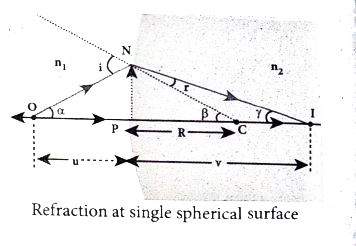
Light from O falls on the refracting surface at N. The normal drawn at the point of incidence passes through the centre of curvature C. As `n_(2) gt n_(1)`, light in the denser medium deviates towards the normal and meets the principal axis at I where the image is formed.
Snell.s law in product form for the refraction at the point N could be written as,
`n_(1) sin i = n_(2) sin r`
As the angles are small, sin of the angle could be approximated to the angle itself.
`n_(1)i = n_(2)r`............. (2)
Let the angles,
`angleNOP =alpha, angleNCP = beta, angleNIP =gamma`
`tan alpha =(PN)/(PO), tan beta =(PN)/(PC), tan gamma = (PN)/(PI)`
As these angles are small, tan of the angle could be approximated to the angle itself.
`alpha = (PN)/(PO), beta = (PN)/(PC), gamma =(PN)/(PI)`.............(3)
For the triangle, `triangleONC`,
`i = alpha + beta` .............(4)
For the triangle, `triangleINC`
`beta = r + gamma` (or) `r = beta - gamma`.........(5)
Substituting for i and r from equations (4) and (5) in the equation, (2).
`n_(1)(alpha + beta) = n_(2) (beta - gamma)`
Rearranging,
`n_(1)alpha + n_(2)gamma = (n_(2)-n_(1))beta`
Substituting for `alpha, beta` and `gamma` from equation (3)
`n_(1)(PN)/(PO) + n_(2)(PN)/(PI) = (n_(2)-n_(1)) (PN)/(PC)`
Further simplying by cancelling PN,
`n_(1)/(PO) + n_(2)/(PI) = (n_(2)-n_(1))/(PC)`
Following sign conventions, PO =- u, PI = +v and PC =-R in equation (6),
`n_(1)/-u + n_(2)/v = (n_(2)-n_(1))/R`
After rearranging, finally we get
`n_(2)/v - n_(1)/u =(n_(2)-n_(1))/R`...........(7)
Equation (7) gives the relation among the object distance u, image distance v, refractive indices of the two media and the radius of curvature R of the spherical surface. It holds for any spherical surface.
If the first medium is air then, `n_(1) = 1` and the second medium is taken just as `n_(2)=n`, then the equation is reduced to,
`n/v - 1/u = (n-1)/R`................. (8)


